Share the post "Paris-Roubaix: 40 Years of Technological Revolution on the Cobbles"
From the finesse of steel frames with 21 mm tubulars to aerodynamic bikes shod with 32, or even 35 mm tubeless tires, the Hell of the North has profoundly transformed the equipment used by pros in just over 40 years. So much so that the average speed has continuously increased: in 2026, Wout van Aert set a new record with 48.9 km/h over 260 km, a symbol of an evolution where the quest for speed has ultimately redefined comfort.
By Guillaume Judas – Photos: depositphotos.com, DR
On the cobbles of Paris-Roubaix, equipment is a decisive factor in performance. Since the early 1980s, the race has served as a unique testing ground, pushing engineers and riders to constantly rethink their machines. In 40 years, the transformation has been radical, and sometimes even counter-intuitive.
The era of harshness: the 1980s
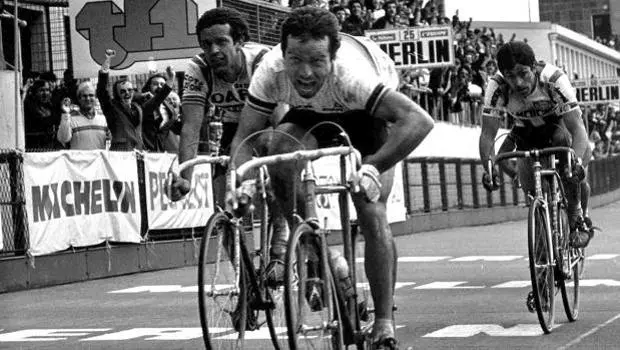
In the early 1980s, the bikes entered in Paris-Roubaix were primarily designed for resistance. Steel frames dominated, wheels with 32 or 36 spokes were favored for their solidity, and tubulars remained narrow, often around 21 mm in width. In reality, apart from perhaps wheels with more spokes, the bikes used differed very little from those used in other circumstances.
The logic was simple: stiffness and efficiency. The gear ratios used were high, with 52 or 53-tooth chainrings paired with freehubs with very close-ratio sprockets (12-21 or 13-23). Force was prioritized over cadence. However, on the cobbles, this philosophy quickly showed its limits. High pressures made the bikes extremely uncomfortable, and muscle fatigue became a major factor in failure.
The 1990s: all-out experimentation
Faced with this brutality, the 1990s marked a period of intense innovation. Teams tested radical solutions: suspension forks, frames integrating damping systems, and even full-suspension bikes.
These innovations allowed for better vibration filtering, but they came with significant compromises: increased weight, loss of efficiency, mechanical complexity. On the drivetrain side, gear ratios evolved little: chainrings remained standard (53-42, or even 44 or 46), even if cassettes widened slightly (up to 23 or 25 teeth). While some victories occasionally validated these choices, the trend did not last. French rider Gilbert Duclos-Lassalle won at 37 and 38 years old in 1992 and 1993 with a bike equipped with a telescopic fork. One idea emerged: on the cobbles, comfort is inseparable from performance.
The 2000s: the era of compromise
With the arrival of carbon, a new approach emerged. Rather than adding suspension systems, manufacturers sought to integrate flexibility directly into the frame structure.
Chainstays became slimmer, seatposts became more flexible, and specific models for Paris-Roubaix appeared. The goal was to absorb vibrations without sacrificing efficiency. At the same time, riders dared to use high-profile carbon wheels for the first time in this type of race. This proved the now recognized reliability of this material as well as the need to seek the slightest aerodynamic gain.
The 2010s: the triumph of “endurance” bikes
The following decade saw the rise of bikes specifically designed for comfort, often referred to as “endurance” or “sportive” models. More forgiving geometry, integrated absorption systems, increased tire clearance: everything was designed to tackle the cobbles.
Tire widths continued to increase, up to 28 mm, while comfort became an assumed priority. On the gearing side, 11-28 cassettes became common, allowing riders to maintain a higher cadence on difficult sectors. But this approach revealed a limit: these bikes, though more forgiving, were not always the fastest. A dilemma then arose: should comfort or speed be prioritized?
2015–2020: the silent revolution
The answer would come from a series of major technical innovations. Disc brakes freed up the constraints associated with traditional calipers, allowing the use of wider tires. Tubeless made its appearance, reducing the risk of punctures and allowing lower pressures.
Above all, tires progressively became the central element of performance on the cobbles. Their width increased (28, then 30 mm) and their ability to absorb irregularities transformed the behavior of bikes. In parallel, cassettes widened further (up to 30 or 32 teeth), offering a much wider range of gears, even if this is far from an essential criterion on Paris-Roubaix.
The 2020s: the return of aerodynamics
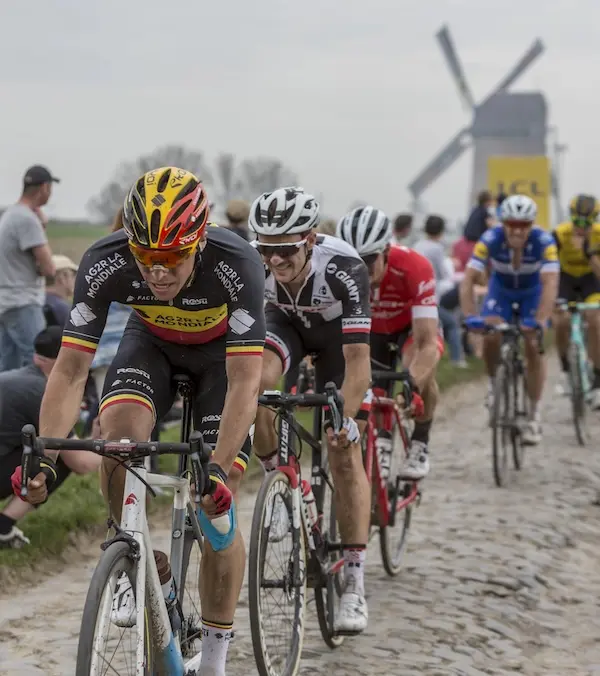
Against all expectations, Paris-Roubaix specific bikes gradually disappeared. Riders returned to aerodynamic models, initially designed for fast stages.
The reason is simple: the gains provided by wide tires and tubeless largely compensated for the absence of specific comfort devices. Bikes became faster without being less effective on the cobbles. Drivetrains evolved in the same direction: larger chainrings (52 to 54 teeth) paired with wide cassettes (up to 11-30 or 11-32), allowing for a combination of maximum speed and flexibility. And above all, to experiment with single chainrings.
2026: the perfect synthesis
As the 2026 edition approaches, a form of technical consensus seems to have emerged. Bikes combine aerodynamics, reliability, and comfort, without resorting to complex solutions.
32 mm (or even 35 mm for some) tubeless tires, sometimes combined with anti-puncture inserts, play a central role. They absorb shocks, improve grip, and maintain optimal efficiency on cobbled sectors.
The drivetrain choices perfectly illustrate this evolution: the first two finishers of the event, Wout van Aert and Tadej Pogačar, opted for single chainring configurations, 54/10 for the Belgian and 56/11 for the Slovenian respectively. Radical choices, made possible by the reliability of modern drivetrains and the need to simplify effort management on chaotic terrain. For some teams, we even saw the adoption of MTB derailleurs, equipped with tighter springs, to minimize the risk of chain jumps during intense effort.
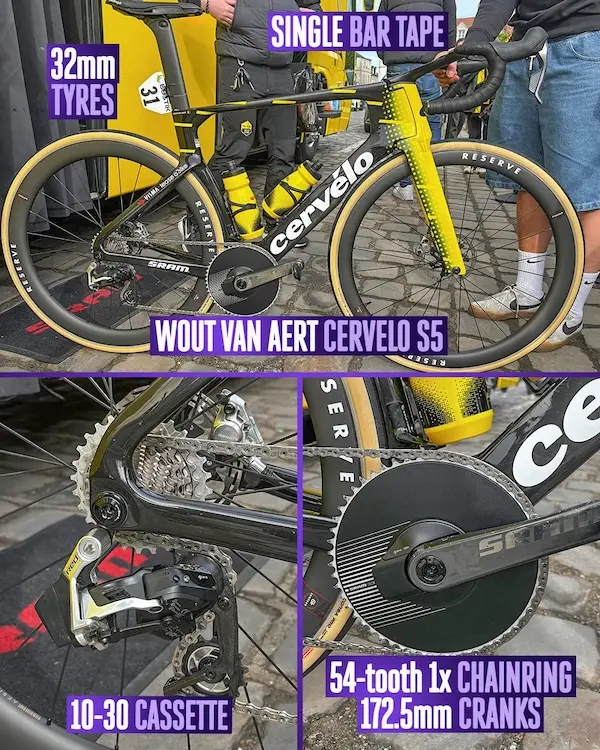
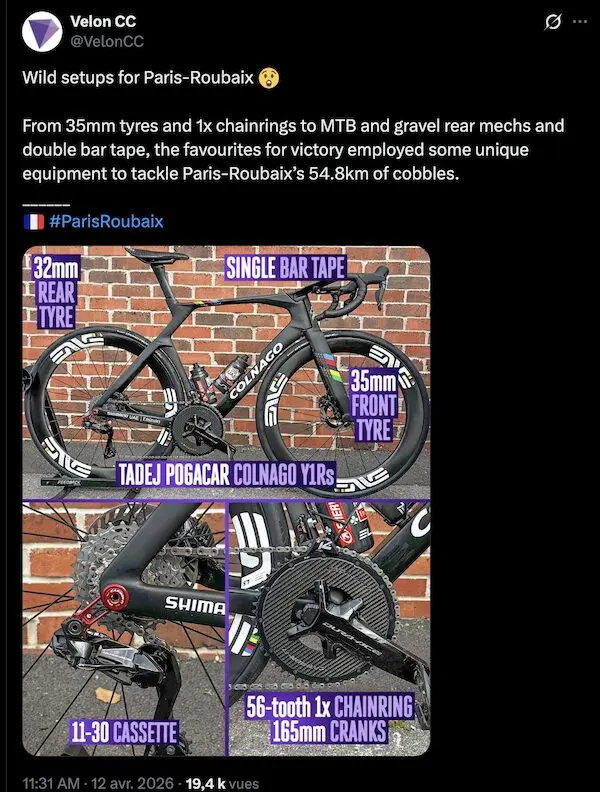
These gear ratios also respond to the global evolution of cycling, even on difficult terrain like that used by Paris-Roubaix riders. In 2026, Wout van Aert broke the event’s speed record at 48.910 km/h average over 260 km. The previous record belonged to Mathieu van der Poel in 2024 with 47.802 km/h, already with an aero bike and 32 mm tires. For comparison, Bernard Hinault won Paris-Roubaix in 1981 at 40.868 km/h average, an edition that was admittedly run in the rain.
A conceptual revolution
Beyond material evolutions, a true paradigm shift has occurred. Where it was thought in the 1990s to 2020s that a specific bike was indispensable to tackle Paris-Roubaix, experience has shown that a fast bike, correctly configured, could be just as effective, if not superior.
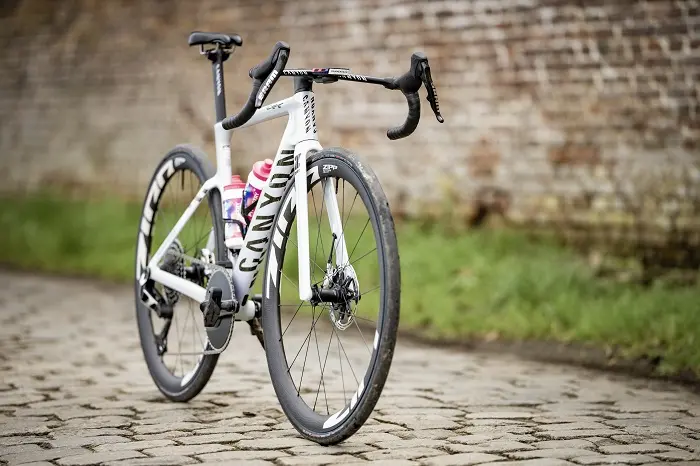
Comfort, long sought in the frame or suspension, is now almost exclusively provided by the tires, while drivetrains allow for optimal exploitation of this new ability to maintain speed and fluidity on the cobbles.
In four decades, Paris-Roubaix has seen cycling move from a logic of rigidity to an approach based on adaptation to the terrain. An evolution that perfectly illustrates cycling’s ability to reinvent itself, even on the oldest roads.
Share the post "Paris-Roubaix: 40 Years of Technological Revolution on the Cobbles"