Share the post "Tour of Flanders: the invisible trap of the single chainring"
While Tadej Pogačar imposed his will with an almost disconcerting mastery, another, much more discreet subject was playing out on the pedals. A subject that is not always perceived… unless you know where to look. And that is precisely where the analysis of Anthony Colas, cyclo-cross consultant on Eurosport, takes on its full value.
By Jeff Tatard – Photos: All rights reserved
The technical choice that leaves no room for error
In this Tour of Flanders, several riders opted for a single chainring setup. Among them were Wout van Aert and Mads Pedersen.
A coherent choice in absolute terms: fewer mechanical constraints, fewer risks, a simplified reading of the effort. But on the Flemish climbs, the reality is more nuanced.

The revealer: the Paterberg
The Paterberg tolerates no approximation. Short, steep, brutal, it demands a perfect reading of the gear ratio and tempo. In this type of section, the drivetrain becomes an unforgiving judge: the slightest wrong choice is immediately paid for. As Anthony Colas perfectly observed, “in the Paterberg, Pedersen was really spinning his legs… he wanted to drop one tooth. Except he dropped five at once.”
This moment says it all. What should have been a simple adjustment becomes a sharp break in rhythm. And behind this scene, Colas highlights an essential, often underestimated point: the very structure of wide cassettes like the 10-46 XPLR (10, 11, 12, 13, 15, 17, 19, 21, 24, 28, 32, 38, 46), capable of transforming a subtle intention… into a brutal mechanical imbalance.
When mechanics dictate the law
A question of effort culture
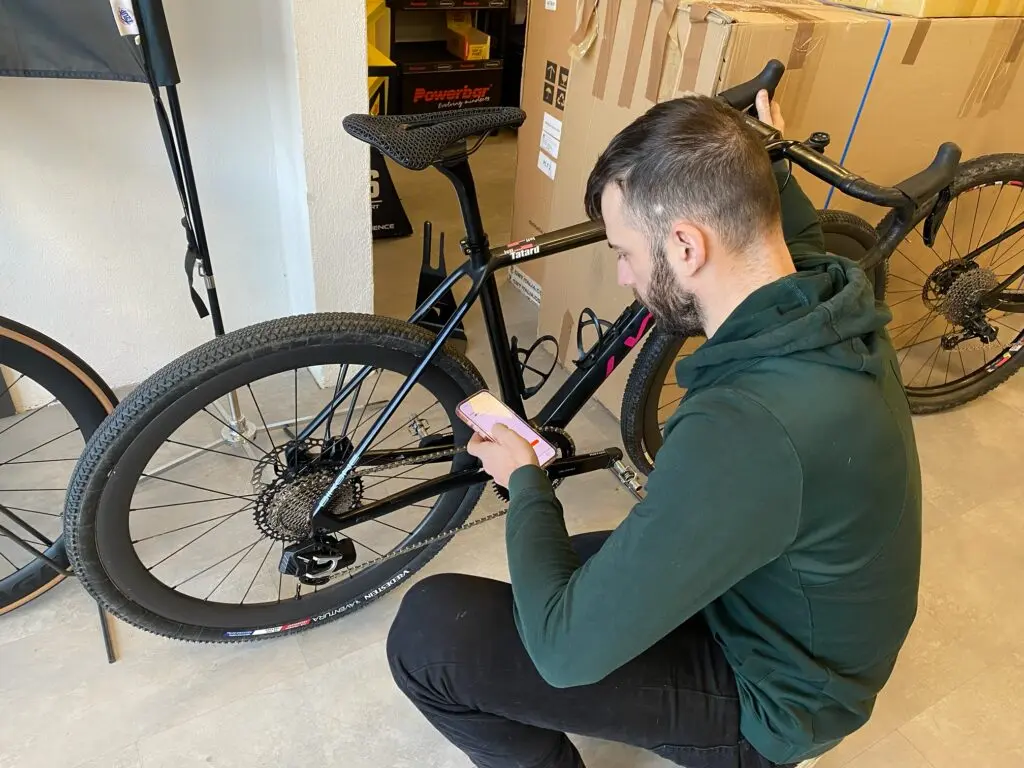
This phenomenon goes far beyond a simple material choice. As Anthony Colas explains, a mountain biker is naturally accustomed to these gaps: they integrate these breaks, anticipate changes, and accept a certain discontinuity in cadence. Conversely, a road cyclist builds all their efficiency on precision, on this ability to finely adjust their gear ratio to maintain a stable cadence and optimize every watt. And on the Belgian climbs, this requirement becomes central: maintaining traction on irregular cobbles where the slightest loss of grip is immediately paid for, avoiding jolts that break the rhythm and disrupt the effort, and above all preserving momentum, that invisible capital that allows you to crest the summit without suffering. Here, everything comes down to the continuity of the movement, to this ability to smooth the effort where the terrain constantly tries to fracture it. “On this type of effort, the finesse in shifting up and down gears is crucial.”
A limit in an extreme context
The single chainring is not an error in itself. It offers simplicity, by lightening decision-making and eliminating a potential source of error, reliability, with fewer exposed components and therefore fewer mechanical risks, and efficiency in varied environments, where versatility and robustness take precedence over absolute precision.
But it also imposes a compromise: less precision at the moment when the effort demands the opposite.
In a classic race finale like the Tour of Flanders, these micro-details become decisive.
What this reveals
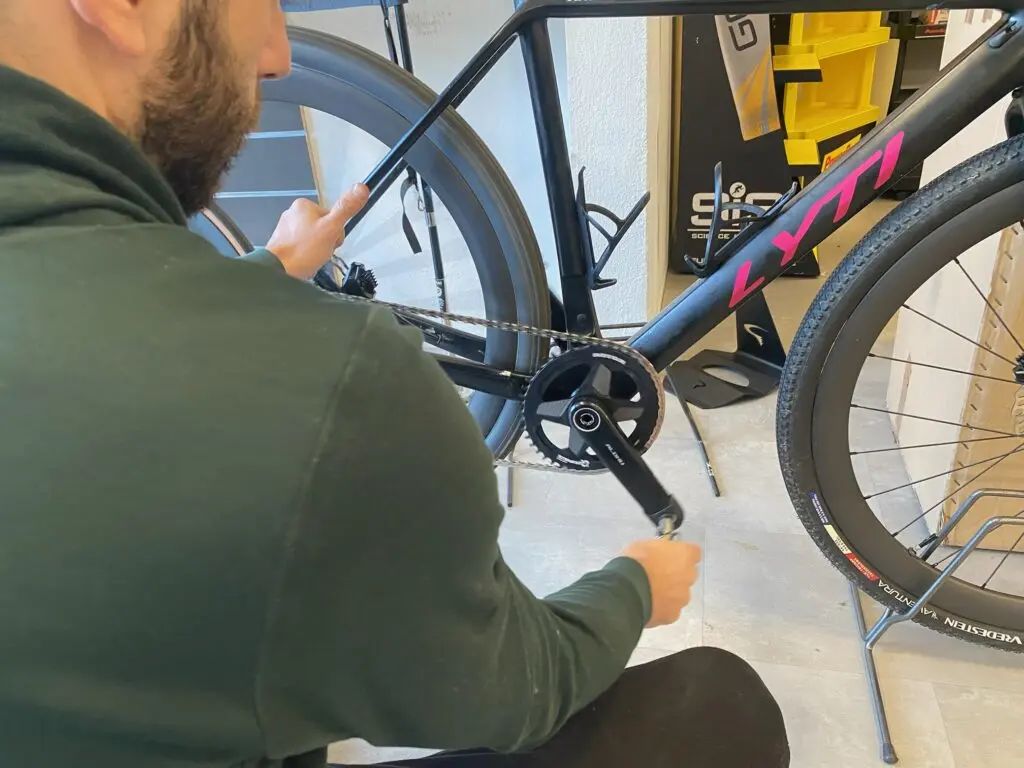
As Anthony Colas points out, modern cycling is hybridizing its influences, borrowing more and more from gravel, cyclo-cross, and even mountain biking. But this evolution has its limits: not all technical solutions are universal. Some shine in specific environments… and show their flaws as soon as the context changes. And this is precisely what a race like the Tour of Flanders reminds us of: an unforgiving judge, an extreme terrain where the slightest approximation, even invisible, always ends up being paid for.
Key takeaways
|
Ultimately, as Anthony Colas so rightly clarified, it’s not about opposing modernity and tradition, but about understanding something more subtle: suitability. The right equipment, yes… but in the right place, at the right time, in the right context. Because on the Flemish cobbles, performance is not just about raw power. It’s about continuity, about precision, about this ability to stay connected to your effort from the first to the last meter. And sometimes, the real difference is made there: never breaking the thread.
=> Road single chainring: simplicity versus versatility, reread this article
=> Why do Wout Van Aert and Jumbo-Visma use a single chainring? The answer is here
Share the post "Tour of Flanders: the invisible trap of the single chainring"