Share the post "Sportive: how to nail your start"
The day you start a sportive, a botched start can be enough to ruin your entire event. A rushed or non-existent warm-up, poor positioning, poorly anticipated intensity: the first few minutes are often more decisive than one might imagine. To avoid suffering in the race from the very first kilometers, you need to learn to prepare your start as a key moment of your performance. Here are some tips to best approach this moment when everything can already go wrong.
By Guillaume Judas – Photos: depositphotos.com
The success of a sportive like the Étape du Tour or similar is often associated with the quality of training, equipment choice, nutrition, or effort management. However, another factor weighs heavily on the course of a race: the way you start your day.
In many events, gaps are created very early. Not necessarily because the strongest riders fly off from the first kilometers, but because groups form immediately. A first acceleration, a climb placed too early, a first flat section at over 45 km/h, and the hierarchy already begins to establish itself. When the right group leaves without you, it’s often very difficult to catch up. You find yourself chasing, making useless efforts, drawing too early on your reserves… and jeopardizing the rest of your event, and thus your enjoyment. In short: a start is not endured, it is prepared.
Why so many sportive riders miss the first few minutes
The scenario is classic. On the morning of the event, everything happens quickly: early wake-up, breakfast, travel, bib number collection, final adjustments, rising pressure, bathroom break, queue to get to the start line… and amidst all that, the warm-up often becomes the adjustment variable. Many arrive at the start with a simple idea: “It’ll sort itself out while riding.” That’s rarely true.
Because the start of a sportive is often too fast, too nervous, and too irregular to serve as a gradual warm-up. The pace is high from the outset, cadence changes are frequent, and the slightest break can be costly. It’s like a real race, but with participants not necessarily accustomed to this kind of situation.
Result: those who start poorly prepared very quickly experience very unpleasant and performance-hindering sensations such as shortness of breath, burning legs from the first accelerations, a heart that is slow to get up to speed, and the feeling of already being in the red even before tackling the first real difficulties of the course. It’s not always a problem of fitness level. Often, it’s a problem of preparation for the initial effort.
An effort in itself
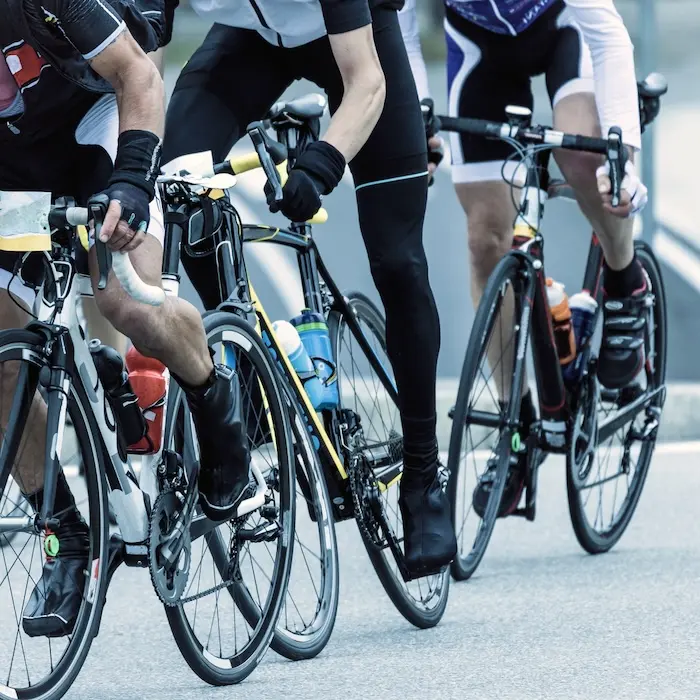
Considering the first kilometers as a mere prelude to the race is a common mistake. In reality, the start is already a performance phase. And even a very specific phase. For several minutes, you will often be riding above your target pace, sometimes at an intensity close to your threshold, or even beyond, depending on the course profile and the peloton’s level. You need to accelerate, reposition yourself, absorb pace variations, sometimes tackle a first climb without losing contact.
In other words, the start requires power, reactivity, clear-headedness, and the ability to quickly produce a high effort without losing composure. This is precisely why it deserves specific preparation.
First, warm up properly
The warm-up probably remains the most underestimated lever among sportive riders. Many reduce it to a few easy minutes in the parking lot. Others avoid it completely, for fear of burning out before the start. In reality, a good warm-up doesn’t tire you out: it prepares you. Its role is not just to activate the muscles. It primarily serves to gradually activate the cardiovascular system, increase muscle availability, facilitate the first increases in intensity, and avoid the brutal shock of a violent effort from cold.
Without a warm-up, the body takes longer to respond. With a well-structured warm-up, you enter the effort with an engine already ready.
What does a truly useful warm-up look like?A good warm-up before a sportive should be simple, progressive, and geared towards the first few minutes of the race. The goal is not to do a big intensity session, but to prepare the body to handle a fast start. Example of an effective warm-up before the start:
This type of warm-up has a major advantage: it prevents you from discovering high intensity… at the exact moment the race starts. |
Waiting at the start line
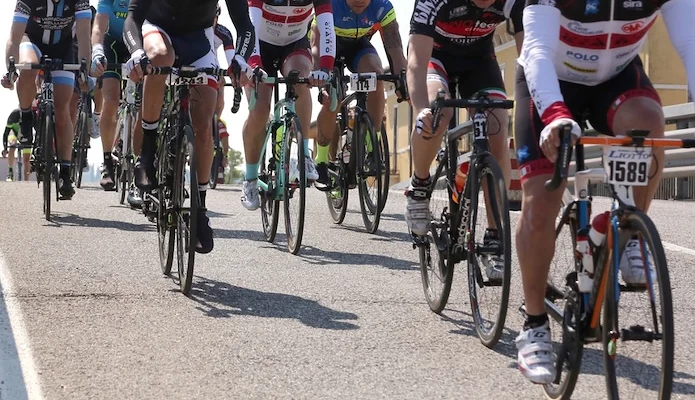
You can have the best legs of the day, but if you start too far back on the line, you still risk suffering. Positioning plays an immense role, especially in sportives where roads are sometimes narrow, where the peloton stretches out quickly, and where the first difficulty arrives early. Starting too far back often means having to make unnecessary efforts to move up, constantly braking and accelerating, getting stuck behind slower riders, or arriving at the foot of the first climb already in difficulty.
The idea is not necessarily to elbow your way through or to place yourself on the front line at all costs. However, you must arrive early enough to position yourself in a way that is consistent with your level and your ambitions for the day. If you are aiming for a group or a time, your place on the line should already be thought out according to that objective.
Nevertheless, this necessity can contradict the previous paragraph. Is warming up properly before the start compatible with then waiting sometimes more than 30 minutes on the line to be well-positioned at the moment of the kick-off? Yes, without hesitation. The answer is simple: the body doesn’t reset to zero. Even if your heart rate drops, you retain the benefits of the activation performed just before. The cardiovascular system is already mobilized, muscles are more reactive, and the transition to intense effort will be much less brutal. It’s better to wait a little after a good warm-up than to start completely cold.
Positioning: the other half of a good start
Don’t start all out, but start at the right pace. This is an important point. Starting well doesn’t necessarily mean giving everything from the first few seconds. The classic mistake, in contrast to an overly passive start, is an excessive start. Carried away by the atmosphere, adrenaline, and group effect, one very quickly exceeds their control zone. And this type of excess sometimes takes its toll from the very first climb. A good start relies on a more subtle idea: being able to handle the intensity without falling apart.
Concretely, this means accepting that the start will be fast, while avoiding unnecessary overreactions. You need to choose your efforts and not blow up trying to follow a group that is clearly too strong for you. The good start is not always the one that seems the most impressive. It is often the one that allows you to stay in your race.
The first difficulty as the first test
In many sportives, the selection doesn’t happen in the first 500 meters, but when the road rears up for the first time. This is often where everything is decided. Those who went into the red at the start drop off, those who were poorly positioned get stuck, those who started cold plateau, and those who anticipated well pass the test.
That’s why you must think of the start not as a bad moment to get through, but as a complete sequence extending to the summit of the first difficulty, or until the first group stabilizes. Your goal is not just to cling to the first group at all costs. It is to remain competitive throughout the selection phase.
Specific training
If you often miss the first ten minutes of a race, it’s likely that the problem won’t be solved on race day alone. You also need to train your ability to withstand a rapid increase in intensity, changes in pace, and the repetition of demanding sequences right from the start of a ride. In other words, you cannot expect to handle fast starts well if you haven’t prepared for them beforehand.
To do this, you can refer to our other articles on training, which will teach you more about how to work on threshold, MAP, or different power zones.
How to organize yourself for a stress-free start?
Succeeding in your start is also a matter of organization. If you improvise your morning, you will almost always arrive at the start with too little time, unnecessary stress, and a sacrificed warm-up. Conversely, a well-prepared routine changes a lot of things.
Before a sportive, anticipate your arrival time on site, the time needed to collect your bib number, bike preparation time, your complete outfit, your bottles and nutrition, the time you need to start warming up, and the moment you need to reposition yourself on the line. What you gain here is not just mental comfort. It’s also performance available at the right moment.
Mistakes that lead to a failed start
|
No longer suffering through the first few minutes
A successful start doesn’t rely on a magical detail. It’s the result of a combination of things done well: arriving ready, being warmed up, positioning yourself intelligently, accepting the intensity, and knowing how to manage it. This is often where the difference between a suffered race and a controlled race is made.
If you’ve ever felt like you blew up too early, missed the right group, or only found your legs half an hour after the start, then there’s a good chance your room for improvement is here. And that’s excellent news:
working on how you approach the start is undoubtedly one of the fastest ways to improve your performance in a sportive.
Share the post "Sportive: how to nail your start"