Share the post "Riding cobbles: how to stop suffering and start mastering"
Between the Tour of Flanders on Sunday, April 5th, and Paris-Roubaix the following week, the roads transform into granitic chaos for brave… or reckless cyclists. Amateurs, seduced by the idea of riding like the pros or signing up for the Tour of Flanders cyclo or the Paris-Roubaix Challenge, quickly discover that cobbles cannot be tamed by talent alone. Here, we’re going to give you some tips to survive these unforgiving surfaces and, let’s be frank, to stop being shaken like a plum tree between each cobblestone.
By Guillaume Judas – Photos: deposiphotos.com, ©Etienne Schoeman/Specialized, ©3bikes.fr

Cobbles aren’t just pieces of granite thrown there by sadistic municipalities: they are a part of cycling history. Champions capable of taming them have always inspired dreams. And let’s admit it, we all want to pedal a bit like them, even if it’s just to show off to our cycling friends.
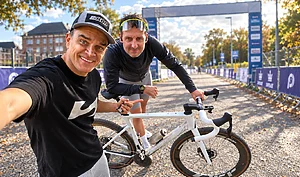
But beware, a small warning: I am not a specialist. When I was racing, cobbles and I were like oil and water. I hated them, and to be honest, I was absolutely terrible. At 55 kg, crossing a cobbled sector was a miracle. It took me years to start tolerating, even enjoying a little, these infernal surfaces. And then there was that day spent with Peter Sagan (three-time world champion, winner of Paris-Roubaix in 2018 and the Tour of Flanders in 2016), a true reference. Between his advice and trying to stay on his wheel (not for long), I finally started to understand a little better the art of riding on cobbles… or at least to stop losing my teeth with every pedal stroke. Let me explain.

The bigger, the better
No, we’re not talking about the cyclist’s weight… although, that does help a bit not to bounce like a ball on the cobbles. Here, it’s mainly about tires. Forget telescopic forks or other high-tech systems supposed to absorb vibrations. They work, but they’re not the main thing. The best damping remains simple and reliable. Wide tires, ideally tubeless, allow you to ride at low pressure and survive the cobbles while maintaining some semblance of dignity.
To give you an idea, Mathieu van der Poel rides on 32 mm tires at Paris-Roubaix, inflated to 3 bars. When I was young, we tried the cobbles with 23 mm. Imagine the result: with my light weight and lack of technique, I was tossed around like a straw.

During my day with Sagan, I tested 28, 32, and 35 mm. Even between 32 and 35, the comfort, and therefore the speed on chaotic sections, as well as the grip on wet areas, completely changes the game. I found my compromise with 2.5 bar in the front and 2.7 in the rear, and that’s where I recorded my best times on these cursed surfaces.
But be careful: too wide, and the efficiency on the asphalt between cobbled sections takes a hit. With 35 mm, you feel it very quickly. As often in cycling, you have to find the right balance between comfort and performance… without ending up crushed by the cobbles, or by your own ambitions.
Riding position
As Peter Sagan says, on the cobbles, you need to move back a little on the saddle, much like when climbing a pass. Why? Putting weight on the rear wheel improves traction and limits bouncing, while the front becomes lighter and less likely to dance a jig on each cobblestone. Well, he also added: “you get well back, you crush the pedals and you go for it.” Uh, yes Peter, we’ll try!

As for your hands, forget the tense grip like “I’m going to hold on until the apocalypse“: stay relaxed. The idea is to let the front wheel be a little free to absorb vibrations rather than turning into an unchained robot. As for your gaze, don’t fixate on your wheel like a hypnotized hamster. Ten meters ahead is enough to anticipate irregularities and avoid turning every cobblestone into a tooth trap.
The gear ratio, meanwhile, is a subtle compromise between power and cadence. Too soft, and your backside gets shaken on the saddle; too hard, and restarting after a turn or on a more technical section becomes a nightmare. The secret is to skim (or at least try to) the cobbles: ride fast to absorb irregularities without being crushed by them, while remaining ready to accelerate whenever necessary.
The right intensity: like climbing a hill
The cobbles of Paris-Roubaix are not a leisurely ride: they are serious business. Some sections are downright atrocious, and if you want to get through them quickly without counting every gap like a trivia controller, you need to adopt an intensity similar to what you would use to climb a steep hill.

Riding through cobbled sections is a bit like doing an interval session at maximum aerobic power (MAP): it hurts, it shakes you, and you have to stay focused. The pros who attack early in Paris-Roubaix do it as if they were climbing a long pass, managing their effort, gear ratio, and position so as not to blow up before the finish line. In short, the cobbles are earned, and pain is part of the package.
Dry or wet cobbles: two worlds, two struggles
On dry cobbles, the rule is simple: ride fast and hard. It’s physically demanding, but there’s a major advantage: you can see where you’re putting your wheels. You can choose different lines, overtake other cyclists, or even ride on the verges to avoid the most chaotic areas. In short, it’s hard on the legs, but less dangerous for your teeth.

Wet cobbles, on the other hand… that’s another dimension entirely. Some sectors resemble large-scale cyclocross: slippery, unpredictable, ready to send you to the ground at the first mistake. Ideally, you should stay on top of the cobbles, but these rounded bumps quickly turn into miniature ice rinks. Tricky turns, laborious accelerations: everything becomes more complicated. Large tires and maximum concentration are mandatory to avoid ending up as the star of a spectacular crash.

The cobbles of Roubaix or those of the Tour of Flanders?
In reality, they have little in common. In Flanders, the flat cobbled sections are relatively smooth, almost like city cobbles. In the hills, everyone is stuck: there’s a gradient and the cobbles bounce, but you never climb very fast. The big difference with an asphalt hill? It’s impossible to ride out of the saddle. In short, no need for specific equipment, unless you want to shine on the small hills.
One exception: the Koppenberg. Steep, narrow, under the trees, and often wet in April, this sector turns any cyclist into an unfortunate tightrope walker despite themselves. In a group, it’s impossible to pass without putting a foot down, stuck by another competitor. Forget the idea of re-clipping your pedals: with a 20% gradient and slippery cobbles, it’s better to finish the climb on foot… next to your bike, dignity optional.

The cobbles of Roubaix, however, are another story. Some sectors are truly bad, opened almost only once a year for the race. Here, it’s a real discipline in itself: power, technique, and concentration are not always enough, and even the best can be shaken like a well-agitated soda. In short, Roubaix is serious business, not a picturesque detour.
Enjoying the cobbles… or at least surviving with a smile
Ultimately, riding on cobbles isn’t just a matter of equipment or technique: it’s a state of mind. For my part, it took me years to start enjoying these infernal surfaces a little, and even today, every pedal stroke on granite reminds me that cycling is sometimes a slightly masochistic discipline. But with a good gear ratio, suitable tires, the right position, and a bit of concentration, you can really start to get a sense of speed on the cobbled sections… or at least avoid ending up as a contemporary sculpture on the asphalt.
The most important thing is to keep the fun and humor. The cobbles are demanding, sometimes humiliating, but they are part of cycling’s history and legend. So yes, you will bounce, slip, grumble, but you will also feel that unique thrill when everything aligns and you cross a section like a pro, or at least like someone who survived to tell the tale. After all, if even Peter Sagan had to show you the way, a little humility doesn’t hurt.
Share the post "Riding cobbles: how to stop suffering and start mastering"