Share the post "Amateur Cycling: A Safety Alert, Johan Lebon’s Cry"
The tone is serious, direct, almost desperate. A few hours after an accident that could have turned into a tragedy, Johan Lebon, president of the Grand Prix Gilbert Bousquet organization, spoke out on social media. His widely shared message goes beyond a simple rant: it highlights a deep security crisis in amateur cycling.
By Guillaume Judas – Photos: depositphotos.com, facebook.com/johan.lebon, DR
On Saturday, March 28, in Landivisiau, all the ingredients for a perfectly supervised event seemed to be in place. Six months of preparation, about fifteen volunteers mobilized beforehand, and 150 people on the ground on race day. A prefectural decree had even been issued to guarantee temporary exclusive use of the roadway. On paper, nothing was missing.
In reality, the system now appears dramatically insufficient. Faced with a peloton of 100 riders speeding at over 45 km/h, only two gendarmes and 25 civilian motorcyclists were responsible for ensuring security. A blatant disproportion, which the accident at kilometer 14 brutally revealed.
The disaster scenario
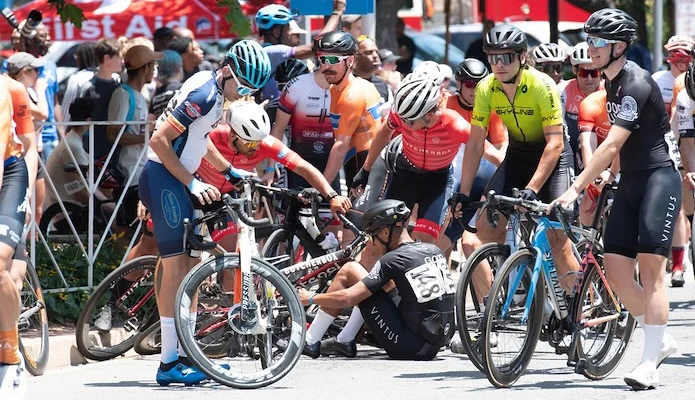
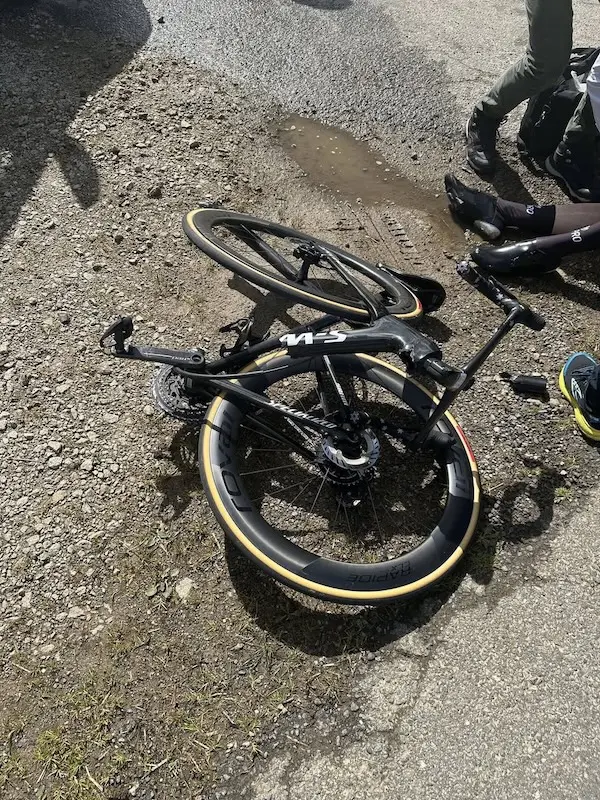
Two vehicles, refusing to wait a few minutes, forced a barrier held by a volunteer. They inserted themselves between the lead car and the peloton, causing a chaotic situation. Despite the intervention of a commissaire motorcyclist, the crash was inevitable. Massive. Violent. Emergency services had to intervene urgently, mobilizing firefighters, ambulances, and even a helicopter. The race was interrupted for two hours.
But beyond the accident, a staggering fact stood out: the two vehicles involved fled without stopping.
An increasingly dangerous society
For Johan Lebon, this episode is not a simple incident. It reveals a system at its breaking point. In his message, he denounces organizations relying on derisory means in the face of very real risks. He also points to a worrying trend: that of an increasingly impatient society, unable to accept a few minutes of waiting, even when lives are at stake.
Volunteers left to fend for themselves
What the organizer also highlights is the increasing pressure on volunteers. These invisible pillars of amateur sport find themselves managing critical situations, sometimes facing dangerous behaviors, without having either the authority or the sufficient means to guarantee safety. Behind this anger, a question insistently returns, almost like a threat: will we have to wait for a death for things to finally change?
An incomprehensible paradox
Because the paradox is striking. While other public events benefit from reinforced security measures, cycling races, although authorized and supervised, must make do with limited resources. A situation that many now consider untenable.
The stakes extend far beyond the local context. Amateur cycling forms the foundation of the entire sector. It is where vocations are born, where future champions are trained, where the future of emblematic events like the Tour de France is built. Weakening this foundation is to jeopardize an entire segment of French sport.
A warning that can no longer be ignored
Through his message, Johan Lebon calls for collective awareness. He demands more human resources, particularly from law enforcement, but also a clear recognition of the level of risk to which riders and organizers are exposed. He also insists on the need to hold road users accountable and to firmly sanction dangerous behaviors.
What happened in Landivisiau is not an isolated accident. It is an alarm signal. And this time, ignoring it could have irreversible consequences.
Share the post "Amateur Cycling: A Safety Alert, Johan Lebon’s Cry"