Share the post "What if you’ve been riding too narrow for years?"
What if you’ve been riding too narrow for years? From 25 to 35 mm: the silent revolution of road tires. For a long time, the rule was simple. Thinner is faster. A truth repeated in pelotons, on forums, in shops, until it became an almost cultural given. 23 mm was the norm, 25 mm an evolution, 28 mm a concession to comfort. Beyond that, one entered suspicious territory, vaguely associated with cycle touring or practices deemed less “pure”. And then, almost silently, things began to change. Today, tire widths are increasing. Not just among curious amateurs or long-distance enthusiasts. In the professional peloton, where every watt counts, riders are now on 30 mm… and sometimes beyond. A gradual, almost discreet shift, but one that says a lot about the evolution of modern cycling.
By Jeff Tatard – Photos: All rights reserved
When the road corrects theory
The turning point didn’t come from a spectacular technological revolution, but from a more subtle realization. On paper, a narrow tire has less contact surface, thus less rolling resistance. The theory is elegant. Except that the road is never truly elegant. Imperfect asphalt, micro-vibrations, invisible energy losses : what engineers now call “vibration losses” has finally emerged as a central parameter.
In other words, riding on a real road is nothing like riding on a test bench.

Paris-Roubaix, a real-world revelation
It’s probably on Paris-Roubaix that this reality is most clearly expressed. Long an extreme testing ground, the “Queen of the Classics” has become a revealer. The goal is no longer just to survive the cobbles, but to exploit them. And for that, the tire plays a key role.
“At a lower pressure, you get comfort to better conform to the shape of the cobbles.” The phrase might seem innocuous. It isn’t. It reflects a shift: that of a cycling that finally accepts that performance is not solely about rigidity, but also about adaptation.
Even Mathieu van der Poel, long a loyal 28 mm user because he “felt good with it,” is evolving. Switching to 30 mm is not a whim; it’s a reading of the terrain. And for a rider of this level, feel is never disconnected from performance.
At the same time, some teams are going further. Team TotalEnergies has chosen to ride 32 mm Continental GP5000 S TRs. A few years ago, this would have raised eyebrows. Today, it’s setting a trend.
And then there’s Tadej Pogacar. His ability to perform on all terrains, with a certain freedom in his choices, makes him a valuable indicator. Seeing him ride with wider tire widths is not a minor detail. It’s a signal.
Quick timelineWhen tire widths get wider2015 – John Degenkolb (Paris-Roubaix) 2018 – Peter Sagan (Paris-Roubaix) 2022 – Dylan van Baarle (Paris-Roubaix) 2024–2025 – Mathieu van der Poel / Tadej Pogacar |
30 mm: the new sweet spot
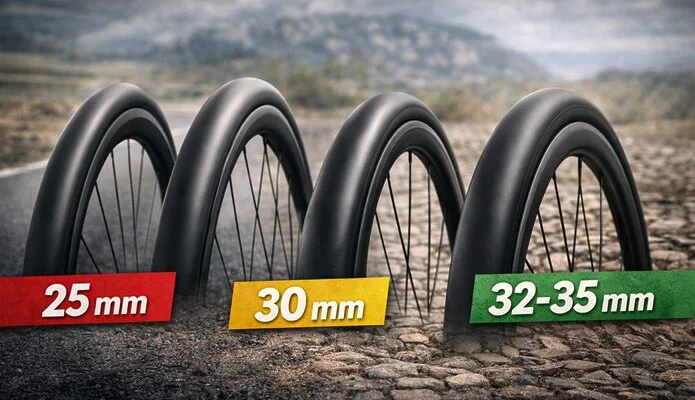
What is emerging today is quite clear. 25 mm is gradually disappearing, 28 mm remains a solid base, but 30 mm is establishing itself as a new standard for real-world performance.
Why? Because it offers a compromise rarely achieved until now. Lower pressure, better filtration, fewer energy losses, more grip. And above all, the ability to maintain a high level of efficiency over time.
What many still underestimate is the impact on fatigue. Fewer vibrations mean fewer micro-tensions, less energy dispersion. You don’t necessarily go faster at a given moment, but you are able to maintain a higher level for longer.

The mistake would be to fall into the opposite extreme
However, it’s not that simple. Believing that “wider = always better” would be an error symmetrical to that of the past. The balance depends on many factors: rim width, aerodynamics, terrain, rider profile.
A tire that is too wide, poorly integrated, can degrade the overall setup. The bike loses coherence, precision, and sometimes even enjoyment. Performance remains a system, not an isolated variable.
A cultural rather than technical evolution
What’s interesting about this shift is that it’s not just technical. It’s cultural. For a long time, cycling valued a form of radicalism: stiffer, thinner, more direct. Today, we accept the idea that performance also comes from the ability to absorb, smooth, and adapt.
It may seem less spectacular. Yet it is infinitely more intelligent.
And perhaps more honest too.
Key takeaways
|
https://www.tiktok.com/@3bikes.fr/video/7626670024270368022
=> So what width? 23, 25, 28, 30, 32 or even more?
Share the post "What if you’ve been riding too narrow for years?"