Share the post "Those noises or creaks that drive you crazy"
With the return of good weather, a symphony of creaks often appears on our bikes, even among the most expensive ones. Let’s admit that there’s not much more annoying, especially when it’s hard to identify the cause. Behind these noises that can drive you crazy often lie simple and easy-to-fix causes. You just need to know where to look. Here are some leads.
By Guillaume Judas – Photos: depositphotos.com
It’s a ritual almost as reliable as the switch to daylight saving time. Temperatures rise, roads dry out, and suddenly, your previously silent bike starts emitting a whole range of small noises, as irritating as they are elusive. Creaks, clicks, squeaks: a veritable soundtrack that turns every ride into a mechanical investigation.
The most frustrating thing about this is that the noise rarely seems to come from where you hear it. The frame amplifies, resonates, shifts the clues. You’d swear it was a bottom bracket problem, and yet, the culprit is sometimes hiding at the other end of the bike. Enough to push some people to methodically disassemble every component… often for nothing.
Why in spring?
What makes these noises particularly frequent in spring is almost elementary physics. After months of humidity, components accumulate dirt and oxidation. Then the air becomes drier, protective films disappear, and interfaces start working bare. The bike, in short, starts to speak.
I’ll take an experience that everyone can try. Just yesterday, my bike was making an incredible racket, after three weeks on the road without rain and, I admit, minimal maintenance. I quickly went to the high-pressure wash station to give it a quick clean with less effort. Instantly the noises disappeared all the way home… only to reappear today.
The most frequent (and most vexing) culprits
In fact, the most common causes are almost annoyingly trivial. Thru-axles, for example, are all-category champions of the discreet creak. A dry thread or a poorly lubricated bearing surface is enough to generate micro-movements under stress. A simple disassembly, a little grease, and tightening to the correct torque often solve the problem in a few minutes, where you were about to blame much more expensive parts.
The same logic applies to chainring bolts, those often-forgotten items of routine maintenance. Slightly loose or dry-mounted, they produce a noise perfectly synchronized with pedaling, to the point of perfectly mimicking a worn bottom bracket. Here again, cleaning, lubrication, and careful reassembly are usually enough to silence the mechanics.
The perfect trap: the derailleur hanger
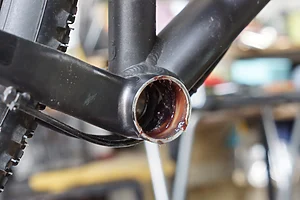
Even more insidious, the derailleur hanger regularly plays the invisible culprit. Sandwiched between the frame and the drivetrain, it undergoes significant stress and can generate diffuse creaks that propagate throughout the bike. A dirty or dry interface, and doubt sets in. A quick disassembly and clean reassembly often restore silence.
The classics we end up forgetting
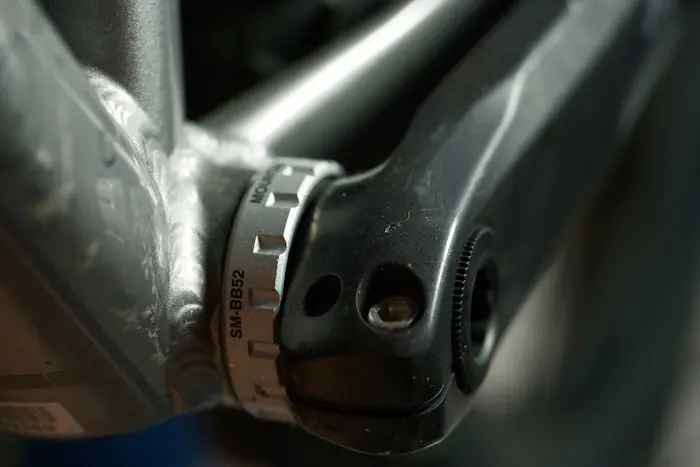
The bottom bracket can also play the orchestra conductor. And it’s even worse if you have BB30 type bearings (much less so on threaded models). But it’s ultimately rarer than one might imagine. And what if, before disassembling everything, it was enough to check the greasing and tightening of the bottle cage bolts, especially if they are alloy. I can speak from experience, as I have also encountered this problem.
To these well-known suspects are added the obvious things we readily neglect: dry seatpost, worn pedals or cleats, dirty drivetrain, or even approximate tightening everywhere. The common thread always remains the same: a lack of lubrication or an unsuitable tightening torque, which allows micro-movements where everything should remain perfectly solid.
A solution often simpler than you think
The good news is that in the vast majority of cases, there’s nothing serious. A complete cleaning followed by a methodical disassembly of key points (axles, chainring bolts, seatpost, derailleur hanger) is enough to solve the enigma. Provided you proceed with a minimum of rigor, and ideally by retightening everything with a torque wrench to avoid replacing one noise with another.
Because deep down, these creaks have something deeply ironic about them. They give the impression of a worn-out mechanism, when they are often just the symptom of neglected maintenance or a simple lack of grease. As if the bike, annoyed at being taken out a little too quickly at the first rays of sun, decided to make itself heard.
Share the post "Those noises or creaks that drive you crazy"