Share the post "StravaLeaks: when our rides say more than our performance"
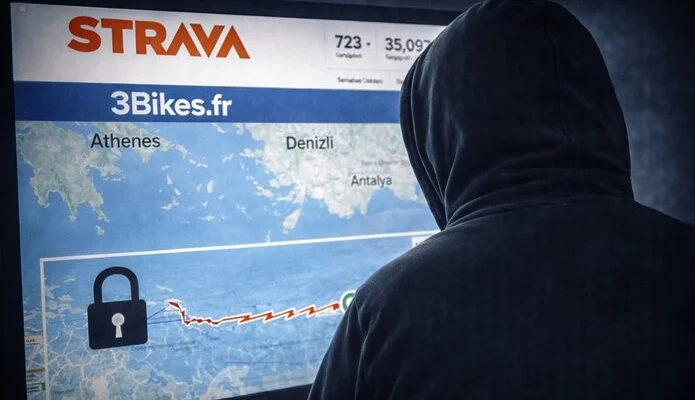
Data, GPS tracks and privacy: what if our sports activities told a different story than the one we think we’re sharing? A track is never insignificant. Recording an outing has become a reflex. A running session, a bike ride, a few kilometers, a bit of elevation gain, then automatic synchronization. The gesture is simple, almost invisible. Yet, a Strava activity is not limited to a sports performance. It constitutes a footprint. Geotagged, time-stamped, repeated data. And this footprint can, in some cases, reveal much more than we imagine.
By Jeff Tatard – Photo: @jefftatard
When data contradicts the narrative
Several recent situations illustrate this discrepancy between what we think we’re sharing and what we’re actually exposing. In a company, an employee declared on a business trip publishes, without paying attention, a running activity. The public track shows a route taken in the middle of the day, several hundred kilometers from the announced location. The starting point is identifiable, the timing undeniable. No need for in-depth investigation: the data is enough to undermine the discourse.
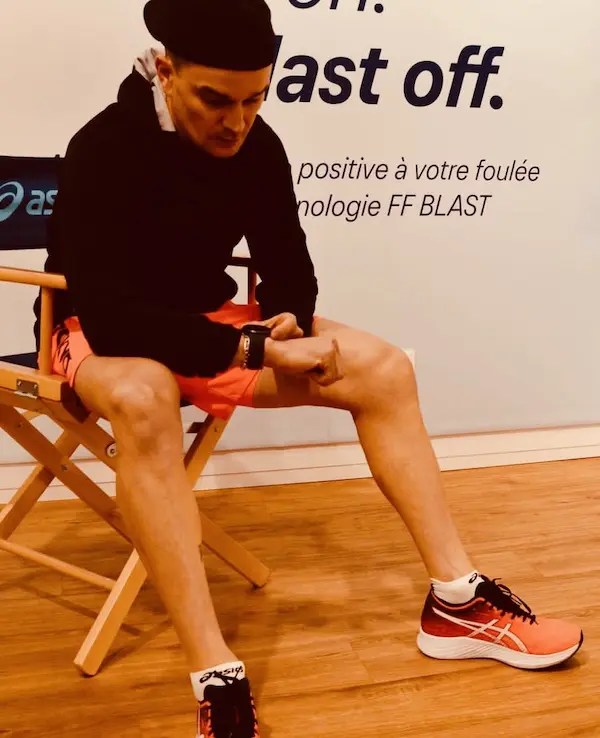
In a more personal context, another case highlights the silent power of this information. A man harbors doubts without tangible proof. It is neither a message nor a call that will clarify the situation, but a Strava activity. Not his partner’s, but that of a third party. A regular, repeated loop around a specific house, at times incompatible with the announced movements. Here again, the track says nothing explicitly, but it makes the situation legible.
When sport reveals sensitive areas
The most striking example remains that of the global heatmap published by Strava in 2018. By aggregating millions of activities, the platform inadvertently revealed bright traces in isolated, deserted areas, sometimes considered sensitive. Regular loops, typical back-and-forth movements of sports activities. This data made it possible to identify the existence, and even the precise location, of certain military bases in Afghanistan, Syria, or Africa. Not from strategic observation tools, but from sports activities automatically shared by users.
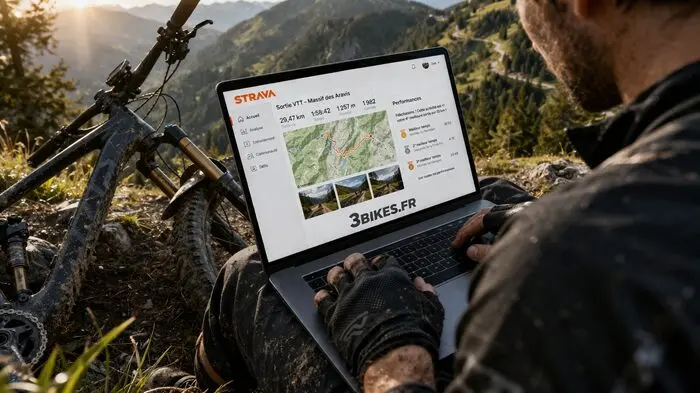
The paradox of the connected athlete
The development of measurement tools has profoundly transformed sports practice. Increasingly precise GPS, power meters, heart rate analysis, longitudinal performance tracking: everything contributes to a better understanding of effort. But this quest for precision is accompanied by increased exposure. Every published activity potentially contains information about habits, places of residence, schedules, routines. Performance becomes a data vector.
By wanting to measure everything, the connected athlete sometimes forgets that they are also showing something other than their watts or average pace.
Particularly high exposure for cyclists
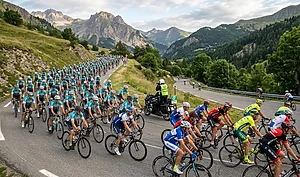
Cyclists are particularly affected by this issue. Rides often start from home, extend over long distances, and follow recurring routes. The repetition of tracks quickly allows for the identification of a starting point, the reconstruction of habits, and the anticipation of absences. What was initially simple sports sharing can, through accumulation, become a much broader source of information.
Protecting your data without giving up the tool
The goal is not to question the use of Strava. The platform remains a powerful tool for motivation, tracking, and sharing. However, it requires a minimal mastery of its privacy settings. Implementing privacy zones around the home, limiting activity visibility, or deactivating automatic publications can significantly reduce risks. Most of these features exist but remain underutilized.
Taking back control of what we show
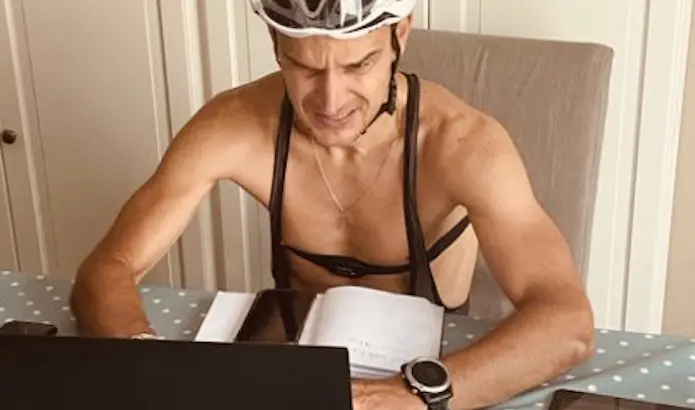
The question is not technological, but behavioral. Strava only reveals what we choose, or agree, to make visible. In an environment where data is omnipresent, it becomes essential to distinguish between what constitutes voluntary sharing and what results from poorly controlled automation.
An assumed position
In this context, certain individual choices take on their full meaning. Today, it is possible to measure, analyze, and progress without necessarily exposing one’s activities. This is the approach taken by some practitioners, including myself. Not out of rejection of the tool, but out of a desire to preserve a degree of intimacy, especially in a professional setting where geolocation and habits can have concrete implications.
In conclusion,
Strava is a formidable tool for sports storytelling. It allows documenting effort, tracking progress, and sharing experiences. But this ability to tell a story extends beyond mere performance. It also touches on private life, habits, and sometimes much more sensitive elements.
Technology does not betray. It makes visible. It is up to each individual to decide what they truly wish to show.
=> And if you want to better understand how the aircraft carrier Charles de Gaulle was located in real time thanks to the Strava application, read this article from “Le Monde”
Share the post "StravaLeaks: when our rides say more than our performance"