Share the post "Ride smarter, not harder: the lost cyclist’s guide"
Between improvised rides and data obsession, many amateur cyclists struggle to structure their training. Yet, a few simple principles, along with the right tools, are enough to transform their rides into real progress.
By Guillaume Judas – Photos: depositphotos.com
Just talk to any cycling enthusiast and you’ll hear the same frustration: “I ride a lot but I feel like I’m not really progressing anymore“. Halfway between pleasure and performance, the amateur cyclist often finds themselves lost, oscillating between random rides and overly complex training attempts. The good news is that there’s a simpler, almost counter-intuitive path: do less, but better.

Three types of rides to change everything
On the bike, everything starts with a reality that many discover late: not all rides are equal. Effective training actually relies on a balance between three types of efforts. On one hand, long, easy rides, often neglected, which build endurance. On the other, shorter but intense sessions, those that truly lead to progress. In between, recovery periods, essential but often sacrificed out of enthusiasm. Because yes, riding every day is not necessarily a sign of seriousness, but sometimes a classic mistake.
Intensity, that invisible trap
What complicates things is managing intensity. Without a power meter or heart rate monitor, many ride by feel, but this feeling is often misleading. Too fast on rides meant to be easy, not structured enough during hard sessions. The result: constant fatigue and little progress. Yet, coaches summarize the rule with a simple formula: the majority of time should be spent at low intensity, with only a small portion of truly demanding efforts. A simple, but remarkably effective principle.
The rise of training apps
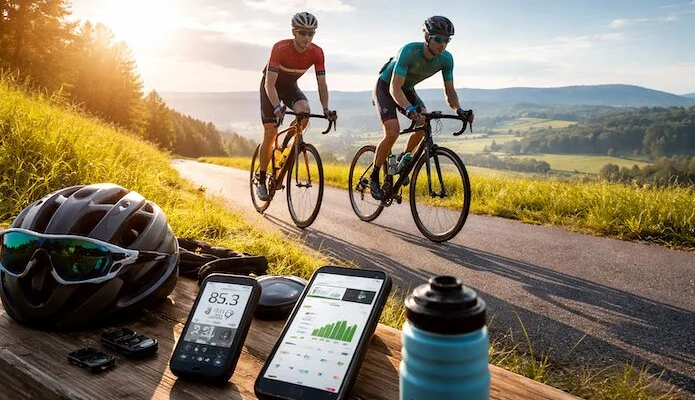
In this context, digital tools have invaded cyclists’ daily lives. The Strava app has become essential, transforming every ride into a visible and shareable performance. It motivates, pushes riders to excel on segments, but remains limited for structuring training, unless you invest in a Premium subscription. It shows what you do, but not always what you should do.
More advanced solutions, like Garmin Connect, go further by analyzing training load, recovery, and even overall fitness. Users find valuable indicators there, sometimes even session suggestions. But this data, however rich, still requires some interpretation.
It’s with platforms like Wahoo SYSTM or Hammerhead that we take an additional step. Here, training becomes guided, almost scripted. Sessions are planned, adapted to the current level and fatigue, with a logic similar to that of a personal coach. An appealing approach for those who want to progress without spending hours building their own program. Even if, from our point of view, such a program will never replace human contact with a coach.
Example of weekly organization (3 to 4 rides)For an amateur cyclist who rides regularly, a typical week might look like this:
The essential thing is to maintain balance: only one truly demanding session, volume in endurance, and sufficient rest between efforts. |
Technology doesn’t replace feel
But beyond apps and algorithms, a truth persists: no tool replaces understanding your own body. The most consistent cyclists are not those who blindly follow complex plans, but those who know how to listen to their sensations, accept to ease off, and give meaning to every ride.
To stagnate, or even regress over time, especially after a certain age, there is no worse strategy than… not having a strategy. And chaining bike rides, all the same or almost, without any thought behind them. Basically, you have to stop being a spectator of your own activity, and become the main actor again.

Learning to slow down to progress
Ultimately, progressing on the bike doesn’t necessarily require more time or more kilometers. It mainly requires better organization, a little discipline and, sometimes, the ability to slow down to go further.
Share the post "Ride smarter, not harder: the lost cyclist’s guide"