Share the post "Mathieu van der Poel and the wide handlebar paradox"
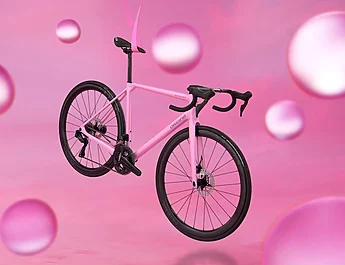
While the professional peloton adopts increasingly narrow handlebars to gain a few precious aerodynamic watts, Mathieu van der Poel makes the opposite choice. The Dutch champion uses handlebars significantly wider than the current trend. A seemingly technical detail, but one that actually reveals a much deeper question about the evolution of modern cycling: should aerodynamic theory or the reality of power be prioritized?
By Jean-François Tatard – Photos: DR
When the Peloton Narrows
Modern cycling loves trends. It only takes an idea to appear in a corner of the peloton, for an engineer to observe it in a wind tunnel, or for a rider to win a major race with a particular technical detail, for that detail to become almost a norm a few seasons later. For several years, this norm has had a name: the narrow handlebar. In the professional peloton, handlebars have progressively narrowed. The formerly standard widths of 42 or 44 centimeters now seem almost generous. Some riders now ride with 38-centimeter handlebars, sometimes less between the hoods, often angled inwards to further close off the position. The reasoning is simple. Bringing the arms closer together reduces the rider’s frontal area and improves their air penetration. At 45 km/h, a few centimeters can represent several watts. And in a sport where everything is now measured, analyzed, and optimized, these few watts quickly become a difficult argument to ignore.

Van der Poel’s Calm Choice
In this increasingly homogeneous technical landscape, Mathieu van der Poel is almost an exception. The Dutch champion rides with handlebars of about forty-five centimeters (outside). By current peloton standards, that’s wide. When asked about it, his answer is almost disarmingly simple: he simply uses the handlebars he has always used. In other words, he hasn’t changed. It’s the others who have progressively narrowed their setup. For Van der Poel, the question isn’t really about fashion or innovation. His priority remains the feel on the bike, stability, and the ability to produce power in the decisive moments of the race.

The Biomechanics Behind the Handlebar
This technical detail actually reveals a much deeper debate. A narrower handlebar can improve aerodynamics, but it also changes how a rider uses their upper body. Handlebar width influences chest opening, bike stability, and the ability to pull on the handlebars when riding out of the saddle. For a rouleur or a time trial specialist, this compromise may be acceptable. But for a rider like Van der Poel, whose style relies on brutal accelerations and explosive attacks, the logic is different. When he launches an attack on the cobbles or exits a corner with maximum acceleration, the handlebar width becomes almost a mechanical lever. It allows for better bike control, but also to transmit more force with each movement. In those moments, a few watts theoretically gained against the wind perhaps matter less than the ability to produce a violent and perfectly controlled acceleration.
A Subtle Lesson for Amateur Cycling
This story of wide handlebars is also interesting for amateur cyclists. For several years, many have sought to replicate the positions of the professional peloton : very narrow handlebars, extremely compact positions, settings sometimes very far from what actually suits their morphology. But cycling remains above all a sport of biomechanics. The best position is not necessarily the most aerodynamic on paper. It’s the one that allows you to breathe correctly, produce power, and maintain perfect control of the bike when intensity increases. On this point, Van der Poel simply reminds us that performance is not limited to an aerodynamic equation.
The Strength to Remain Oneself
Ultimately, these slightly wider handlebars perhaps tell a simpler story. In a peloton obsessed with marginal gains, Mathieu van der Poel seems to follow a different logic: that of personal consistency. He prefers to maintain a position in which he feels perfectly powerful rather than giving in to a trend that wouldn’t suit his racing style. And when we see the way he blows up certain races, often with a violence and fluidity that seem almost natural, we understand that this consistency may have more value than a few watts gained in a wind tunnel. Modern cycling often seeks performance in technology. Van der Poel simply reminds us that it is sometimes found in something much simpler: a bike set up exactly as it should be… for the rider who rides it.
=> If you wish to discover the exchange that inspired this reflection, you can read the original Cyclingnews article
Share the post "Mathieu van der Poel and the wide handlebar paradox"