Share the post "X-One-G Ti pedal review: Look’s take on race-ready gravel"
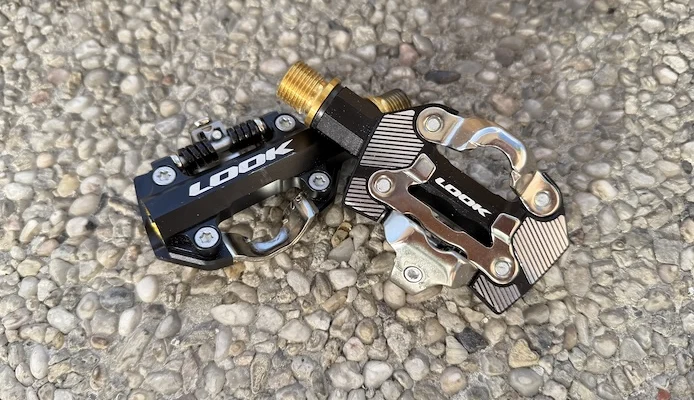
With the X-One-G, Look offers pedals specifically designed for competitive gravel riding. A new approach in a world where most solutions still derive directly from cross-country mountain biking. At the top of the range, the X-One-G Ti version promises high power transfer and a record weight, while maintaining the robustness and practicality of an off-road system. We were able to test this model, which embodies the French brand’s new gravel strategy.
By Guillaume Judas – Photos ©3bikes.fr
For a long time, gravel riders used pedals derived from XC mountain biking, a logical choice but one that doesn’t always perfectly meet the demands of this hybrid discipline. Some even prefer road pedals and shoes, which implies other compromises. Aware of this evolution, Look has decided to develop a complete range of pedals specifically designed for gravel.
The objective is to offer solutions adapted to different riding profiles, from competition to adventure. This new family of pedals is thus structured around three main platforms, all compatible with the SPD standard to maintain broad compatibility with most off-road shoes on the market.
The first, the X-One-G, clearly targets performance and competition. The X-Track, already well-known in the brand’s catalog, is positioned as the versatile solution capable of accompanying both road and trail rides. Finally, the new X-Venture series replaces the old trekking category and targets adventure and bikepacking enthusiasts, with pedals offering a wider platform and even more grip in difficult conditions.
X-One-G: the pedals for fast gravel
However, it is the X-One-G that represent the true novelty of this range. Developed to meet the demands of the most athletic gravel riding, they seek to combine the efficiency of road pedals with the reliability of an off-road mechanism.
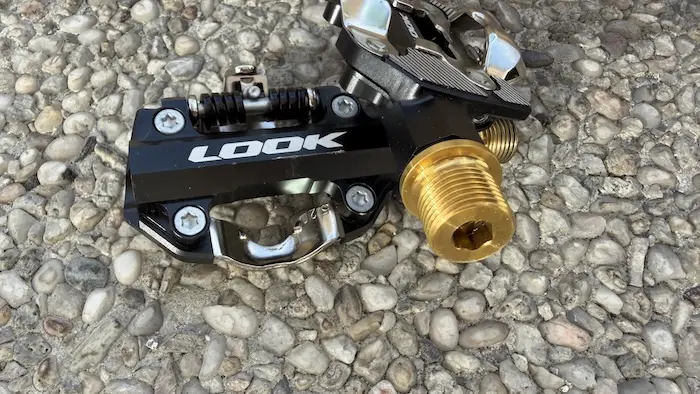
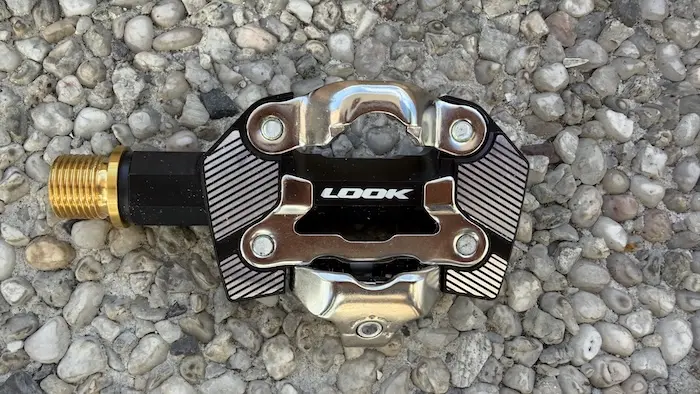
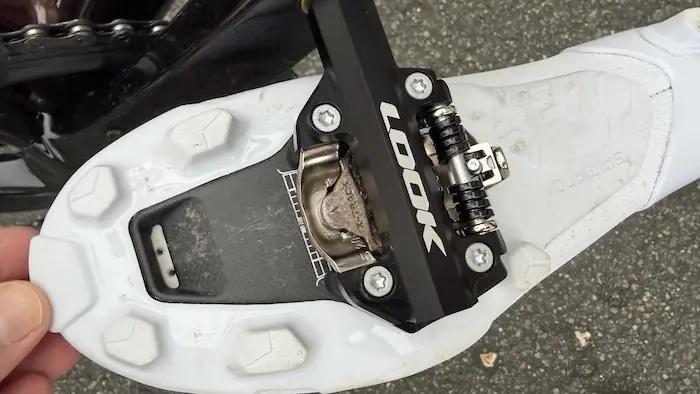
To achieve this, Look has designed a platform offering a large support surface to optimize power transmission and foot stability. The idea is to provide sensations close to a road pedal, while maintaining the ease of engagement and mud shedding capability of a mountain bike-inspired system.
The main difference from mountain bike pedals concerns single-sided entry, whereas pedals usually used in the discipline offer a mechanism accessible from both sides. This choice allows for a cleaner pedal design and, above all, reduces weight.
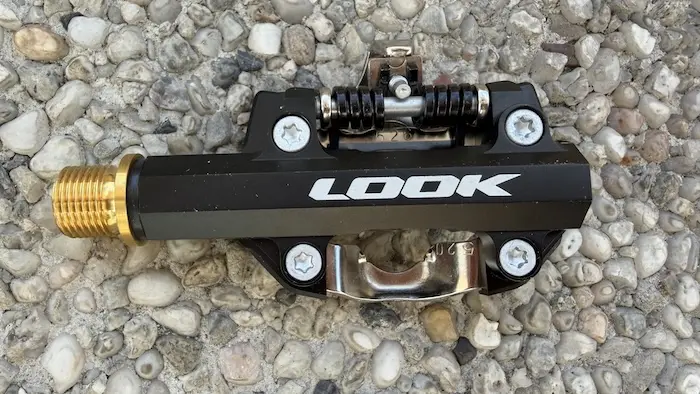
The X-One-G range comes in two models:
- X-One-G Ti, top-of-the-range version with titanium axle
- X-One-G Max, more accessible version with chromoly axle and aluminum body
These pedals were developed with feedback from athletes competing on the international gravel scene, notably Simon Pellaud and Russell Finsterwald.
Focus on the X-One-G Ti
Positioned at the top of the range, the X-One-G Ti stand out primarily for their very contained weight. Thanks to their titanium axle, the pair claims only 244 g, a particularly competitive figure for SPD-compatible clipless pedals, and close to that of some very lightweight road pedals. For comparison, I weighed my Shimano Deore XT pedals at 342 g, almost 100 g more for the pair.
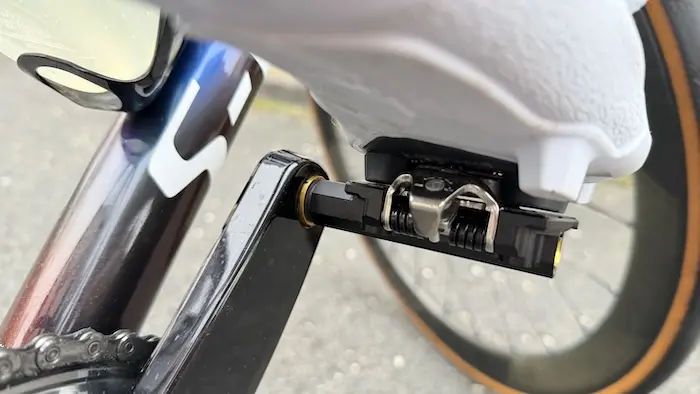
The platform offers a contact surface of 650 mm², significantly larger than many mountain bike pedals. This extra width aims to improve foot stability and power transfer, a particularly sought-after point when intensity approaches that of a road event.
As the X-One-G are SPD compatible, I was able to test them with the new Shimano S-Phyre RX910 shoes, equipped with the Pontoon cleat system, itself designed to improve the support surface and power transfer. The combination is a bit like wearing both a belt and suspenders: the stability felt on the pedals is close to that of road pedals, without the floating sensation above the cleat that can sometimes be perceived when support relies solely on the thin SPD cleat.
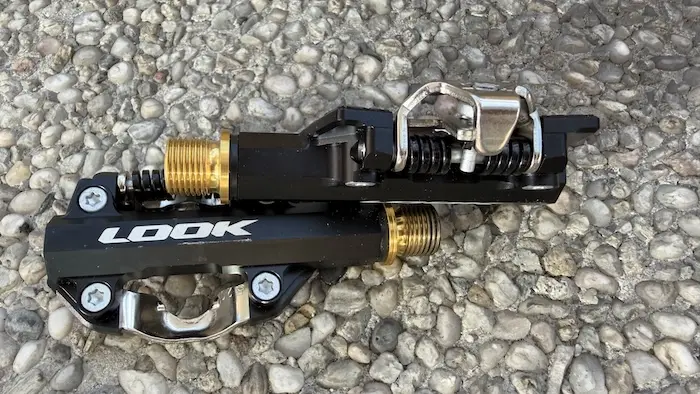
Furthermore, the minimalist design of the mechanism has also been conceived to promote the evacuation of mud, sand, and small stones. This is an essential characteristic on gravel courses, where conditions can quickly deteriorate. Even if one is supposed to put a foot down less often than in mountain biking or cyclocross, it only takes one time in bad conditions to have difficulty re-engaging.
From this point of view, the X-One-G perform quite well. While I did encounter some clipping difficulties, they are mainly related to the single side of the pedal, which is necessarily less easy to find under the sole than a double-sided mountain bike pedal.
Angular float
As with most SPD-compatible systems, the X-One-G pedals offer a certain angular float to preserve joint comfort and allow for natural pedaling. This lateral rotation here reaches 6° around a central point, which gives the foot enough room to move to avoid any sensation of excessive constraint while maintaining precise guidance during sustained efforts.
On the trails
On the trail, the particularity of the single-sided engagement logically requires a short adaptation period. Clipping in proves a little less intuitive than with a typical double-sided mountain bike pedal, as you have to orient the pedal correctly before clipping. After a few rides, however, the motion becomes more natural and no longer constitutes a real handicap in gravel riding, where you generally unclip less often than in mountain biking or cyclocross.
Once clipped in, the behavior of the X-One-G Ti is, however, very convincing. The wide platform provides a good sensation of stiffness when pedaling hard, with stable support that in some respects recalls road pedals. The 6° of angular float also offers a natural foot movement sensation, without excessive strain on the knees.
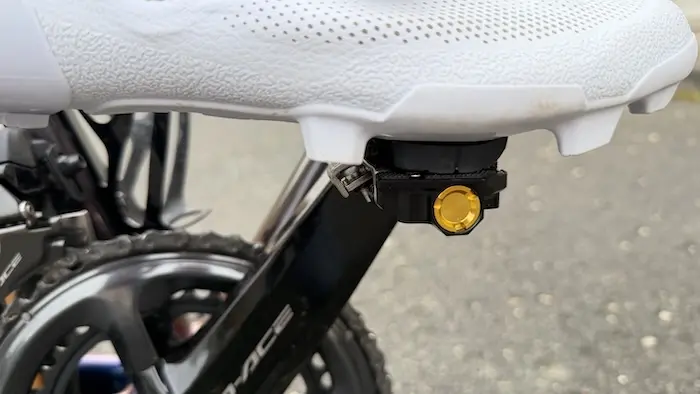
The Q-factor is identical to that of Shimano Deore XT pedals, which facilitates the transition for users already accustomed to this standard. In terms of adjustment, the clamping force appears quite high: for my part, I rode with a setting close to the minimum to facilitate clipping in, and yet I never unclipped under effort, even during sprints or strong accelerations. This leaves a comfortable adjustment margin for the most powerful cyclists or heavier riders.
Very high-end gravel pedals
With the X-One-G Ti, Look offers a clearly performance-oriented vision of the gravel pedal. The extremely low weight, large support surface, and sensation of stiffness make it a product that closely resembles road pedals in terms of efficiency, while retaining SPD compatibility and the practicality of an off-road system.
However, the positioning is very high-end, both technically and in terms of price, as the pair is listed at €299. A high price that reserves this model for the most demanding riders or competitors, but which also testifies to the arrival of a new generation of pedals specifically designed for fast gravel. By seeking to combine pedaling efficiency, minimal weight, and off-road functionality, this type of product indeed opens up interesting perspectives for a discipline that continues to refine its equipment over the years.
The Look X-One-G Ti pedals in brief…Pros: weight, support surface, system stiffness, mud shedding SPD standard pedals with single-sided engagement, specific for gravel. Contact surface of 650 mm². Q-Factor of 53 mm. Two versions available:
Contact: https://www.lookcycle.com/fr-fr/ |
Share the post "X-One-G Ti pedal review: Look’s take on race-ready gravel"