Share the post "At what temperature do you switch to bib shorts?"
The debate that returns every spring. In cycling, some debates never end. 25 or 28 mm tires. The ideal tubeless pressure. Coffee before or after the ride. And then there’s this question that comes back every year as winter begins to recede: at what temperature can you finally get out the short bib shorts?
By Jeff Tatard – Photos: ©Damien Rosso, ©SterlingLorence / Giant
The scene is always the same. In a club parking lot, in front of a cafe, or when leaving home, you glance at the thermometer, then at the sky, then at your friends’ legs. Because in cycling, short bib shorts are not just a piece of equipment. They are almost a symbol of the season’s return. The first day you put them on, it feels like the cycling year truly begins.
When cycling believed in “sweating out toxins”
For a long time, cycling had a rather strange relationship with temperature. In certain eras (not so distant, in fact…) there was even a form of thermal suffering culture. Riding covered, sweating a lot, “getting the toxins out.” Some old-school racers still talk about those summer rides where they would go out in long tights, sometimes even without water bottles, convinced that sweat cleansed the body.
In hindsight, we mainly realize how approximate this idea was. Modern physiology has since put things in their place: sweating does not “purge” the body; it simply serves to regulate body temperature.
And when dehydration sets in, it’s not the body that cleanses itself; it’s performance that collapses. Blood volume decreases, heart rate climbs, power drops. Dehydration remains one of the major enemies of performance.

The professional peloton as a laboratory
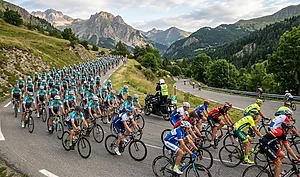
Today, habits have changed. The pro peloton, which often remains the best observation laboratory, regularly proves this. Just think back to the week before the Omloop Het Nieuwsblad this season.
During the reconnaissance of the Mur de Grammont, the thermometer barely showed 12 or 13 degrees. Yet, a large part of the riders were already riding bare-legged. Among them, Mathieu van der Poel, perfectly at ease in short bib shorts on the Flemish cobbles.
Twenty years ago, some sports directors would probably have raised an eyebrow. Today, it no longer shocks anyone. Modern cycling has become much more rational, and much less superstitious.
The magic zone: between 12 and 15 degrees
So what’s the right temperature?
The truth, as often, is less spectacular than one might imagine. It is generally somewhere between 12 and 15 degrees. From this range, the majority of cyclists begin to be perfectly comfortable in short bib shorts, provided, of course, that the rest of the equipment is adapted.
A long-sleeved jersey, a gilet in the pocket, or some arm warmers are usually enough to complete the outfit. Short bib shorts are not a question of bravery, but of thermal comfort.

Sun, wind, and intensity: the real arbiters
But reducing the question to a simple number would be a bit too simplistic. A cyclist’s thermal sensation depends on a set of much more subtle factors.
The sun, for example, completely transforms the perception of cold. Twelve degrees under a blue March sky can seem almost mild, whereas the same temperature under a gray, damp sky brutally reminds you that winter is never far away.
Wind also plays a decisive role. On a bike traveling at thirty kilometers per hour, the air circulating around the body amplifies cooling. This is also one of the reasons why professional riders often tolerate short bib shorts more easily: the intensity of the effort produces enough muscular heat to compensate for this cooling.
The psychological dimension of short bib shorts
And then there’s an element that physiological studies measure poorly but that all cyclists know perfectly: the psychology of spring.
The first day in short bib shorts is always a small event. The legs are still pale, almost fluorescent after months of winter. The tan lines from the previous season have disappeared. But it doesn’t matter. You feel lighter, freer, almost faster. Scientifically, the effect is debatable. Mentally, it is undeniable.

The real rule
Ultimately, the simplest rule probably remains the fairest…
If you’re cold from the first kilometers, it means the time wasn’t right yet. If you’re hot after ten minutes of effort, you probably should have worn less.
And if you hesitate for a long time in front of your cycling wardrobe, wondering whether to wear short bib shorts or not, it means you are exactly in that strange period of the calendar where winter is still clinging on while spring is already starting to pedal.
The good news is that in a few weeks, the question won’t arise at all. And short bib shorts will once again become, as every year, the natural uniform of the cyclist.
=> And to better understand the effects of dehydration on sports performance, you can read this article from Sciences et Avenir which very clearly explains the mechanisms involved.
=> Or hydration: true or false
Share the post "At what temperature do you switch to bib shorts?"