Share the post "RMPRO from the jersey you wear to the jersey you make"
In cycling, some stories are written on the roads, and others continue long after the finish line. Some are born in the roar of a peloton speeding at fifty kilometers per hour. Others take root in a workshop, behind a computer screen, in the silence of an office where jerseys are designed. The story of Charles and Clément Guilbert belongs to both worlds. It’s one of transmission, a discreet legacy, and a passion that flows like an underground current between generations. It connects the professional peloton of the 1990s, the demands of modern cycling, and the entrepreneurial adventure of a small family business: RMPRO. A story that begins in a peloton. And that continues today in the jerseys that other riders will wear.
By Jeff Tatard – Photos: All Rights Reserved
The Memory of the Peloton
Twelve years as a professional. In a cycling career, that’s both long and short. Long because each season counts its thousands of kilometers, its winters of preparation, its hopes and its injuries. Short because one day, almost without warning, it all stops.
When Charles Guilbert is asked what images come back to him first, it’s not just the victories. It’s mostly moments. Fragments of the peloton. “I obviously have great memories. Victories, results… but what comes back to me first are the years spent in certain teams, especially at Bretagne. We were a bit of a team of comeback riders. There was Stéphane Petilleau, Philippe Dalibard at the helm… humanly it was formidable.”

In cycling, teams are sometimes temporary families. Fragile alliances built on fatigue, solidarity, and kilometers.
At Bretagne Jean Floc’h, Guilbert found a form of late recognition. The team had the appearance of a tight-knit collective, made up of strong personalities and riders who came to find their place: Noan Lelarge, David Lelay, Carl Naibo, Samuel Plouhinec, and Christophe Thébault. Around them also revolved guys like Jean-Luc Delpech, Sébastien Duret, and Stéphane Petilleau, all driven by the same desire to prove their worth.
After years of working in the shadows, the results finally came: a victory at the Tour de Gironde, a stage of the Ruban Granitier Breton, honorable finishes in several French classics. And even a third place at Paris-Camembert. For a Norman, that’s no small detail.
But the strongest memories are not always those the public sees. There are also those invisible days. Like that day at Bonjour, when the entire team was dropped from the very first kilometers. “We spent the day riding to get back into the peloton. With Walter Bénéteau… we barely spoke. We just rode, that’s all.”
Cycling is a sport where you learn to suffer together. And where you also learn humility. It’s also the first thing Charles would highlight when he had to present himself in a job interview. “Cycling teaches you humility. You can win a stage one day, and the next day be sick and unable to move forward. You’re never sure you’ll be at your best.” In the peloton, nothing is ever guaranteed. Each race restarts the story.

What the Peloton Teaches
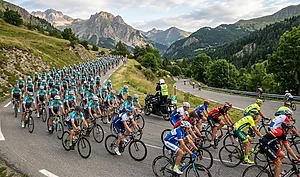
Television shows the winners. It shows the attacks in the final kilometers. But it rarely shows the 180 kilometers spent pulling a peloton. Professional cycling forges a particular skill: anticipation. Reading a race. Sensing movements. Guessing decisive moments. “On a bike, you learn to anticipate events. That’s something that stays with you.”
But paradoxically, when a career comes to an end, this knowledge is not always recognized. At thirty-three, Guilbert began preparing for what came next. He had interviews to become a sales representative in the cycling industry. And discovered an unexpected reality. “The recruiters told me: yes, but actually… you’ve never worked.”
For them, twelve years in the peloton did not constitute professional experience. A common misunderstanding for former athletes. Because behind the results lie years of learning: discipline, effort management, resilience, teamwork. But these qualities are difficult to translate into a CV.

Defeats That Build
When Charles is asked what built him the most, he doesn’t hesitate long. It’s not the victories. It’s the difficult moments. “When you win, everyone is there. But when you struggle… that’s when you see who you can count on.” Defeats force you to question yourself. To seek answers. To understand what’s missing. In a cycling career, certain absences leave their mark. Like not being selected for the Tour de France. “I was on the verge of doing it several times. And when you don’t do the Tour, it’s a big blow.”
But these failures also become stages. Turning points. Moments when you understand that the road won’t be eternal.
From Cycling to Business
Many former riders stay in the peloton. Sports directors. Coaches. Advisors. Charles Guilbert chose another path. Commerce. And more specifically: cycling apparel.
A decision also based on a simple reason. Family. “Being a sports director means a lot of absences. I also wanted to be present for my wife and children.” So the former rider started as a sales representative in the cycling industry. And gradually discovered the world of technical apparel. An industry in its own right. With its codes. Its constraints. Its margins. And above all, its risks. Because becoming an entrepreneur means moving from a world where rules already exist… to a world where you have to invent them. “When you’re a sales rep, the price is set by your company. When you’re an entrepreneur, it’s up to you to decide. And that’s not easy.”
Little by little, the idea took shape. Create a company. Build products. Develop a brand. Thus RMPRO was born.
But behind these two letters lies a story much older than the company itself.
RM are the initials of Raymond Martin. The great Norman climber, third in the Tour de France 1980 and best climber of that same edition, the one who wore the polka dot jersey on the roads of the Tour and whose climbing silhouette marked an entire generation of enthusiasts.
Long before personalized cycling apparel became a real market, Raymond Martin had already imagined a way to stay connected to cycling differently, after his years of competition: making jerseys for clubs and teams. A simple idea, almost natural for someone who had spent his life in a peloton.
A few years later, Charles Guilbert, his son-in-law, would take over and gradually develop the company, structuring the activity and refining the products. Today, with the arrival of Clément, a new generation enters the adventure. Three generations connected by the same thread. Cycling, of course. But also this symbol that spans all eras of cycling: the jersey. The one worn in the peloton. The one designed. And the one manufactured so that others, in turn, can write their own story on the road.

The Economics of a Jersey
For a cyclist, a jersey is a simple object. For a manufacturer, it’s a complex equation. Charles summarizes it simply. A good jersey is recognized by three things: the cut, the fabrics, the finish. “You can have a fabric that looks good but doesn’t breathe. Or a jersey that deforms after three washes.”
In technical textiles, details matter. The seams. The closures. The elasticity. The durability. And of course, the price of materials. Some fabrics cost a few euros per meter. Others more than thirty. That’s also where the difference between brands plays out. Today, RMPRO deliberately positions itself clearly: a quality product, built from the needs of cyclists. An approach that could be called market vision. Observe practices. Understand expectations. Then develop the product. Because not all cyclists want the same clothing. Some seek absolute aerodynamics. Others simply prefer to be comfortable on their bike. “There are recreational riders who don’t want to be compressed in an ultra-tight jersey. They want to be able to breathe.” Cycling apparel has become a delicate balance between technology, comfort, and design.
When Performance Enters the Fabric
In modern cycling, clothing has become a performance element. Fabrics can save watts. Time trial suits are studied in wind tunnels. Textures influence air penetration. Clément Guilbert is part of this new generation.
And his perspective has changed certain things in the company. “Today, clothing is also a performance accessory. Fabrics can save a few watts.”
To measure these gains, manufacturers use calculations related to air penetration and speed. The differences are sometimes minimal. But in a sport where differences are counted in seconds, they become significant.

The Transmission
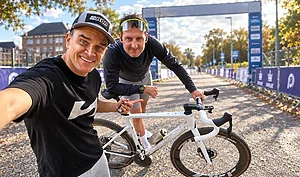
This is where the story takes on a family dimension. Because Clément Guilbert is not only Charles’s son. He is also a cyclist. And he now works in the company. As often in these stories, everything starts naturally. A bit by mimicry. “I grew up in it. I loved cycling… and also clothes.” Little by little, Clément began to learn graphic design. To draw. To design jerseys. Today, he participates in many aspects of the company: graphic design, product development, relations with teams. And continues his racing career in parallel. A double life made possible by the particular rhythm of cycling. “The company’s rush is mostly in winter. And in winter I don’t race. So I work more in the office.”
In summer, the roles are reversed. Races take over.
Two Generations of Cycling
Between Charles and Clément, almost twenty years of cycling. Two eras. Two different pelotons. Charles observes a major transformation. The peloton has gotten younger. “When I turned elite, there were riders aged 28 or 30. Today, the oldest are sometimes 25.” With this rejuvenation, certain implicit rules have changed. The hierarchical respect of the peloton. The progressive learning. Today, competition is immediate. Young riders arrive quickly. Very quickly. But Clément doesn’t feel the weight of a legacy.
He is simply building his own path. “I take advice from my father and my grandfather… but I’m doing my own journey.” Because the Guilbert family also has another connection to cycling history. Charles’s father-in-law is none other than Raymond Martin. Third in the Tour de France 1980. And best climber that same year. A figure of French cycling. Yet another generation. Another era.

A Day in Clément’s Life
On Monday morning, after a race like Manche-Atlantique where his younger brother Mattéo, five years his junior, had just taken a solid 66th place or a round of the Coupe de France, the weekend’s interlude gently closes. In the Guilbert household, Sunday evening discussions often revolve around cycling. About races, sensations, trajectories in a sprint, or a breakaway that never quite stuck.
The fatigue is still there, sometimes the legs too, marked by the kilometers and accelerations of the day before. But the routine resumes. Wake up around 8:30 AM. Even when the race finished late and the car was parked in front of the house well after 11 PM. A one-and-a-half-hour training ride to get the legs going again. Then off to the office.

There, another rhythm begins: graphic design, orders, exchanges with teams, development of new products. The hours pass differently, until late afternoon.
Because in the Guilbert family, cycling is not limited to a story between a father and his son. Mattéo, too, has embarked on the adventure. And then there’s the little sister, fourteen, who watches all this with curiosity. She hasn’t chosen cycling yet, preferring for now to collect achievements in gymnastics, but the desire is never far away.
An entire family that revolves, in one way or another, around cycling. And in the midst of all this, for Clément, a life straddling two worlds. Cycling. And business.
Emma’s Role
In this small family structure, every person counts. And there’s also Emma. A discreet but essential presence. Always available, always in a good mood, she brings a valuable serenity to the company’s daily life.

In a human-sized structure, balance sometimes depends on small things. An atmosphere, an energy, a way of approaching problems. Emma is one of those people who smooth everything out, simply by their presence.
A Cycling Family
In the Guilbert family, cycling is everywhere. In memories. In work. In weekends spent by the roadside. But also in the sacrifices it sometimes imposes. “Cycling demands a lot from my wife and daughter.” Because behind every passion, there are also those who accept it. Who support it. Who make it possible.

And Tomorrow?
At the end of the interview, the question of the future arises. In ten years. What will remain of this adventure? Charles answers with a form of simplicity. No grand ambitions. No grandiose plans. Only the desire to do things well. To satisfy customers. To continue to progress. And to remain faithful to what has always guided them: cycling.
As the great philosopher Kung Fu Panda says, with more wisdom than it seems: “Yesterday is history. Tomorrow is a mystery. Today is a gift.”
There is undoubtedly, in this unexpected formula, an essential part of what the Guilbert family’s story tells. The past is the years in the peloton, the kilometers, the victories, the struggles, and the silent lessons of high-level competition. The future, meanwhile, remains open, shifting, still to be invented. But between the two, there is the present: concrete, living, transmitted.
A father. A son. A business. A shared passion. And this almost invisible thread that connects all these dimensions without ever breaking: the jersey, the one you put on to race, the one you design, and the one you craft so that others, in turn, write their own story.
=> To better understand the RMPRO range: WEBSITE RMPRO
=> And here, if you want to discover all our other portraits: All our Portrait articles
Share the post "RMPRO from the jersey you wear to the jersey you make"