Share the post "Short cranks: cycling’s new illusion"
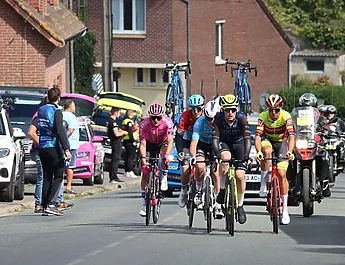
For two seasons, a new watchword seems to have taken hold in amateur cycling: 165 mm. In discussions among cyclists, on forums, and at bike shops, one idea keeps coming up: short cranks have become the miracle solution. At the origin of this trend, we obviously find Tadej Pogačar. The Slovenian popularized the use of shorter-than-average cranks in the modern peloton. Since then, many professional riders have tested reduced lengths. And as often happens in cycling, what a champion does instantly becomes a universal truth. Right or wrong?
By Guillaume Judas – Photos: depositphotos.com
The phenomenon is classic: when a rider dominates the sport, their equipment is immediately suspected of being the key to their success. After short saddles, wider tires, or ultra-narrow handlebars, now it’s short cranks. The result: everyone (or almost) swears by them.
In bike shops, the discourse is often the same: most requests now concern 165 mm cranksets. And when asked why, the answer is rarely biomechanical. Most of the time, it’s simply: “Because the pros ride with them.”
The arguments… which are not wrong
Let’s be honest: proponents of short cranks are not entirely wrong. Reducing crank length opens the hip angle at the top of the pedal stroke. It also slightly reduces pressure on the patellar tendons, at the knee. These two elements can allow for a more aerodynamic position (in other words, to get lower on the bike), especially on modern bikes with very low head tubes. Regarding what are called marginal gains, shorter cranks reduce the bike’s frontal area, and even allow for slight modifications to its geometry, as some manufacturers lower the bottom bracket shell height to gain stability at high speeds.

Shorter cranks also facilitate adopting a higher pedaling cadence. Many riders feel a smoother, rounder pedal stroke.
On paper, all of this is consistent. In certain very aggressive positions, particularly in time trials, the gains can be real. But that’s not the problem. The problem is that these advantages come at a price.
Mechanical leverage: the forgotten reality
A crank is a lever. That’s even its primary role. When you shorten this lever, you mechanically decrease the torque applied to the crankset. In other words, for the same muscular effort, you transmit slightly less force to the drivetrain. To compensate for this loss of leverage, you need to increase your cadence. In other words: spin more. For some cyclists, this works very well. But not for everyone.
Not all cyclists pedal the same way
If you are a smooth rouleur who likes to spin your legs, short cranks can indeed work very well. But if your profile is different (a climber who climbs at a lower cadence, an explosive puncheur, or a powerful sprinter) the situation is not the same.

A powerful sprinter, for example, relies heavily on mechanical leverage to produce very high torque. Reducing crank length can then become a disadvantage. Even in the professional peloton, some engineers remain cautious. Mathieu Heijboer, for example, performance director at Team Visma–Lease a Bike, told us that with Jonas Vingegaard, they had tested cranks down to… 147.5 mm, before going back and sticking to… 155 mm! (which is already very short). But for powerful riders or rouleur-sprinters like Wout van Aert, this excessive reduction in length did not work. He reminded us that short cranks are not universal: for riders who rely more on torque than on cadence, the gain is not obvious. Or that this gain is acquired with a lot of patience and training, without it really being worth it in the end.
Changing cranks does not change your power
There is also a widespread confusion among amateurs. Changing crank length will not increase your raw power. Your physiological capacity remains the same. What changes is simply how you transmit that power: more cadence with a shorter lever, or more torque with a longer lever. It’s a matter of pedaling style, not mechanical miracle.
The proof on classified ad sites
You just have to take a look at classified ad sites to see the reality of the phenomenon. For several months, ads for almost new 165 mm cranksets have been popping up. Why? Because some cyclists tried them… before realizing they weren’t suitable for them. The trend came, the purchase too. Then the resale. With a loss of money involved, especially for those who have several bikes.
The real question: should you really change?
So, short cranks or long ones like before? The answer is much less spectacular than what social media would have us believe: it depends. It depends on your morphology. On your position on the bike. On your pedaling style.
If you have hip problems or if your position is very aerodynamic, shorter cranks may be relevant. But if you have no particular discomfort and your pedaling suits you… why change?
Cycling loves trends
Ultimately, this story about short cranks tells something very simple: cycling loves trends. With each generation, a new technical detail suddenly becomes the key to performance. And each time, amateurs rush to it, thinking they are replicating the champions’ recipes.
But the reality is less glamorous. If Tadej Pogačar wins races, it’s not because his cranks are 165 mm. It’s mainly because he is Tadej Pogačar. And unfortunately, no crankset can copy that.
https://www.tiktok.com/@3bikes.fr/video/7620195106280312086
Share the post "Short cranks: cycling’s new illusion"