Share the post "Hypoxia: training with a lack of air to go faster"
On social media, some details sometimes go unnoticed. A training session, a landscape, an intense workout… and then suddenly a strange object. This is exactly what happened to us at 3bikes.fr when we recently watched a video of Steven Le Hyaric. The ultra-cyclist explains that he decided, for the first time, to integrate hypoxic training into his preparation. In short: training with a voluntary lack of oxygen. For an endurance athlete, the idea seems almost paradoxical. Why complicate the effort… when it is already difficult enough? The answer is simple: to force the body to adapt.
By Jeff Tatard – Photos: All rights reserved
When the body lacks oxygen
Hypoxia literally means a decrease in available oxygen. This is exactly what happens at altitude. From approximately 1500 to 2000 meters, atmospheric pressure decreases and oxygen becomes scarcer.
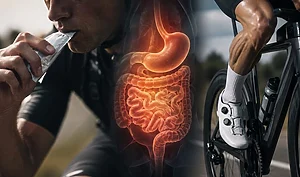
Faced with this physiological stress, the body has only one option: to adapt. It then triggers a series of mechanisms. The production of erythropoietin (EPO) increases, which stimulates the production of red blood cells. Gradually, the blood’s capacity to transport oxygen improves.
This process increases hemoglobin mass and thus the oxygenation capacity of the muscles used during effort.
In summary: the body optimizes its oxygen transport system. And for an endurance athlete, this is obviously a major lever for performance.
STEVEN LE HYARIC |

An old idea… made modern again
Altitude training is nothing new. Endurance athletes have been using it for decades, especially since the Mexico City Olympics in 1968, which marked a massive awareness of the effects of altitude on performance.
Since then, methods have been refined. The best known remains the principle of “Live High / Train Low”, which consists of living at altitude while training lower down.
The idea is simple: sleep or live at altitude to stimulate physiological adaptations related to oxygen deprivation, while performing training sessions on the plains to maintain intensity and quality in the work.
This strategy allows to increase hemoglobin mass while maintaining quality training sessions. Today, however, modern technologies allow us to go even further in reproducing and controlling these effects.
Hypoxia… without mountains
It is now no longer necessary for runners to go to Font-Romeu for three weeks or to Sierra Nevada for cyclists.
Today, technologies allow to simulate altitude directly at home or in a training room. Several devices exist: hypoxic chambers, altitude tents, respiratory systems, or hypoxia masks.
The principle remains the same: artificially reduce the oxygen concentration in the inhaled air to reproduce a virtual altitude that can reach approximately 2000 to 3000 meters.
Some studies show that these methods can improve several key markers of endurance, including increased hemoglobin and certain timed performances.

Physiological adaptations
Why is this method so appealing to endurance athletes? Because hypoxia acts at several levels of performance.
First, on oxygen transport. EPO production stimulates red blood cell formation, which allows the blood to transport more oxygen to the muscles.
Next, on muscle metabolism. The body gradually becomes more efficient in using available oxygen, which improves energy yield during effort.
Finally, on effort economy. At equivalent intensity, the cardiovascular system works less: the engine becomes more efficient.
But it’s not that simple
As often in sports physiology, the reality is more nuanced. The benefits of hypoxia depend on several factors, including exposure duration, simulated altitude, the athlete’s level, and training quality.
Some research shows, for example, that the most significant adaptations appear after at least three weeks of exposure, at an altitude greater than approximately 2000 meters.
And above all, not all athletes react in the same way. In some cases, the gains may remain modest.
The ultimate tool… or a gimmick?
The question is divisive. Some coaches consider hypoxia to be an extremely powerful tool. Others see it primarily as an interesting, but not indispensable, complement.
One thing is certain: it is not a miracle solution. Without training volume, without recovery, and without a solid work structure, hypoxia will not work miracles. But used correctly, it can provide a small physiological gain. And in high-level sport, sometimes: 0.5% more performance can change a lot of things.
Why it makes sense for ultra-endurance
For an athlete like adventurer Steven Le Hyaric, the logic is quite clear. His playgrounds often consist of very long expeditions, prolonged efforts, sometimes (and even often) at altitude, and most of the time in extreme conditions.

Optimizing the body’s ability to use oxygen over time therefore becomes a particularly interesting lever. In these disciplines, performance does not depend solely on maximum power… but also on metabolic efficiency. And this is precisely what hypoxia seeks to improve.
The real question
Ultimately, hypoxia poses a simple question. Is it necessarily necessary to train more to progress?
Or sometimes simply to train differently? As often in endurance sports, the answer probably lies somewhere in between.
What is certain, however, is that athletes continue to explore all possible avenues to push the limits of performance. And sometimes, it simply starts with a slightly crazy idea: breathing a little less… to go a little faster.
To go further=> Take a few minutes to watch Steven Le Hyaric’s video => And read this detailed article After that, you will no longer look at altitude training in the same way. |
Share the post "Hypoxia: training with a lack of air to go faster"