Share the post "Review of the 2026 Giant Propel Advanced SL: The Perfect Balance?"
With the fourth generation of its aerodynamic bike, Giant aims to push the boundaries of overall performance in the high-end segment. Lighter, more integrated, and touted as more efficient than ever, the new Propel Advanced SL is designed for both mass sprints and long days on the hills. First impressions of a bike that promises measurable gains and a systematic approach to speed. By Guillaume Judas – Photos: ©Damien Rosso, ©SterlingLorence / Giant

At Giant, the Propel has served as the brand’s pure-bred aerodynamic model for over a decade, complementing the TCR, which is more focused on lightness and versatility in the mountains. With this 2026 version, the Propel Advanced SL represents the technological pinnacle of the lineup, ranking above the Propel Advanced Pro and Propel Advanced models. In a segment dominated by increasingly fierce competition, every marginal gain becomes strategic. Giant backs up the claims with specific figures to support the evolution of a model that, let’s face it, isn’t the most eye-catching—especially in this satin white finish, the only option in the high-end catalog, even though slightly bolder color schemes are available as frame kits, notably the stunning version ridden by the Jayco AlUla WorldTour team.  The model’s history is intertwined with the rise of modern aerodynamic bikes. Launched in the early 2010s to meet the demands of the professional peloton, the first Propel made a name for itself in 2014 when Marcel Kittel won the first stage of the Tour de France and donned the yellow jersey. Since then the model has continued to evolve, incorporating disc brakes in 2018 and then expanding its range of use, ultimately demonstrating its versatility on the roads of the 2022 Tour while becoming lighter on the scale.

Stiffness: Targeted Gains on the Advanced SL Version
Giant says the announced testing protocols follow industry standards using size M frames. According to Giant, the new Propel Advanced SL now delivers bottom bracket stiffness of 84 N/mm, up from 82 N/mm on the previous generation—a 2.4% increase. Torsional stiffness has also reportedly increased, rising from 120 Nm/° to 124 Nm/°, a 3.3% increase. The fork’s stiffness has also improved by 3.4%, reaching 60 N/mm compared to 58 N/mm previously.

Giant says the Advanced Pro and Advanced models have lower frame stiffness numbers, at 77 N/mm for pedalling stiffness and 110 Nm/° for torsional stiffness, an 8.3% drop. These figures confirm the Advanced SL model’s decidedly elite positioning within the lineup—and not just because of its Shimano Dura-Ace Di2 groupset, compared to the Shimano Ultegra Di2, SRAM Force, and Shimano 105 Di2 found on models in lower tiers. As for the price, it’s obviously no exception—even if it’s very slightly lower than the competition—at €11,500. A version equipped with SRAM Red AXS (with a power meter) is also available for €12,400.
Weight: An Overall Reduction in System Weight
Giant says the unpainted Advanced SL frame in size M has dropped from 845 g to 800 g, a 45 g saving. That’s not much from one generation to the next. It’s also worth noting that to achieve this light weight, this high-end version retains an integrated seatpost system (which is not the case with lower-end versions)—a feature that isn’t entirely practical, either when adjusting the bike or when potentially reselling it. Nevertheless, Giant reports an additional significant weight reduction of 355 g thanks to a new one-piece cockpit (77 g lighter), new CADEX Max 50 wheels rated at 1,250 g compared to 1,350 g previously, and tires that have gone from 580 g to 440 g per pair.

 By comparison, the Propel Advanced Pro weighs 300 g more with the same components, while the Advanced version weighs about 1,000 g more, positioning it as a more affordable but significantly heavier option.

To be specific, our test model weighed in at 6.840 kg, including a computer mount, two bottle cages, and Garmin Rally power meter pedals, which add nearly 100 g more than Shimano Dura-Ace pedals. Who could have predicted just a few years ago that an aerodynamic bike with disc brakes like the Propel would be right on the UCI limit?
18.44 watts saved compared to the previous model
Such precision might raise a smile, but the most significant figures concern the total drag measured at +/- 20° of yaw. Linear drag would drop from 234.9 watts to 222.48 watts. Wheel-rotation drag would drop from 5.46 to 5.04 watts. Finally, rolling resistance (front and rear) would fall from 27.4 to 21.8 watts.
 Giant says the new Propel Advanced SL saves a total of 18.44 watts compared with the already quick previous generation. At 40 km/h over 40 kilometers, this would represent a theoretical advantage of 72 seconds. These results are in line with the AeroSystem Shaping concept, which involves optimizing the frame, cockpit, wheels, and tires as a single unit. The 50-mm hookless carbon rims, specialized tires, and the integrated Contact SLR Aero cockpit all contribute to this comprehensive approach aimed at reducing drag while improving lateral stability.

Modernized Comfort and Versatility
Beyond gains in stiffness and aerodynamics, the new Propel places greater emphasis on comfort. Giant reports up to 25% more vertical compliance in the rear thanks to coordinated design work on the seat tube, chainstays, and integrated seatpost. Up front, the cockpit and head tube reportedly offer 12.8% more compliance to filter out vibrations.

Slightly more tire clearance now fits rubber up to 32 mm wide, improving both efficiency on imperfect roads and stability in windy conditions.
New wheels and a top-of-the-line drivetrain
In terms of components, the Giant Propel Advanced SL features the new in-house CADEX Max 50 wheelset, with 50-mm-high hookless rims and carbon spokes integrated into the hub, paired with the new CADEX Aero tires. These top-of-the-line wheels retail for nearly €4,000, which immediately places the bike among the ranks of exceptional machines.

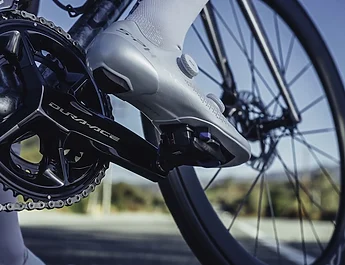
This positioning is reinforced by the inclusion of the proven and consistently reliable Shimano Dura-Ace Di2 groupset, now entering its fifth season. Another version of the Advanced SL 0, equipped with a SRAM Red groupset, is available, as are configurations featuring SRAM Force, Shimano Ultegra Di2, and Shimano 105 Di2 for more affordable and less performance-oriented versions of this new Propel.
More of a climber than a road racer?
It’s always difficult to gauge the aerodynamic gains claimed by manufacturers on the road, especially on unfamiliar roads or circuits where you have few points of reference. Before testing this new Propel, I expected a true rouleur, in keeping with the model’s reputation. But it wasn’t its pure efficiency on the flats that impressed me the most—it was its overall balance, both on climbs and descents.

First and foremost, the new Propel surprised me most with how effortlessly it handles steep climbs. On long climbs, the Propel Advanced SL feels almost weightless. The 6.8 kg recorded on the scale are noticeable with every acceleration. Thanks to the high stiffness of the frame and fork, power is transferred immediately to the drivetrain. But what stands out most is the absence of any penalizing wheel inertia on steep gradients. The new CADEX Max 50 wheelset, though aerodynamically shaped, never give the sensation of having to haul around a heavy mass. It feels as though the bike climbs with ease, without fighting against any gyroscopic effect. When riding out of the saddle, the response is instantaneous. The bike responds instantly, with precise front-end handling and a bottom bracket that doesn’t give way. You can swing the bike from side to side without the slightest delay. This responsiveness contributes greatly to the overall impression of lightness.

One minor drawback, however—more related to the build than to the frame itself—is that the relatively short cranks and fairly narrow handlebars on our size S test model didn’t quite match my usual setup. On very steep sections, I sometimes felt like I was lacking a bit of leverage, both when pedalling and when pulling on the handlebars. It’s nothing deal-breaking, but it’s definitely something to discuss with your bike shop when you buy it, so you can adjust the crank lengths and handlebar width to fit your body type and riding style.
Impressive on Descents
Where the Propel impresses just as much is on descents. The bike feels extremely secure. At high speeds, it inspires great confidence, with remarkable stability. The aerodynamic design hasn’t come at the expense of overall balance: even when exposed to crosswinds, the bike remains stable.  In a series of hairpin turns, even on rough road surfaces, it combines stability and maneuverability. It tracks precisely, responds to course corrections without drifting wide, and never feels like a struggle to control. When braking, its handling is exemplary: no wobbling, no sudden weight transfer. The frame stays perfectly on track, further enhancing the feeling of safety.

Paradoxically, it was on the terrain that should be its forte that the Propel left me the least impressed. On the flat, it’s undeniably fast, but it offers a bit less excitement than I expected from a pure aerodynamic bike. Perhaps this is precisely because of the wheels, which are very light and very responsive, but lack just a touch of positive inertia to maintain speed once you’re up and going.
I also wasn’t entirely convinced by the stock tires. While they clearly contribute to the overall rolling resistance savings claimed by Giant, I found them to feel a bit less “smooth-rolling” than models with softer cotton sidewalls. Again, this is more a matter of feel than measurable performance, but on a bike of this caliber, every little detail counts.

At the WorldTour level
Ultimately, this new Propel Advanced SL easily ranks among the best bikes on the WorldTour. It’s no longer just a pure rouleur’s bike: it now stands out for its versatility and that clever blend of lightness, stiffness, and stability. And undoubtedly its aerodynamics, if the highly precise figures provided by Giant are to be believed. It may even be this well-rounded performance that impresses the most. Rarely has an aero bike felt so at home in the mountains, while still commanding on descents and high-performing on the flats.  Aesthetically speaking, this satin white version lacks a bit of personality for my taste to really stand out from the crowd. Others, on the other hand, will appreciate this elegant, almost clinical simplicity. It’s a matter of personal taste. Finally, in terms of price—listed at €11,500—it falls toward the lower end of the range for top-of-the-line bikes used by professionals. That pricing aligns with its performance and confirms that this Giant Propel Advanced SL is now much more than just an aerodynamic bike. So much so that one might wonder whether Giant’s other top-of-the-line model, the TCR, is still justified.
The GIANT PROPEL ADVANCED SL 0 at a glance…Pros: weight, stability, overall balance Cons: short cranks and narrow handlebars on size S, color scheme a bit too subdued Frame: Propel Advanced SL Grade-Composite – Fork: Propel Advanced SL Grade-Composite – Wheelset: CADEX Max 50 – Tires: CADEX Aero 700x28c tubeless – Crankset: Shimano Dura-Ace 52-36 – Rear derailleur: Shimano Dura-Ace Di2 12-speed – Shifters: Shimano Dura-Ace Di2 12-speed – Brakes: Shimano Dura-Ace Disc – Cassette: Shimano Dura-Ace 12-speed 11-30 – Handlebar and stem: Giant Contact SLR 0 Aero – Seatpost: Advanced SL-grade composite, integrated design – Saddle: CADEX AMP – Extras: computer mount and bottle cages included Weight: 6.530 kg in size S without pedals (with bottle cage) – Sizes: 6 – Price: €11,500 – Contact: giant-bicycles.com Other models in the lineup:Propel Advanced SL 0 (RED): Propel Advanced SL frame, SRAM Red groupset, CADEX Max 50 wheelset, €12,400 |

Share the post "Review of the 2026 Giant Propel Advanced SL: The Perfect Balance?"