Share the post "Why Everyone’s Talking About Zone 2 Cycling"
There was a time when people simply said: “I’m going to build my base.” Today, we say: “I’m going for a Zone 2 ride.” Same ride. Same pace. But with power displayed on the Garmin, a graph on TrainingPeaks, and a physiologist in the evening podcast. For several years now, Zone 2 (Z2) has become the new mantra of cycling training. It’s found everywhere: in training plans, club discussions, YouTube videos, and even in the training of the peloton’s stars. But what exactly is Zone 2? Why do pros do so much of it? And why is this “easy” intensity actually the foundation of performance?
By Jeff Tatard – Photos: All rights reserved
Zone 2: Riding fast… without looking like you’re trying hard
Zone 2 corresponds to a low aerobic intensity, meaning an effort that can be sustained for a long time while remaining relatively comfortable. In practice, this corresponds to approximately 55 to 75% of FTP, 65 to 75% of maximum heart rate, with controlled breathing and the ability to hold a conversation. This is the famous “talk test”.
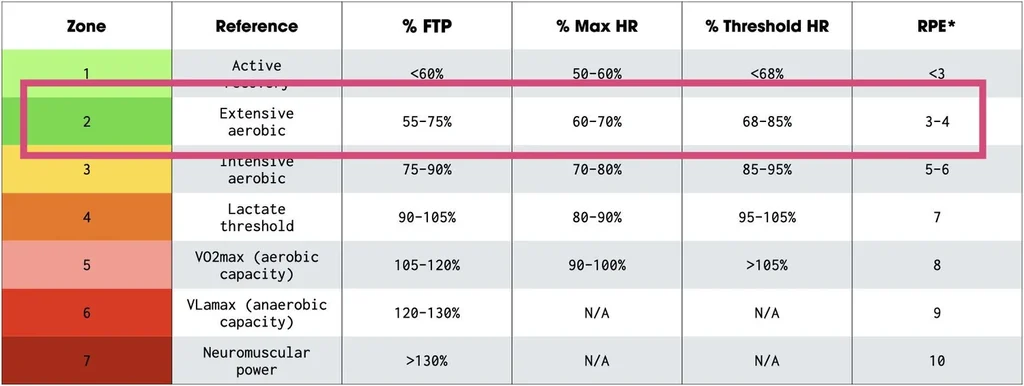
If you can discuss politics, nutrition, or tire pressure without gasping for breath, you are probably in Zone 2.
Concrete example:
| Level | FTP | Zone 2 |
| Trained Amateur | 270 W | 150–200 W |
| Elite Amateur | 320 W | 180–240 W |
| WorldTour Pro | 420 W | 260–320 W |
Yes, you read that right. When Tadej Pogačar rides casually in Zone 2, he develops more power than most amateurs at full gas.
The cyclist’s invisible engine
Why is this moderate intensity so important? Because it works on the physiological foundation of the engine.
Riding in Zone 2 develops several fundamental adaptations. First, mitochondria, the true energy powerhouses of cells. The more numerous they are, the longer the muscle can produce energy sustainably. Next, fat utilization. Zone 2 teaches the body to burn more lipids, which allows glycogen sparing. In short: you can ride longer before “hitting the wall”. It also promotes muscle capillarization, meaning a denser network of capillaries that improves muscle oxygenation. Finally, it improves lactate control: the body becomes capable of recycling it more efficiently.
Result: you can go faster for the same energetic cost.
The (not so secret) secret of the pros
Contrary to what one might imagine, pros don’t spend their days attacking in the mountains. The majority of their training is calm and very consistent. The most widespread scientific model is polarized training, popularized by physiologist Stephen Seiler. For pros, this often represents 20 to 25 hours of training per week, the vast majority of which is in Zone 2. A classic training ride can thus last 4 to 5 hours, with stable power, moderate intensity, and a few targeted efforts.
In summary: pros spend a lot of time building the engine, and relatively little time pressing the accelerator.
The Pogačar case (or the scary Zone 2)
Physiologist Iñigo San Millán, who has worked with Tadej Pogačar, strongly emphasizes the precision of metabolic Zone 2. For a rider of this level, an “easy” ride corresponds to a power output roughly between 270 and 320 watts, and sometimes more. Yes: what is an easy ride for him often corresponds to the intensity of a fast sportive for many amateurs. But the key is not absolute power. It’s the relative intensity for the body.
The classic amateur mistake: the gray zone
Most amateur cyclists often ride in the wrong physiological zone. Not easy enough to build endurance. Not intense enough to stimulate performance. This is called: the “gray zone”. This intermediate intensity causes a lot of fatigue… but develops little. It’s exactly the opposite of what pros do.
How much Zone 2 should you do?
It all depends on the available volume. For an amateur:
| Level | Z2 Volume |
| Beginner | 1-2 h |
| Trained Amateur | 2-3 h |
| High-level Sportive Rider or Competitor | 3-4 h |
One long Zone 2 ride per week can already make a huge difference. The key is simple: consistency.
The truth behind the myth
Zone 2 is not a revolution. It’s simply the modern rediscovery of base training. What the old-timers already did very well, without power meters or scientific podcasts. They called it: ”putting in the kilometers, building the engine, riding at a steady pace”. Today, we talk about mitochondria and lipid oxidation, but the principle remains exactly the same. Power meters have simply made it possible to precisely control the intensity of an effort and stay in the correct physiological zone.

In summary
Zone 2 has become popular because it corresponds to what the world’s best cyclists actually do. It allows for developing endurance, improving metabolic efficiency, pushing back the threshold, and recovering faster.
In short, building the engine. And as an American coach said: “Zone 2 builds the engine. High intensity teaches it how to race.”
So, the next time you see a rider cruising quietly at 200 W with a knowing smile… they might simply be building something much more serious than it appears. And meanwhile, somewhere north of Monaco, Pogačar is probably riding in (the beginning of…) Zone 2… at 330 W.
=> To go further, listen to this Podcast with a dense, accessible, and extremely insightful exchange from Stephen Seiler
Share the post "Why Everyone’s Talking About Zone 2 Cycling"