Share the post "Federico Musi: holding the line, from the LOOK P24 to Nevers"
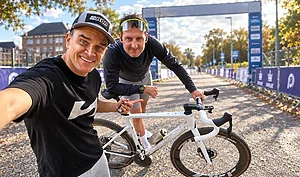
The empty track, the naked truth. The velodrome was empty. Not almost empty. Empty. On a Wednesday evening around 10:30 PM in Saint-Quentin-en-Yvelines, light slowly faded on the 250 meters of blond wood. Without an audience, the Olympic track seemed vaster, the turns steeper, almost dizzying. You could hear everything: the tubular tire sliding on the black strip, the regular breathing, the dry tension of the fixed chain. In the silence, every trajectory becomes a confession. We were alone. Two bikes. Two shadows. Two lines. Even before he spoke, there was his way of riding. And when he speaks, there is that Italian accent, light but distinct, from Vicenza, birthplace of Campagnolo, a musicality that smooths the edges and places words with precision. Not a decorative accent, an accent that tells of an industrial culture, a European history of cycling, an inherited demand. On the track, his pedaling has the same signature as his voice: composed, structured, without excess. Federico Musi was riding in front of us on the LOOK P24, the bike for the Paris 2024 Games. Compact. Dense. Precise. There was nothing ostentatious in his way of occupying the curve, no unnecessary gesture, no tension. Just that almost clinical fluidity in the turn entry, his gaze fixed far ahead, shoulders low, the machine not suffering, but accompanying. At that moment, we didn’t see a CEO who came to test an iconic product. We saw a man who understands the intimate mechanics of the gesture. And that nuance changes everything.
By Jeff Tatard – Photo credits: © LOOK
Being an athlete is not an activity. It’s a mental structure
In the silence of the track, this question came to us naturally: how to maintain such physical discipline when leading an industrial group, exposed to market tensions, raw material volatility, pressure from financial results and overall performance? He doesn’t seek effect. He doesn’t read a prepared answer. He responds directly: “Being sporty is a state of mind. Being an athlete is a state of mind.”
The phrase might seem simple. In reality, it is fundamental. For him, sport is not a hobby, nor a break. It is a mental architecture. A way of thinking, of structuring effort, of managing complexity, of making choices. “You need a vision, a strategy to get there, and execution.” The word returns: execution. In sport, it’s the medal or the stage victory. In business, it’s sustainable performance, consistent decisions, the ability to absorb shocks, to bounce back, to persist.

He speaks of resilience, rigor, and energy with lucid clarity. “Sport is at the center of my life.” Not as a hobby, but as a nervous system. He practices several disciplines. He rides whenever he can, maintaining this physical connection to movement. “It helps me mentally and physically.” And then he adds a sentence that one is surprised to reread almost twice: “Performance is largely mental. Physical qualities can make a difference, but they are not enough to become a true champion.” We then understand that, for him, leadership is primarily a matter of mindset.
Leading a passionate brand
LOOK doesn’t sell screws or mechanical bricks. LOOK sells desired objects. Objects that enter lives. That evoke emotions. That tell a story when placed on their workshop stand.

We ask him if his personal practice influences product decisions. He remains humble. “There are people more expert than me in engineering.” But he refuses to delegate strategy 100%, because, he says, it’s not just engineering. It’s about relationship. It’s about emotion. “It’s my philosophy.” Then he utters a sentence that sums it all up: “We sell passionate products. A frame, a pedal, it’s like a musical instrument.” An instrument is not chosen only for its characteristics. It is chosen for the relationship it creates. It tells of a connection between the cyclist and their machine. The designer and the user. Technology and human.
He doesn’t ride like a professional, he says, but he knows why a bike is chosen. “Understanding why a product is bought is very important.” It is this link between emotion and decision that, according to him, makes strategic choices more natural. On the track that evening, he wasn’t playing a role. He was inhabiting his product.

1984: the rupture that obliges
It’s impossible to write this portrait without returning to 1984, a foundational year for LOOK. The invention of the clipless pedal remains an emblematic rupture in the history of cycling equipment.
One can cite indexed gears, carbon, deep-section wheels, electronic groupsets from Shimano, Campa or Sram. But if you ask enthusiasts what truly changed the sport, the answer always comes back to the clipless pedal. “The clipless pedal truly changed the sport.” Optimized power transmission, increased stability, enhanced safety, direct connection between foot and machine: a new way of pedaling, a new way of racing.
But heritage can be a cage as much as a ramp. “Heritage must be a strength.” Hinault, La Vie Claire, the 1996, 2000, 2004 Olympics and so on, Jalabert, then Cofidis today. On the track, the French team generation after generation, Benjamin Thomas and others. “Every new technology is associated with a champion.” Technology only lives if it wins. It doesn’t impose itself through discourse, it imposes itself through victory.

To read also on 3bikes
First ride on the Olympic track and P24 testBefore meeting Federico Musi, we took the time to ride on the Olympic track of Saint-Quentin-en-Yvelines with the P24. A raw immersion in the speed, rigidity, and extreme precision of a bike designed for the Games. => Read the full story |

Nevers: the courageous industrial choice
We talk a lot about design, aerodynamics, CFD. We talk less about the smell of the workshop, the machines, the production lines, the workers and technicians. In Nevers, 90% of LOOK pedals are produced. Plastics, heat treatments, dimensional control, fatigue tests: every axle, every spring, every interface is checked, measured, optimized.
In a world where production is often outsourced to the other side of the globe, maintaining an industrial core in France is not economically neutral. It’s more costly. It’s more complex. It’s more exposed. But it’s a strategic choice.
“Knowing the supplier, auditing the supplier, working with close partners provides flexibility.” Technical flexibility, strategic flexibility, human flexibility. In a cycling market that has gone through major tensions—post-Covid boom, component shortages, overstocks, brutal demand contraction—having local industrial control becomes a differentiating advantage.

This is not a patriotic flag waving. It is a lever for adaptation, quality, and responsiveness. On frames, the logic changes but the tension remains. The P24 is not derived from a road frame: it is an extreme project, designed for extreme use. Specific layup, very high modulus fibers, complex trade-offs between maximum rigidity and optimized aerodynamics. “The balance of rigidity / aerodynamics / comfort is not the same on a track frame as on a road frame.” Some fibers used come from very advanced technological fields, rarely employed in consumer cycling. “We worked with very specific fibers to achieve the characteristics we wanted.”
We then understand that lighter is not always synonymous with better: more coherent often is. Precision has become an industrial morality.

Vicenza, France and the European thread
When we mention Vicenza, his hometown, and Campagnolo, Federico’s smile is discreet but genuine. Two European brands LOOK & Campa that changed cycling forever: one revolutionized transmission, the other the connection to the bike. Today, these two cultures intersect at Cofidis. It’s not simply a commercial agreement. It’s a bridge between two industrial legacies that echo each other.
Italy, France, World Tour: two industrial cultures, a common obsession with detail. There is something profoundly European in this way of approaching performance: mastery of material, respect for the gesture, transmission of know-how. When the French track team rides LOOK, when Cofidis lines up French frames and Italian groupsets, it’s not a simple product configuration: it’s a cultural continuity.
Federico doesn’t romanticize this story; he structures it. He explains it, he documents it, he embodies it. But he knows that this history obliges: not to betray the heritage, to remain relevant, to evolve without losing identity.

Gravel: mutation or continuity?
The market is evolving. Gravel is gaining ground. A logical extension of road cycling, an autonomous discipline, organized chaos? Federico responds with nuance: “Our goal is to be present in all segments.” On the pedal side, LOOK wants to cover the entire spectrum of practice to remain a global leader. On the frame side, the road DNA permeates gravel: controlled rigidity, intelligent comfort, relevant carbon design.
Customers migrate, LOOK accompanies them. Performance and adventure are not opposed; they complement each other. Gravel is a response to a contemporary aspiration: to explore, to dare, to prolong the gesture, to extend the pleasure. “There is room for both demanding performance and carefree enjoyment on a bike.” It’s a way of thinking about cycling without compartmentalization.
Can cycling still be revolutionized?
The question is posed. Can a rupture of the same magnitude as 1984 still be provoked? “Today, innovations are more marginal.” Marginal does not mean weak, but incremental. Gains are made in optimization, in global coherence, in continuous improvement.
Spectacular revolution is rare. Permanent progression is daily. The true modern rupture is perhaps organizational: attracting different talents, structuring differently, adapting to a volatile world. LOOK is not trying to make noise. LOOK seeks to endure. And to endure, one must learn as much as invent.

What a young person should feel
We talk to him about childhood, about those moments when one dreamed of a LOOK as an accomplishment, a silent grail. He answers without hesitation: “The same joy as for their first bike.” An object one looks at before sleeping, touches, keeps in their room. “One must feel that they have bought a beautiful, high-performance product, with a history.” He doesn’t talk about market share. He talks about magic. About that intimate connection between an individual and an object that makes sense.
The finish line
Night has long since fallen. The wood reflects a cold light, the lines appear sharper, more cutting. Federico stops at the top of the curve, the P24 suspended at an angle, motionless. The silence is total. He looks at the black line. He doesn’t speak.

In that moment, there is no more strategy, no more economic tension, no more discourse. There is only a trajectory. Perhaps everything comes down to this: holding the line. Holding the line in an unstable market. Holding the line against global competition. Holding the line between heritage and innovation. Holding the line between passion and profitability.
He descends. The wheel brushes the black strip. And in the silence of the empty velodrome, we understand something simple and rare: at LOOK, performance is not a slogan. It is a responsibility. On 250 meters of wood, everything is visible. And that night, nothing was forced. He held the line.

=> To better understand the LOOK range: LOOK WEBSITE
=> If you want to relive our experience with the P24
=> And here, if you want to discover all our other portraits: All our Portrait articles
Share the post "Federico Musi: holding the line, from the LOOK P24 to Nevers"