Share the post "Raphaël Dalle: The man who makes shoes talk"
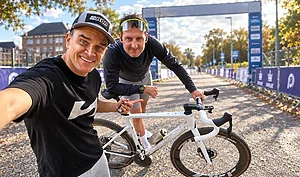
There are video calls where you just tick boxes. And then there are those where, from the very first minute, you feel like you’ve just opened a door to an invisible workshop, a place where performance is crafted in silence, down to the millimeter, by instinct… and with rigor. This afternoon, it was the second category. Camera on, Southern light, an accent that smells of hot asphalt and roads that know no winter truce. Raphaël Dalle is there, in the Var region, in this “land of cycling” that he claims with the same fondness as a Northerner talks about the Carrefour de l’Arbre. He has that honest gaze: that of people who have spent more time observing how things are done than explaining how they should be. And very quickly, without even needing to press “record,” he starts pulling out the pieces.
By Jeff Tatard – Photo credits: © Giro
Not slides. Not bullet points. Shoes.
One by one. As if we were flipping through a photo album, except here the memories have a sole, a tongue, a material, a smell of prototyping. For 1h30, Raphaël shows us the models he has worked on, over the years and continents. The Babolat. The Decathlon. The Adidas… and especially, that one: Messi’s shoe.
Yes, you read that right… Lionel Messi’s shoe. The kind of object that, for some, is worth a display case. He keeps it as proof, not of glory, but rather a responsibility. At the time, he was at the heart of the mechanics: sending Lionel Messi the pair straight from the factory, ensuring it arrived perfect, being the filter between the genius on the field and the realities of a million pairs a month. “When you send a pair to Messi, you can’t afford to be approximate. Every millimeter counts.”
And then, as if that wasn’t enough, he tells us the scene that sums up his entire character: one day, he takes a laceless, BOA-less model, something from another world… and “converts” it into a cycling shoe. In one week. With holes made by hand to insert cleats. Just to test the transferability of an idea. “I wanted to see if the intuition held up. So I drilled it.”
We smile. And we understand: Raphaël is not just “the head of the shoe range at Giro.” He is a transmitter. A translator. Someone who carries performance from one sport to another, and comes back with unexpected solutions. And that’s exactly why this portrait is worth more than a CV.

The journey: an engineer who couldn’t stand “the engineer”
His LinkedIn is atypical, yes. But above all, it tells of an obsession: understanding reality. Raphaël started in the North of France, a “classic” engineering school, with strong ties to Decathlon. The path could have been linear: headquarters, projects, validations, meetings, a nice office, prototypes arriving, reports leaving. Except that for him, it was stifling.
He says it bluntly: he can’t stand the idea of being a “go-between“, that role between designer and factory where you don’t feel like you’re adding value. He wants to see, touch, understand how a product is really made. So he does what few do: he leaves. Asia, first China. Canton. Two years on tennis shoes, alone on site, bridging the gap between the Lyon headquarters and the factories. Every day. The factory isn’t a concept, it’s his daily life.
Then Vietnam. Adidas football. There, the scale and pressure change. At Adidas, it’s not “a brand,” it’s an industry: 1,300,000 pairs a month in his factory. Thirteen million a year. And he, in charge of production. It’s huge. And paradoxically, that’s where he learns the detail.

At Adidas, they want to control everything. And when you control everything, every micro-decision counts: a material, a seam, a bond, a tool, a protocol. It’s “design for manufacturing“ in its purest sense. A discipline that forces you not to dream unrealistically. And in the middle of all that, there’s Messi. Raphaël works on the player’s “signature” models. He talks about this “athlete service” as a culture: doing everything to satisfy the athlete, then bringing the demands down to accessible products. The elite as a laboratory, but also as a compass. Vietnam is also a life: his wife, a child born there, then that moment when you tell yourself it’s time to go home “to experience fatherhood” with loved ones.
Back “home”: Decathlon, Lille. And there, a new learning loop: rugby first (a natural bridge with football), then running. And with each sport, a truth: the development method has common bases, but the demands change in nature.
- Tennis: abrasion, lateral support, lightness.
- Football: ball touch, dynamism, grip depending on field conditions.
- Running: comfort, resistance, support, dynamism, immediate feel.
The same object: a shoe. But different worlds.
What is being built here, without him yet explicitly stating it, is a mental library. A living database of innovations, sensations, compromises, and solutions. And the more we listen to him, the more we understand that he doesn’t collect brands. He collects principles.

The shift: aiming for the highest level
After a few years, Raphaël wanted something else: to get closer to the highest level. Not for the hype, but for the intensity of the feedback, the speed of learning, the truth of the bodies.
He joins Ekoï (at a time when shoes were not yet a strong “proprietary” product) and builds the range. He summarizes these years with brutal simplicity: “You create, you test, you adjust, you fail, you start over.”
With athletes, demands, concrete results. And above all: he finally connects his passion (cycling) to his profession (shoes). Then Giro arrives. A year and a half ago. And it’s obvious: he has found a playground that matches his obsession.
Giro: heritage as a guideline, performance as a flame
At Giro, many first think of helmets. But for us, listening to Raphaël, it becomes clear that his territory is elsewhere: the foot, the contact, the transmission.
He is very clear: he does not manage the helmet division. He exchanges, observes, shares, but his field of action is footwear. And that’s where everything becomes fascinating.
Giro is a strong heritage, a classic, clean, elegant visual identity. No flashy logos. No showboating. A form of controlled restraint. But behind this sobriety, there is a constant desire to push the performance boundaries.
Raphaël summarizes his product engineer philosophy with a phrase that says it all: “Make the most performing products possible with the most classic design possible.”
For us, this sentence is a key to understanding. It’s not about breaking the DNA. It’s about respecting it, while taking it further. “We must honor the brand’s heritage, but each new product must be better than the previous one.”
What we understand is that his work is a permanent equation:
|
And it is in this balance that Giro’s singularity is built.

The invisible part of the iceberg: where everything happens
We talk to him about the “seven-hour leg of lamb”: the customer comes to eat, not to be told about the cooking process. In cycling, it’s the same: we consume happiness. We see a pair, we wear it, we judge. Period. But behind it, there’s the iceberg.
And Raphaël chooses an example that almost no one suspects: the last. This plastic form, the “last,” is not just a tool, it’s the basis of the volume, the anatomical signature of a brand. Some people immediately feel better in one brand than another without knowing why. The answer is often there. “The last is what determines whether the foot feels at home or not.”
At Giro, this becomes a permanent challenge, because the range is not based on a single construction: synthetic leather, mesh + TPU, ultra-thin structures, variable thicknesses, different foams, multiple closure systems. And yet, an almost sacred requirement remains: to guarantee the same last shape across the entire range.
This means working at the detail level. Adjusting 1 or 2 millimeters of foam to move the foot forward or backward, modifying a high point to prevent a tongue from cutting into the ankle, designing asymmetrical constructions so that the closure wraps the foot instead of compressing it. “A millimeter can change everything.”
It’s product micro-surgery. And we think back to those rides where discomfort appears without clear explanation: a pressure point, lateral tension, a floating sensation. Raphaël knows exactly where it hides. And above all, he knows how to track it down.

The process: prototypes, loops, tests… and the truth of the field
When he talks about development, everything seems almost simple. A clear, almost mathematical sequence: a design, a prototype, a test, feedback, a modification… and you loop until it’s right. “We make, we test, we correct. And we start over until it really works.” What changes is not the formula. It’s the rigor of the system.
At Giro, tests are not a formality. There are several levels of evaluation: fitting, where the obvious is immediately captured, it works or it doesn’t; usage, over one or two weeks, with long rides and structured feedback; then durability, over three to six months, where time reveals weaknesses, breakage, wear, delamination, material aging.
And there’s this constant obsession: tests are the absolute priority. “If the field doesn’t validate it, the product doesn’t come out.” This isn’t a stance. He lives in the Var, surrounded by cyclists who ride all year round, 20,000 to 30,000 kilometers a year. Some validate a shoe in two weekends, 250 kilometers swallowed almost effortlessly. The feedback is fast, massive, real.
And he drops an almost counter-intuitive truth: even entry-level models are validated by extremely demanding testers. “We can adjust expectations, but not the level of demand.” A rider accustomed to a double BOA full carbon won’t judge a laced nylon sole in the same way, but the basic principle remains intangible: no problems, no major discomfort, no structural weakness.
Then comes the lab. Tensile machines. Torsion. Compression. Mechanical tests. Historical protocols. And also the future: instrumentation, biomechanics, measurement of plantar pressure. “The ideal is to prove that the new model is better than the previous one, scientifically.”
He gives an example that sounds like a promise: demonstrating a 10% increase in foot/sole contact thanks to an adjusted profile. Here, it’s no longer a sensation. It’s a number. And when performance becomes measurable, it becomes irrefutable.
The trade-offs: the beauty of a product is what it hides
The most beautiful thing about his discourse is that he never romanticizes the profession. He explains it. Development is not a solitary intuition; it’s a perfectly tuned orchestra: design, engineering, production, merchandising, factories, planning, target price. “Our role isn’t just to have ideas. It’s to align everyone.”
Every technical decision has an industrial consequence. Every aesthetic choice must respect a target price. Every improvement must fit into a schedule. “We must guarantee usage, keep to the schedule, and deliver at the right price. If one of these three pillars falls, the product falls.” We then understand that the product engineer is not just a material expert. He is the orchestra conductor of intelligent compromise.

His role, that of the product engineer, is twofold. On one hand, improving the product, materials, technical solutions, construction. On the other, managing the project, aligning teams, keeping to the schedule, delivering at the target price. “We must be both technical and an orchestra conductor.”
At Giro, the operation is almost geographical. A development team based in France, between the US and Asia. Days begin with the factories, Vietnam, Thailand, China, to advance prototypes and resolve technical points. Then the United States wakes up, design takes over, files evolve. When Europe sleeps, modifications continue. In the morning, updates go back to Asia. “We never lose a day. The project moves forward while others sleep.”
It’s a 24-hour relay, structured, fluid, almost surgical. A continuous chain where the product never stops evolving.
Athletes: not to make “athlete products,” but to accelerate the truth
One might think that pros dictate the product. Raphaël sets things straight: products are made for customers. Athletes are not the center, they are an accelerator. “We don’t develop for pros. We develop for our customers. Pros help us go faster.”
Why? Because they have an exceptional attention to detail. And especially because they ride six hours a day, in conditions of maximum performance. That volume is irreplaceable. He cites Paul Seixas. His value is not due to his age, but to his level of demand and his volume of work. “What a rider feels in six hours, an amateur takes weeks to discover.”
A detail that bothers a sprinter like Biniam Girmay in the last 500 meters may seem invisible to the general public. But once adjusted, the entire range benefits.
He shows a prototype: a shortened tongue, with small reinforcements, because some pros prefer this sensation. It’s not a whim, it’s information. And in this detail, we already see the future: an “elite” adaptation that could become a general public solution in the 2028 models.
The elite is not a privilege. It’s a microscope.
The Giro moment: four models, one sole, and a simple idea… that changes everything
At one point, Raphaël mentions what he can bring to the pros: a consistent range. “We can arrive with four versions, all on the same sole.”
Four models, a common base, so no cleat hassle. Ventilated version, lightweight version, more closed and cleanable version, all-season version. Different “flavors,” but identical architecture. It seems simple. In reality, it’s a formidable strategy: offering choice without creating chaos. Maintaining technical consistency while adapting usage.
Then he slips in an almost paradoxical truth: the ultra-ventilated version is undoubtedly the ultimate product… but not necessarily the best-selling. “Real life is rain, mud, Sunday cleaning.”
Riding in the rain, washing the pair, setting off again the next day. That’s the reality. His job is to never forget it.

The shoe he is most proud of: radical simplicity (and a killer price)
And then comes his model. The one he wears the most. The one arriving in spring, around €120–125, and which will replace, in the collective imagination, a model perceived as more high-end.
The twist? The lacing.
At a time when a laced shoe has almost become a luxury at €350, returning to this system is almost a strategic counter-move. Yet, it is the most simple, most effective, most accessible, and undoubtedly the most universal mechanism. “Lacing is basic. But basic doesn’t mean low-end.”
He talks about the internal struggle: established codes, market habits, the idea that entry-level “must” look like this or that. “We can make it beautiful, performing, and accessible. There’s no rule that forbids it.”
This is where his definition of innovation becomes clear: it doesn’t always consist of inventing a futuristic object. Sometimes, it consists of returning to an old gesture, making it consistent with modern construction, integrating it into an architecture designed for performance.
He describes this white pair, elegant, almost traditional in its aesthetics, but entirely designed in the Giro DNA: heritage in form, precision in construction, consistency in price. “If it’s right, it doesn’t need to do too much.”
We already see it as a simple shoe, but never simplistic; a pair you can ride every day without guilt, a shoe that gives meaning back to the price, and that proves accessibility and demanding standards are not incompatible.
Raphaël, or the art of transmitting passion (all the way to the factories)
Last part, more human.
We talk to him about storytelling, heritage, about this “genesis” that one doesn’t necessarily need to consciously know to love a brand, but which acts in the shadows, in the collective unconscious. How to maintain this flame when some teams are far away, sometimes on the other side of the world, without always sharing the same channels or rhythms?
His answer lies in a simple idea: passion is cultivated. “You can’t make a good product without loving what you do.” For him, it starts with recruitment: passionate, committed profiles, connected to real usage. Then it extends to the field: riding together, testing together, experiencing the product differently than behind a screen. “The teams need to feel what the customer feels.”
And above all, sharing. Sharing victories, images, successes. When the shoes win, the information doesn’t stay at headquarters. It goes down to the factories, to the developers in Asia. “They need to see that what they make performs at the highest level.” Performance then becomes collective. And the heritage, living.

He recruits passionate profiles. He rides with his teams. He creates moments where the product is experienced for real, far from screens and technical files. And above all: he shares.
When an athlete wins with their shoes, the photos don’t stay confined to marketing or headquarters. They go to the factory, to the developers in Vietnam, to the teams in Asia who work at the pace of the machines. “Look, your products are winning. That’s huge.”
This gesture is not insignificant. It transforms a production chain into a chain of pride. “They need to know that what they make has an impact.”
And perhaps that’s where the true secret of a good product lies: it’s not just about technical specifications, it’s about women and men who feel proud of what they create.
What we learned at 3bikes (and why it’s inspiring)
Ultimately, this portrait is not of a “star designer” or a “flashy manager.” Raphaël Dalle embodies another school.
- The school of the field; the factory, the test, the sweat, the reality.
- The school of detail; 1 millimeter, a foam, a high point that changes everything.
- The school of process; loops, rigor, validation, proof.
- The school of shared passion; from the laboratory to the end of the chain.
“If the product is right, it’s because everyone has done their part.”
It’s not a spectacular vision. It’s a demanding vision. And profoundly consistent.

And above all, he possesses this rare ability: connecting worlds.
The tennis, the football, the running, the rugby, the cycling. The factories and the athletes. The heritage and the innovation. The very high level and the entry-level. The beautiful and the efficient. The classic and performance.
“Everything is transferable, if you truly understand the need.”
He doesn’t just design shoes. He builds a bridge between what the foot feels and what the bike can finally transmit.
Yes, Giro will long be associated with helmets in the collective imagination. But if, in the spring, a white laced shoe around €120 passes us by, with that simple yet perfectly right look, we will have to remember this video call.
Remember Messi, the hand-drilled holes for cleats, the prototype loops, the adjusted millimeters, the nights between Europe, Asia, and the United States.
Remember this developer based in the Var who set himself an almost crazy mission: to understand, better than anyone, what a cyclist expects from a shoe.
“If the foot is confident, everything else follows.”
And listening to him speak, it becomes hard not to believe it.
=> To better understand the Giro range: GIRO WEBSITE
=> And here, if you want to discover all our other portraits: All our Portrait articles
Share the post "Raphaël Dalle: The man who makes shoes talk"