Share the post "Cyclists: traffic laws to respect when riding in a peloton"
Riding two abreast, organizing a peloton, facilitating car overtaking… On open roads, sporting cyclists are subject to the same Highway Code rules as other road users. With the resumption of club rides and long-distance rides, here are the legal obligations to know to avoid fines and preserve the image of cyclists in a peloton.
By Guillaume Judas – Photos: depositphotos.com
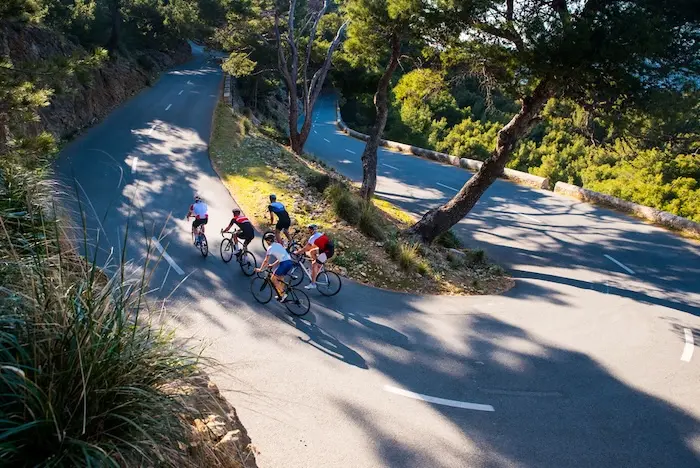
As spring approaches, road safety returns to the forefront of many road users’ concerns. Because on the roadway, sharing space remains a sensitive issue. Contrary to popular belief, the Highway Code does not apply only to car drivers. It governs all road users: motorists, motorcyclists… and cyclists. On a bike as well as behind the wheel, everyone must respect specific obligations to ensure everyone’s safety.
The Highway Code also applies to cyclists in a peloton
In France, the Highway Code does not distinguish between “leisure” cyclists and “sporting” cyclists. Whether you ride solo or in a group during a training ride, you are legally considered a driver. Result: any offense committed on a bike can result in a fine of €135, or even other penalties depending on the severity.
Riding two abreast: what the law says
The question often comes up in clubs: can two cyclists ride side-by-side? Yes, but within a strict framework set by Article R431-7 of the Highway Code:
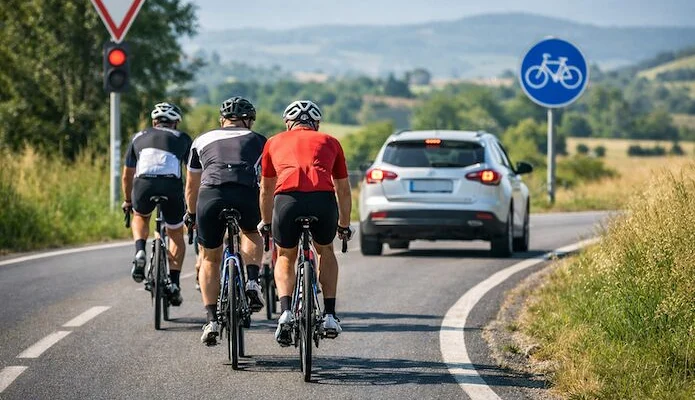
- Maximum two cyclists abreast
- Obligation to form a single file as soon as a vehicle wishes to overtake;
- Forming a single file at nightfall;
- Close positioning so as not to unnecessarily occupy the width of the roadway.
A group that spreads across the entire lane or deliberately delays moving into single file is liable to a fine. Possible fine: €135 for a cyclist in case of non-compliance.
Peloton of more than ten cyclists: it is recommended to split the group
Another often ignored but common-sense rule: beyond ten cyclists, a peloton must be split. The objective is clear: avoid forming a block that is too long and difficult to overtake, especially on narrow or winding departmental roads. In practice, this means leaving enough space between two groups to allow motorists to merge safely.

Trajectory and positioning: beware of competition habits
Certain practices from racing can cause problems on open roads:
- Cutting corners by crossing the median line;
- Riding continuously in the middle of the roadway without necessity;
- Performing disorganized relays that widen the group;
- Zigzagging during position changes.
On a road shared with cars, these behaviors can lead to fines and, more importantly, create dangerous situations.
Red lights, stop signs, and right-of-way: (almost) no exceptions for bikes
Even when exerting themselves, cyclists must respect:
- Red lights (except when an M12 sign authorizes passage after yielding);
- Stop signs;
- Right-of-way rules;
- The direction of traffic in roundabouts.
A visible peloton has no special exemptions.
Earphones prohibited: an often overlooked rule
Wearing earphones or headphones is prohibited for all drivers, including cyclists, since July 1, 2015. On open roads, hearing a vehicle approach from behind is essential for moving over quickly and respecting Highway Code rules in a peloton.
Safe distance: motorists’ obligations
Responsibility is shared. When overtaking, a driver must respect:
- 1 m minimum in urban areas;
- 1.50 m outside urban areas.
Failure to respect this safe distance can result in a fine of €135 and points deduction.
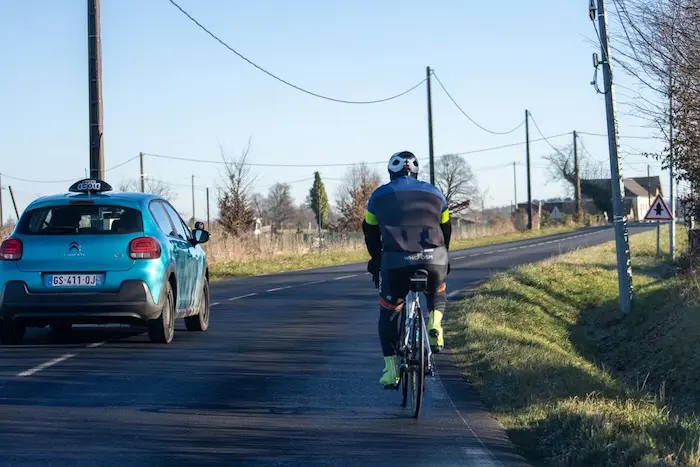
When overtaking, several reflexes are essential:
- Activate the left turn signal,
- Reduce speed,
- Maintain a sufficient lateral distance,
- Activate the right turn signal before moving back.
If the road is too narrow, it is better to wait than to force your way through. Honking to intimidate a cyclist is not only useless but can also worsen the situation.
Note that since 2015, a motorist can cross a continuous white line to overtake a cyclist if visibility and safety conditions are sufficient. This measure aims to prevent overly close overtakes.
Are cycle paths mandatory for a sporting cyclist?
Contrary to popular belief, cycle paths are not automatically mandatory. A cyclist can ride on the roadway, except when a blue circular sign explicitly mandates the use of a compulsory cycle path. These cases remain a minority on most roads, even in urban areas.
A simple principle: mutual respect
Ultimately, the Highway Code is based on a logic of shared responsibility. Cyclists must adapt their behavior to traffic conditions. A structured, disciplined group that facilitates overtaking and respects Highway Code rules contributes to the safety of its members and preserves the reputation of road cycling. On open roads, performance never exempts one from respecting the law. Motorists, for their part, must take into account the vulnerability of cyclists. When it comes to road safety, everyone has a role to play.
FAQ – Highway Code and Cyclists in a PelotonIs a peloton allowed to ride two abreast? Yes, but only a maximum of two abreast and with the obligation to form a single file when a vehicle wishes to overtake. What is the fine for a cycling offense? Many Highway Code offenses are punishable by a fine of 135 euros for a cyclist. Are cycle paths mandatory? Only when a blue circular sign indicates a compulsory cycle path. |
Share the post "Cyclists: traffic laws to respect when riding in a peloton"