Share the post "First ride on the Olympic track and P24 test"
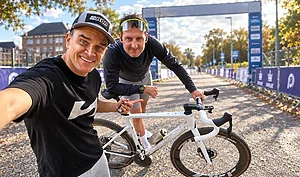
Our coached initiation on the Olympic track… and the privilege of riding the LOOK P24. There are experiences that make you faster.And then there are those that make you more precise. The Vélodrome National de Saint-Quentin-en-Yvelines belongs to the second category. That evening, we weren’t just there to discover a track. We were there to learn to understand it. To respect it. To tame it. Coached by Cintia Voet, Jeff Guiborel and Émilien Clère, guided from the edge of the track via microphone by Christophe Riblon, we experienced the purest thing cycling has to offer: the perfect line. And, as if that weren’t enough, we then had the extremely rare opportunity to ride the LOOK P24, the bike of the 2024 Games, on the very track of the 2024 Games. But let’s start at the beginning.
By Jeff Tatard – Photos : @jefftatard & @louison.gablin
The first look: doubt
An Olympic track is intimidating. 250 meters long. 8 meters wide. Banking turns that seem to defy gravity.
You place the bike at the bottom of the railing. You look up at the curve. You tell yourself it’s too steep. You wonder how it holds. And that’s precisely where the learning begins.
« For a second, I really imagined sliding at the top of the curve. And I wondered if I belonged here. »
« Don’t fight the track »
- The first voice that resonates is that of Christophe Riblon, on the microphone. Calm. Composed. Reassuring. « Look far ahead. Stay relaxed. Climb gradually. »
- Jeff Guiborel approaches and offers an essential piece of advice: « Stay relaxed. If you tense up, the track will make you pay for it. »
- Cintia Voet emphasizes the trajectory: « Don’t cut corners. Don’t brake. Let the speed help you. »
- Émilien Clère reminds us of the essential: « On the track, stability comes from movement. Not the other way around. »
We start…

The first laps: taming speed
The bike is a LOOK 465, quickly adjusted to our measurements. Saddle height set. Length validated. Nothing superfluous. Everything is functional.
No brakes. Fixed gear. Single speed. A single line.
The first laps are cautious. We stay low, on the Côte d’Azur, the blue band that marks the inner limit of the track. We learn to hold the line. To look far ahead. To breathe.
Then comes the moment to climb. The slope is less intimidating than expected. Speed stabilizes the bike. The wood gives a unique, dense, almost muffled sensation.
It’s not violent. It’s not brutal. It’s precise.
The wood returns a dull, almost organic sound, as if the track were breathing with us.

The track is a school
On the road, you can compensate. On gravel, you can improvise. On the track, you must master.
Every trajectory is logical. Every action has an immediate consequence.
Jeff reminds us: « Don’t fight the bike. Go with it. »
Cintia adds: « The track rewards fluidity. It punishes tension. »
Christophe Riblon, still on the microphone: « Think about efficiency. Every unnecessary movement costs. »
We then understand that the track is not a spectacle. It’s a mental discipline.
Jeff Guiborel then confides something telling. A substitute at the Montreal 1976 Olympic Games, he observes today’s machine with an almost amused smile. « With a bike like the P24, I might have been even stronger… »
The sentence is not nostalgic. It is clear-sighted. Equipment evolves. But the track itself remains the same. And for Jeff, the track is above all a matter of looking. « You have to know how to look everywhere. And quickly. »

Not just in front of you. To the right. To the left. Behind. Anticipate trajectories. Read movements. Understand intentions.
The track develops a particular connection : with the bike, but especially with space. Everything becomes faster, clearer, more obvious. You learn to analyze in real time. To decode.
And when you return to the road, everything seems simpler. Trajectories seem wide. Accelerations more readable. Race situations less confusing.
In competition, it’s even more striking. The track teaches you to read an opponent by their pedal stroke. To feel an acceleration before it starts. To perceive hesitation in the cadence. You learn to see an attack before it starts. To feel a leg stiffening. To understand that a cadence changing by half a beat signals something.
It also teaches a sense of rhythm. Cadence is no longer a displayed number. It becomes an inner sensation.
« On the track, you understand that speed doesn’t come from brute force » Christophe Riblon tells us. Before Émilien Clère adds: « It comes from the precision of your gaze and the regularity of your movement. »
And perhaps that is, ultimately, its greatest asset.

The shift
After a few validated laps, the trajectories become natural. Fear disappears. Cadence increases. The sensation changes.
We no longer endure the curve. We draw it.
And it is at this precise moment that something unique is offered to us.
The P24
The bike. That of the Paris 2024 Games. The LOOK P24.

The frame is sculptural. Every tube seems drawn by the wind itself. The fork is massive. The visual rigidity is evident.
You don’t get on this bike like a classic bike. You get on a tool.
Developed with hundreds of hours of CFD simulation, optimized around the « rider + machine » concept, the P24 was designed to reduce overall drag and maximize power transfer. LOOK announces up to 91 watts of aerodynamic savings in certain configurations.
Its price? Around €15,000 for the frame and complete cockpit.
It’s not a mass-market product. It’s a high-competition machine.
And yet, that evening, it was in our hands.
LOOK P24 (Track) in a few words…
|
The first meters with the P24
The position is compact. The rigidity is immediate. The slightest pressure on the pedals triggers an instant reaction. The bike doesn’t flex. It transmits. Directly.
Jeff Guiborel whispers to us: « Don’t push harder. Be cleaner. The bike will do the rest. »
That’s exactly it. The P24 forgives nothing, but it magnifies precision.
We climb into the curve. Higher. Faster. The sensation is different from the 465. Sharper. More honed. More radical. We understand what an Olympic Games machine means.
Exiting the curve, you feel the acceleration kick in instantly, almost dry, as if every watt immediately found its trajectory.

A privilege
Riding on the Olympic track is already exceptional.
Riding the Games bike, lent by LOOK and Federico Musi’s team, coached by technicians and coaches of this caliber, is a rare privilege.
Federico Musi, the CEO of the legendary LOOK brand, himself shares a few laps with us. No pretense. No staging. Just the pleasure of movement.
The full portrait will be published soon…
The lasting advice
From this session, several phrases still resonate:
- Jeff: « Tension is the number one enemy. »
- Cintia: « Your head guides your bike. Always look far ahead. »
- Émilien: « Regularity builds confidence. »
- Christophe: « On the track, you don’t endure speed. You organize it. »
These tips go beyond the track. They speak of cycling. They speak of mastery. They speak of elegance.

Around the track, the energy is discreet but essential. Benjamin Edelin, site coordinator, ensures the balance of the moment. Charlie Conord exchanges, adjusts, observes. And never far away, the attentive gaze of Yann Lemelle, track director, alongside Michel Callot, the president of the FFC and present for the occasion, reminds us that this wooden ring is much more than a place: it is a living heritage.
Why you should do it
The Vélodrome National offers initiation sessions accessible to everyone. Bike, helmet, and shoes are provided. Structured coaching. Clear progression. But behind this apparent simplicity lies something much rarer.
We are talking here about an Olympic track 250 meters long and 8 meters wide, the only one in the world with such dimensions. A wooden ring on which the greatest champions have ridden. A track designed for speed, precision, competition, and yet open to everyone.
Amateurs, triathletes, experienced road riders, or simply curious individuals can come. The rule is simple: initiation is mandatory. It’s the entry point. The moment you discover the trajectories, the Côte d’Azur, the logic of movement, under the watchful eye of a coach who validates your progress before guiding you to the next levels: green badge for beginners, yellow for intermediates, red for advanced. Nothing is left to chance, because on the track, safety and progression go hand in hand.
Slots are available almost all year round, 7 days a week, from morning to evening. You book online, arrive twenty minutes before the session, in simple, close-fitting attire. The initiation costs €49 (€39.20 at a reduced rate) for an hour of intense learning, an hour that profoundly changes the perception of speed.
Good to know – Initiation and track practice at the Vélodrome NationalThe Vélodrome National de Saint-Quentin-en-Yvelines is open to everyone, from the simply curious to the confirmed competitor. The Olympic track measures 250 meters long by 8 meters wide, a unique format in the world, designed for speed and precision. Initiation: mandatory stepBefore accessing open slots, it is imperative to complete a supervised initiation. Duration: 1 hour
The initiation allows you to learn the basics, discover trajectories (Côte d’Azur, black line, curve management) and be guided to the appropriate level. Practice levelsAfter validation:
Each progression is validated by the velodrome instructors to ensure safety and consistency within the groups. Book your slotSlots are available 7 days a week, almost all year round. Book directly online via the official Vélodrome National website Several packages are offered:
Products are valid for one year from the date of purchase. What to remember: you don’t come here to “test an attraction”. You come to learn. And often, you come back. |
It’s not an attraction. It’s a formative experience.
We leave with a new sensation of trajectory, a finer reading of space, a better understanding of cadence. We also leave with a certificate valid for six months, the first step towards more regular practice — single session or annual pass for those who want to extend the experience.
The track teaches regularity. It teaches economy of movement. It teaches precision of gaze. And the most surprising thing is that when you return to the road after this, everything seems more readable, wider, more obvious.
What we remember
The track is not a backdrop. It’s a school of truth. It reveals everything: tension in the shoulders, hesitation in the gaze, cadence that goes awry. With Jeff Guiborel, we understand that relaxation is a strength. With Cintia Voet, that the trajectory always begins with the gaze. Émilien Clère emphasizes regularity, almost methodical. And from the sidelines, Christophe Riblon’s calm voice organizes speed, calms movements, structures space.
On the track, nothing is spectacular. Everything is precise.
The P24, for its part, embodies something else. A demonstration of pure engineering. A machine born for the Games, designed to eliminate unnecessary resistance and magnify precision. And yet, even on this ultimate bike, the lesson remains the same: speed comes first from within.

Sharing a few laps with Federico Musi, the head of LOOK, also gives meaning to the whole experience. We perceive a culture, not just a product. A vision where equipment serves the action, never the other way around.
That evening, over 250 meters, we learned more than a technique. We learned to look better, to breathe better, to read faster. We understand why the track trains great riders: it teaches you to feel an opponent by their pedal stroke, to anticipate an acceleration, to give meaning to cadence.
When you leave the velodrome, everything seems simpler. More readable. More obvious.
It’s not just the privilege of having ridden the Games bike that leaves a mark. It’s this feeling of alignment.
Two hundred fifty meters. A line. A rhythm. And this new conviction: you can always ride faster… by being more precise.
Share the post "First ride on the Olympic track and P24 test"