Share the post "Shimano S-Phyre RX910 Review: Competition-Ready Gravel"
With the S-Phyre RX910, Shimano pushes its definition of competitive gravel even further. Positioned at the top of the brand’s off-road range, these shoes aim to combine maximum efficiency, stability on mixed terrain, and off-bike functionality, notably thanks to the revolutionary Pontoon system for SPD cleats. A radical approach, designed for fast and demanding courses, which we have tested in detail.
By Guillaume Judas – Photos: ©3bikes.fr
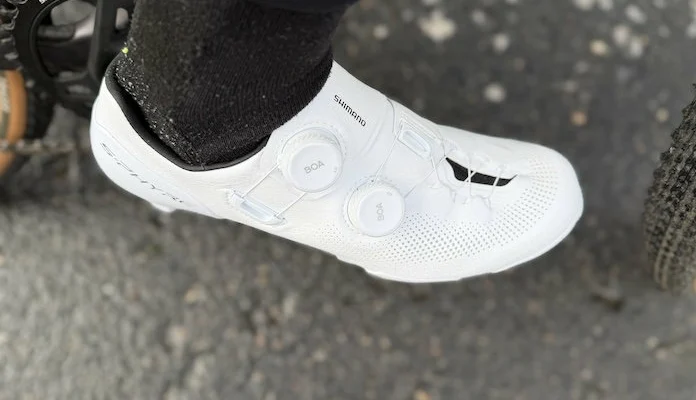
Launched at the end of summer 2025, the Shimano S-Phyre RX910 completes and refines the Japanese manufacturer’s high-end gravel offering. Until now, performance-oriented specialists had to choose between specific but less high-end models like the RX801, MTB/cyclocross shoes like the S-Phyre XC902 or 903, which did not fully meet the demands of maximum on-bike efficiency, or even road shoes with road cleats, with the near impossibility of walking or running if necessary.
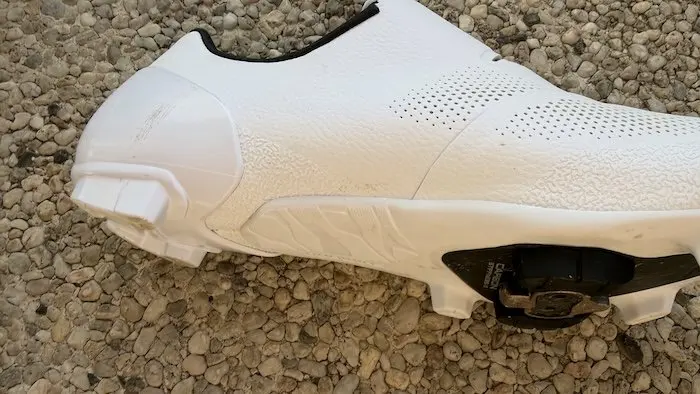
Now positioned at the very top of Shimano’s gravel hierarchy, the RX910 takes on the S-Phyre designation, a symbol of excellence and absolute performance in the brand’s catalog. They are clearly aimed at competitors, committed riders, and fast gravel enthusiasts, for whom efficiency and precision take precedence over versatility or long-distance adventure. These shoes are clearly not made for long runs or extended portage sessions. I initially saw them as “improved” MTB/cyclocross shoes, whereas in fact the test shows that they are more like road shoes “with lugs”.
With this model, Shimano confirms a clear evolution of modern gravel: faster, more structured, and increasingly closer, in its material approach, to high-level road cycling.
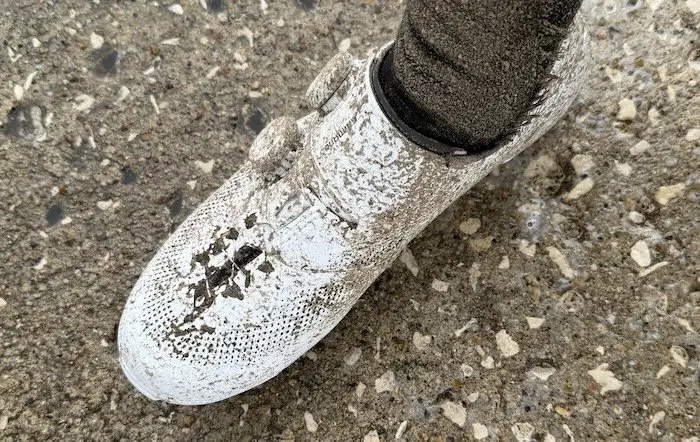
The Pontoon cleat system for stabilizing foot support
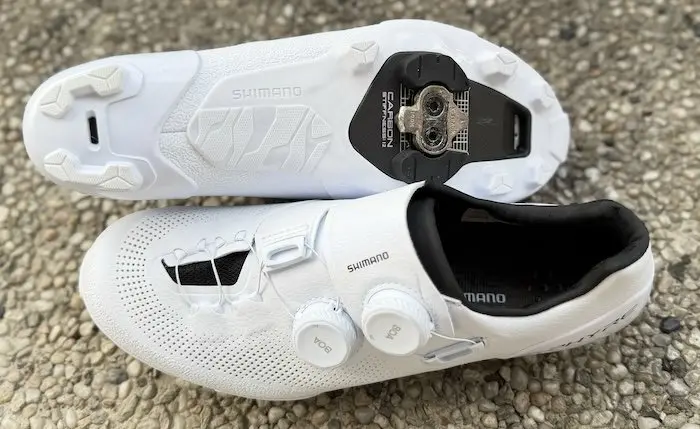
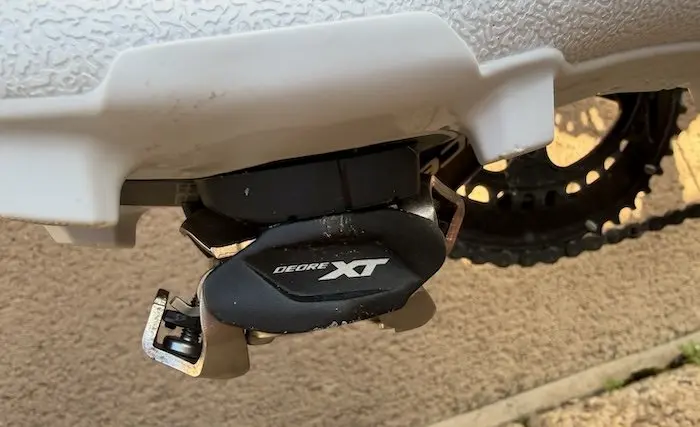
With the S-Phyre RX910, Shimano introduces the Pontoon cleat system, an innovation designed primarily to improve the stability of the shoe-pedal interface in competitive gravel riding. Contrary to what their appearance might suggest, these elements are not intended to facilitate walking, but rather to optimize support during pedaling. Specifically, the system relies on two lateral elastomer pads, positioned on either side of the SPD cleat. Their role is to increase the contact surface between the shoe and the pedal, by resting on the sides of the mechanism when pushing hard on the pedals.
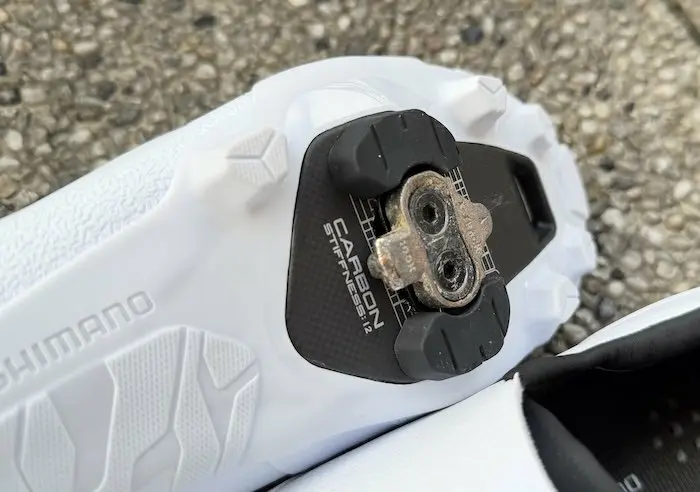
The two pads are very close laterally to the SPD cleat and move with it, regardless of the fore-aft position or orientation chosen during adjustment. Thus, the contact surface between the entire system and the pedal is always the same, unlike a classic SPD setup, which relies solely on the lateral lugs of the shoe’s sole. The Pontoon system is currently only available for the S-Phyre RX910, and on no other pair of shoes on the market, due to the specific shape of the sole. The two elastomer pads are, of course, replaceable in case of wear.
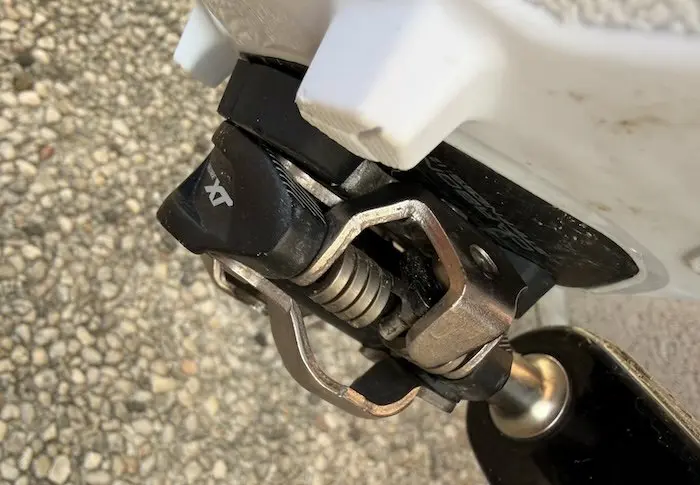
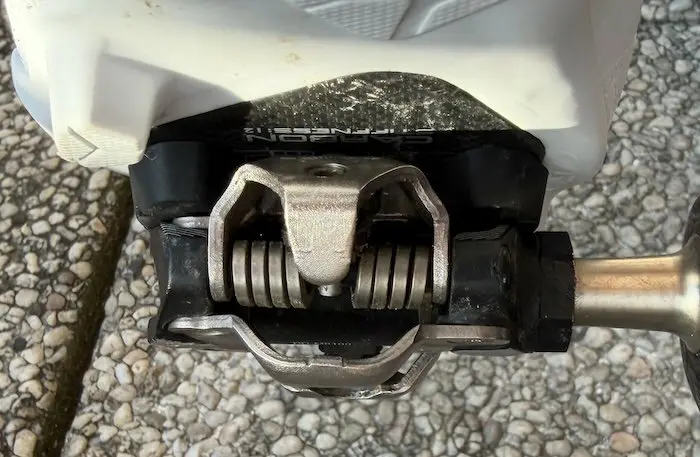
On the trail, this system results in a sensation of stability far superior to the classic SPD system, particularly noticeable during powerful pedaling phases, strong accelerations, or on degraded terrain where support is less consistent. The Pontoon pads limit parasitic movements around the cleat axis, reduce the feeling of float sometimes associated with traditional SPD systems, and improve the transmission of lateral forces, often solicited in gravel. In return, Shimano fully embraces the compromise: the presence of these pads can make mud under the sole a bit more problematic for clipping into the pedal. Furthermore, the reduced spacing between the pads and the cleat decreases the release angle. The Japanese brand prioritizes pedaling efficiency and precision over any consideration of versatility, consistent with the S-Phyre DNA.
A design focused on performance, comfort, and aesthetics
Technically, the RX910 relies on an S-Phyre carbon sole optimized for gravel, boasting a very high stiffness index of 12/12. Like other high-end Shimano shoes, they forgo a midsole, with the upper directly attached under the outsole. This reduces the distance between the foot and the pedal, aiming for maximum power transfer while maintaining sufficient stability on uneven surfaces. In practice, this rigid platform promotes explosive accelerations, sustained efforts, and frequent changes of pace typical of competitive gravel.
Clearly, those accustomed to the brand’s shoes will notice fewer differences between the S-Phyre RX910 and the S-Phyre road shoes than between the RX910 and the S-Phyre XC903 used in high-level MTB or cyclocross.
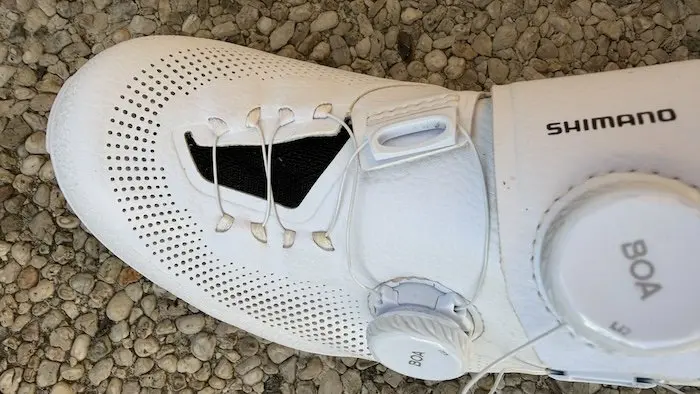
Like other S-Phyre shoes, the upper features a highly structured wrap-around construction, designed to hold the foot without creating pressure points. The material seems slightly less flexible than on the XC902s I already own, which allow for longer periods of running with the bike on the shoulder. The fit of the RX910 therefore appears firmer, better supported, but without being uncomfortable. The synthetic materials used combine lightness, breathability, and good abrasion resistance. Shimano has clearly reinforced areas exposed to splashes and friction to improve durability compared to more road-oriented models.
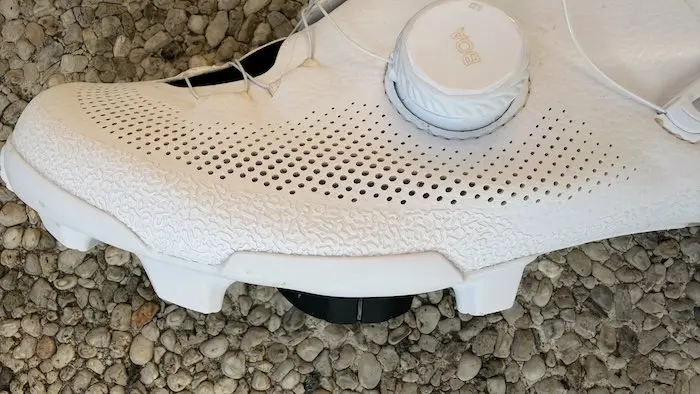
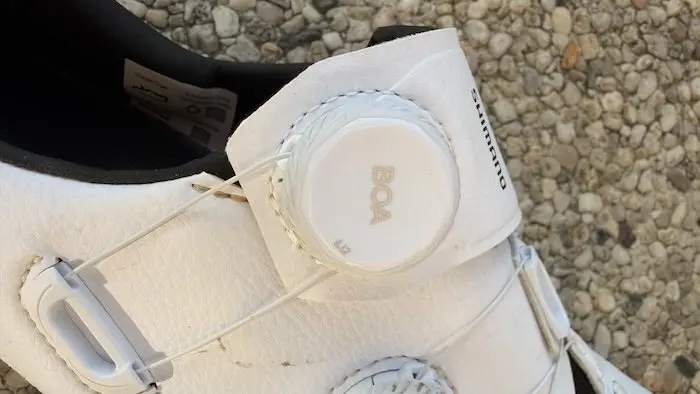
As for the dual, precise, and independent Boa Li2 closure, it allows for fine adjustment over the forefoot and instep, ensuring consistent hold even during maximum efforts or when the shoes are wet and dirty. On this note, and for those who might doubt the relevance of choosing this model in white, let’s clarify that maintenance is not really more complicated than with another color. After a ride, a quick spray with water, possibly a brush with soapy water, and the shoes regain their original shine. The only mesh part at the front and the collar edges are black, so they are not at all exposed to any yellowing.
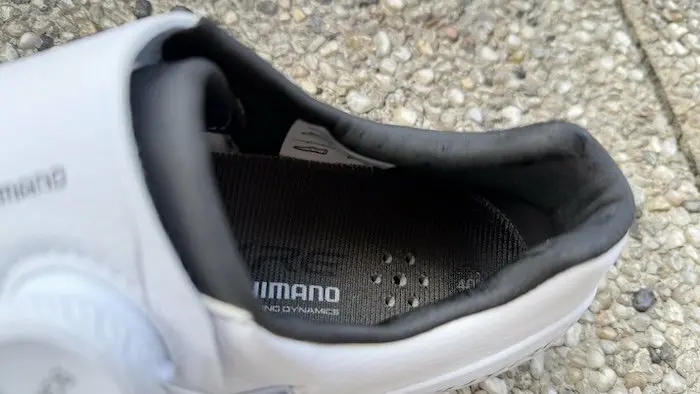
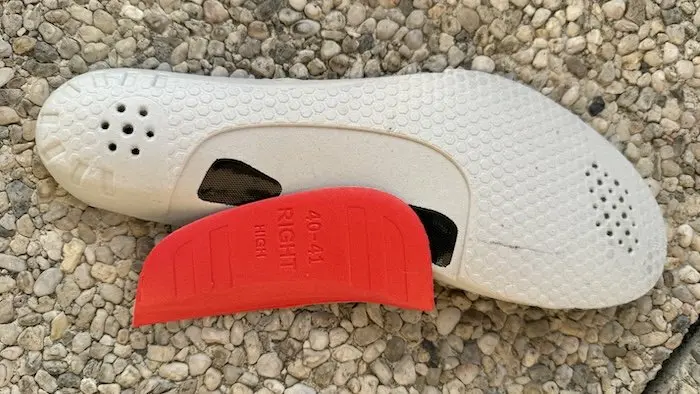
Finally, a last word on the insoles, which are more elaborate than on most cycling shoes on the market: Shimano has long offered insoles with removable arch support on its mid- and high-end models. Two inserts are supplied with the shoes, for medium or high support, suitable for most riders. Only the Giro brand does better by offering three support heights (with, in reality, a third support that is more significant than Shimano’s). This is a plus for comfort, and rare enough to be highlighted. In any case, with the high support here, I quickly found the necessary comfort and support with the RX910, which is not the case with many competing models.
Immediately convincing efficiency
In use, the rigidity of the RX910 sole translates into a sensation of direct connection with the bike, particularly noticeable during accelerations and out-of-the-saddle efforts. On fast tracks and rolling paths, the efficiency is excellent, with a feeling of constant control.
Foot retention is exemplary. The combination of the wrap-around upper and the dual Boa ensures remarkable stability, even during sudden changes of direction and with wet feet. This precision limits fatigue related to internal micro-movements and promotes consistent efficiency over time. Breathability seems well-managed, even though I haven’t tested the shoes in hot weather, and they don’t generate noticeable pressure points when properly adjusted.
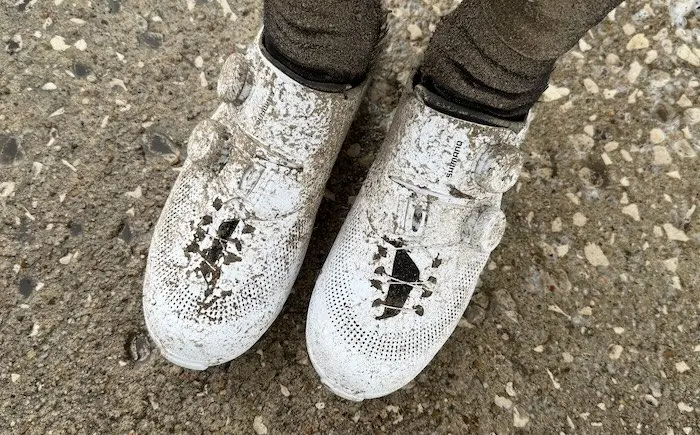
On long rides, the RX910 maintains a good level of comfort, provided one accepts a deliberate firmness. The comfort inside the shoe is not in question, but the “road-type” sole can ultimately prove to be a hindrance for those who embark on ultra-distance, a frequent practice in gravel, and who are looking for a bit of flexibility in the soles of their feet. But this is not the intended use of the S-Phyre RX910, which, on the contrary, loses none of its superb performance when used on the road.
In addition to the sole, the design of the Pontoon cleat system is obviously not unrelated. On my previous S-Phyre XC902 shoes, for example, I was never totally satisfied with the interface between the sole and the pedal, never finding the right support in connection with my cleat adjustment. It was only with SPD-compatible cleats, and not the original cleats (a shame!), that I was able to find some semblance of stability. Nothing prohibitive in pure off-road, but I found it annoying on very rolling sections or on the road, to the point, lately, of preferring to do gravel with road shoes and pedals. An effective solution, but one that obviously poses durability problems, as this system is not designed for that.
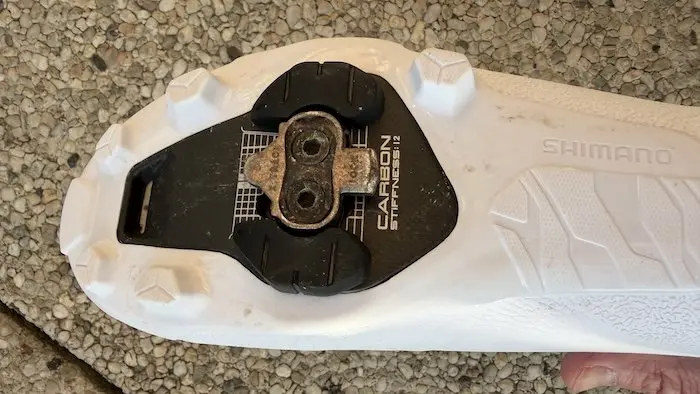
With the RX910 and the Pontoon, you get the best of both worlds, in a way. The connection with the pedal is super efficient and, at the same time, you retain the versatility of an SPD system. Certainly, the super rigid sole of the shoes makes clipping into the pedal a little less intuitive than with more flexible models, and, as I wrote above, the release angle is a little smaller. But the RX910 also allows you to walk, offering sufficient grip in sand or mud thanks to the wide lugs on the sole. On wet rocks, however, the grip is inferior to that of true MTB/cyclocross shoes. For me, I consider these shoes ideal for a practice where off-bike remains exceptional, but not totally excluded. For this use, they are more effective than MTB shoes and less fragile and more stable than road shoes.
A benchmark for competitive gravel
Do you like to put power into your pedals, ride fast, and perhaps even pin on a number for a gravel race, a practice that has been booming in recent years? The Shimano S-Phyre RX910 has just significantly raised the bar and is clearly made for you. Bonus: they are even perfectly conceivable for road use.
With the S-Phyre RX910, Shimano delivers accomplished gravel shoes, clearly oriented towards performance and racing. High rigidity, precise support, enhanced durability, and intelligent integration of the Pontoon cleat system make them a benchmark for demanding riders.
The SHIMANO S-PHYRE RX910 in brief…Pros: rigidity, stability, fit comfort, very close to S-Phyre road shoes Soles: carbon (stiffness index 12/12) – Upper: microfiber leather and mesh – Heel: wrap-around – Closure: two independent Boa Li2 dials for micro-adjustment – Perforations for drainage or ventilation –Insoles: with adjustable arch support – Cleats: SPD with Pontoon TPU pad system – Weight: 218 g (size 39) – Colors: black, blue, white, green – Sizes: 36 to 48 (with half sizes from 41 to 47), wide version from 40 to 48 – Price: €419.95 Contact: bike.shimano.com |
Share the post "Shimano S-Phyre RX910 Review: Competition-Ready Gravel"