Share the post "How to effectively replace an outdoor ride with an indoor trainer session?"
Driving rain, wind gusts, snow or sub-zero temperatures: the worst weather conditions always seem to fall on the only training window of the week. Rather than giving up or braving the elements at the risk of getting into trouble, the indoor trainer is now establishing itself as a credible and effective alternative to outdoor rides. However, you still need to know how to use it to preserve the benefits of training… without feeling guilty.
By Guillaume Judas – Photos: depositphotos.com/All rights reserved
Every cyclist has already experienced this dilemma. The session had been planned long in advance, sometimes squeezed between professional and family obligations, and the weather puts everything back into question. Going out anyway might seem courageous, but the risks are real: falls on slippery roads, hypothermia, increased fatigue, risk of punctures, equipment suffering, and, above all, an often unfavorable benefit-risk ratio. In this context, staying indoors is not giving up, but a reasoned choice.
The indoor trainer, from emergency solution to training tool
For a long time, the indoor trainer suffered from an austere image, associated with boredom and constraint. This vision now belongs to the past. Connected models, combined with sophisticated training platforms, now make it possible to reproduce precise and individualized workloads. Many professional coaches now integrate these sessions into the core of their plans, including for high-level cyclists.
Typical session to replace an outdoor rideObjective: to reproduce an active endurance or hilly ride on the indoor trainer when the weather prevents any outdoor ride. Total duration: approximately 50 minutes to 1 hour, equivalent to a significantly longer outdoor ride in terms of training load. |
Replace the intention, not the ride
The most common mistake is to try to identically copy an outdoor ride. However, this is neither possible nor desirable. What leads to progress is not the distance covered or the number of kilometers displayed, but the physiological objective of the session. An endurance ride aims to develop basic aerobic capacity, a sustained session improves tolerance to prolonged effort, while intensive training stimulates maximum power. It is this logic that must be transposed to the indoor trainer.
Better controlled, but more demanding intensity
On the indoor trainer, the effort is continuous. There are no descents to recover, no red lights to catch your breath, nor variations imposed by traffic. This constancy makes sessions denser and often more strenuous for an equivalent duration. This is why an indoor trainer session can be shorter while remaining just as effective as an outdoor ride. In practice, one hour of well-structured training is largely sufficient to generate a quality stimulus.
Typical session to replace a ‘threshold’ workout rideObjective: to replace a sustained outdoor ride aimed at improving the ability to maintain a high effort over time. Total duration: approximately 50 minutes to 1 hour, equivalent to a long and sustained outdoor ride. |
Adapting duration and volume without losing track
When unfavorable weather conditions recur, there is no need to try to maintain the same hourly volume as during the summer period. Training specialists recommend adjusting the volume downwards while maintaining targeted intensities. This strategy helps limit mental fatigue, often more pronounced indoors, while preserving the long-term progression dynamic.
Typical session to replace a VO2max workout rideObjective: to replace a short, punchy ride focused on developing maximal aerobic power. Total duration: 40 to 50 minutes, largely sufficient to generate a strong training stimulus. |
Applications, allies for motivation and structure
The success of the indoor trainer owes a lot to training applications. Some offer highly structured plans, based on power data and methodical progression. Others focus more on immersion and the community aspect, by recreating virtual routes or collective events. Whatever the chosen approach, these tools offer a reassuring and motivating framework, particularly valuable when training alone indoors.
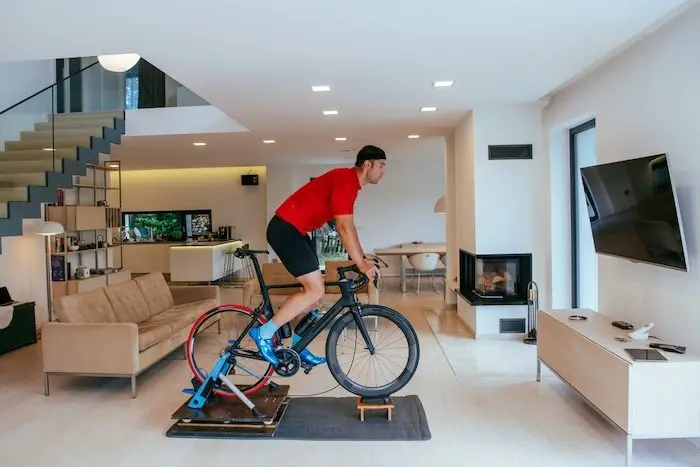
Training without feeling guilty
Replacing an outdoor ride with an indoor trainer session should never be seen as a failure. Going out no matter what in a storm is neither a sign of seriousness nor a guarantee of progress. Knowing how to adapt is an integral part of modern sports practice. In this sense, the indoor trainer is an ally, allowing you to reconcile training, safety, and personal balance.
Typical session to replace a tempo workout rideObjective: to reproduce a rhythmic ride on rolling terrain, at an intensity intermediate between endurance and threshold. Total duration: 45 to 55 minutes, ideal for an effective and low-impact session. |
The best training is the one you do
Ultimately, the ideal training is not the one imagined under perfect conditions, but the one you manage to integrate sustainably into your daily life. By intelligently transforming a cancelled ride into an indoor trainer session, you preserve your consistency, your motivation, and, above all, your progress. Whether it rains, blows, or snows, the main thing is to keep pedaling… differently.
Share the post "How to effectively replace an outdoor ride with an indoor trainer session?"