Share the post "70 watts lost at 0°C: what winter does to your watts"
What winter really does to your efficiency (and why it isn’t your fault). Every winter, the same observation comes back among cyclists. “I’m not getting anywhere.” “I have to push to hold my pace.” “I’ve lost watts.”. And almost always, the conclusion is the same: I’m less fit. That’s wrong. Not totally wrong… but very largely wrong.
By Jeff Tatard – Photos: DR
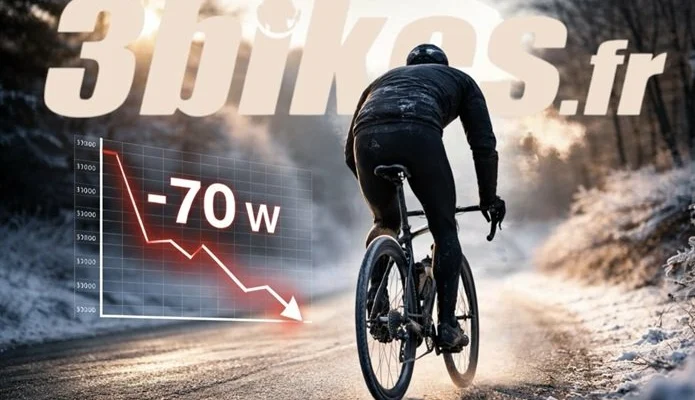
The numbers are unequivocal: at 0°C, you can lose up to 70 watts, without your fitness having moved by a millimetre.
It isn’t a feeling. It isn’t a drop in motivation. It isn’t a placebo effect. It’s pure physics.
And it was while reading a Facebook post by L’Expert Vélo that the idea came to us to dig into the subject, then to watch the full video and the detailed test.
Because what is explained there is probably one of the most underestimated realities of winter cycling performance.

Cold air: your first invisible enemy
The colder the air, the denser it is. At 0°C, the air is about 10% denser than at 20°C. And on a bike, beyond 25 km/h, enemy number 1 is the air. This extra density means one very simple thing: at equal speed, you have to produce much more power.
Without knowing it. Without feeling it. Without your heart rate really changing. You just feel like you are towing an invisible parachute.
Clothing: the aero nobody looks at in winter
In winter, we ride with:
- a thermal jacket
- base layers
- overshoes
- thick gloves
- a neck gaiter
All of which is catastrophic in terms of aerodynamics. Every fold of fabric, every thick material, every extra thickness creates micro-turbulence. Add that to the denser air… and the bill climbs very quickly.

The real underestimated culprit: tires at low temperature
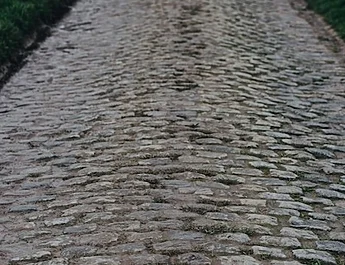
This is where the subject becomes fascinating. A tire’s efficiency depends on its ability to deform and then to return to its shape. At low temperature, the rubber stiffens. The casing becomes less supple. Deformation returns less energy. Result: the rolling resistance coefficient skyrockets. And no power meter will explain that to you.
This is precisely the playground of Manuel Sola Arjona, creator of AeroScale, who works on optimising tire efficiency according to temperature, pressure and surface.
| If you want to go further on this subject, we had already explored AeroScale’s approach in detail in our article “Gaining watts without pedalling harder” a real gold mine of information on how to save energy without changing your muscular effort. |
His approach shows something fundamental: in winter, the choice of tire and pressure can make you gain… or lose an enormous amount of energy. Much more than you would imagine.
Mechanical friction: the drivetrain suffers too
Stickier chain. Thicker greases. Less free-running bearings. Everything becomes slightly less fluid. Nothing spectacular on its own. But added to the rest… the watts fly away.
What you need to understand (and what changes everything)
In winter: a large part of the lost watts do not come from the cyclist.
They come from:
- the air
- the clothing
- the tires
- the mechanics
That is why you sometimes feel “useless” in January… and “miraculous” in April. Your level hasn’t changed that much. The environment has.

Ride harder? No. Ride smarter.
The goal is not to chase performance at all costs in winter. But to understand: where the watts are really lost & how to preserve them without pushing harder That is exactly what is detailed in the video and the article by L’Expert Vélo that triggered this reflection.
Going further=> Take a few minutes to watch the full L’Expert Vélo video => And read the detailed article You will never see your winter rides the same way again. And above all, you will stop thinking that the problem… is you. |
Share the post "70 watts lost at 0°C: what winter does to your watts"