Share the post "Forbidden gear… that everyone uses"
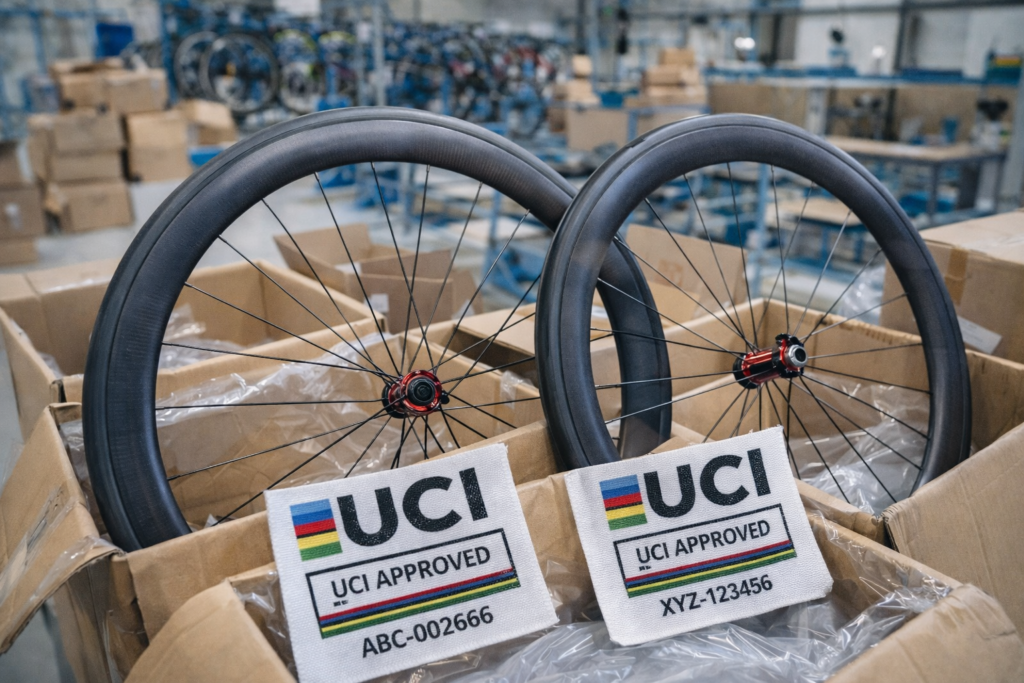
There’s a detail very few cyclists know. And even fewer understand. A detail that, however, could, in theory, prevent you from starting an FFC race… even in Access category. This detail is not the bike’s weight. It’s not the saddle height. It’s not even the crank length or the width of the tucked-in hoods. It’s a small sticker nobody looks at. The UCI Approved sticker.
By Jeff Tatard – Photos: DR & : ©Vincent Lyky
The Great Misunderstanding of Asian Carbon
For several years now, Asian platforms have been overflowing with carbon wheels and frames with perfect lines, modern profiles, attractive weights, and… indecent prices. €450 for a pair of wheels. €600 for a frame. And the same question always comes up, in race parking lots, WhatsApp groups, and Facebook comments: « Honestly, don’t they come from the same factories as the big brands? »
Yes, perhaps. But that’s precisely where the misunderstanding begins. Because the issue is not the factory. The issue is not the mold. The issue is not even not the carbon. The issue is the certified industrial process.
What the UCI Really Certifies (and What Nobody Understood)
When a wheel or frame is « UCI approved », it doesn’t mean: « This part is solid. » It means: « This part was manufactured using a process that the UCI has validated. » An immense nuance. The UCI doesn’t validate a material. It validates traceability.
- The precise model
- The precise factory
- The precise layup
- Standardized mechanical tests
- Industrial repeatability
UCI Frame Labeling: How it WorksAs Fabrice Joudioux from MF Carbon Cycles, who has just had several frames labeled himself, explains to us, the reality of UCI control is often misunderstood. UCI labeling primarily relies on:
However, it is not:
UCI labeling is therefore primarily a regulatory control, not an industrial label. |
The Fascinating Paradox
You can have:
- an €1800 UCI Approved wheel
- a €450 wheel, visually identical, sometimes from the same mold
The difference is not the carbon. The difference is that one was born from a certified industrial process. The other, from an undeclared industrial process. Same mold. Not the same story.
“Yes, but it doesn’t break…”
That’s the argument that always comes up. And it’s true. The majority of these open-mold wheels and frames are ridden for thousands of kilometers without any problems. Some are even of remarkable quality. The issue is not breakage. The issue is what happens the day it breaks.
Because on that day, there’s an expert. An insurance company. A report. And a very simple question: « Is this equipment UCI approved? » And from that moment on, the discussion is no longer about carbon. It’s about regulatory compliance.
The Power Nobody Imagines: That of the Commissaire
This is where the story becomes delightfully unknown. In the UCI regulations. In the FFC regulations. It is written in black and white that… The rider must ensure that their equipment complies with UCI technical protocols. The commissaire may inspect the equipment before, during, or after the event.
Which means, in very strict theory: A commissaire can refuse your start if your frame or wheels are not on the UCI list. Even in Open. Even in Access.
The Reality on the Ground (and the Total Discrepancy)
In 99.9% of amateur races, no one will check the UCI sticker on your wheels. They check the helmet. They check the brakes. They check if everything is more or less holding together. But the regulation, it exists. And it’s this discrepancy that is fascinating. Because you’ve probably been riding for years with equipment that, regulation-wise, could be questioned… without anyone noticing. Until the day when…
Where it Gets Even More Interesting: Frames
For wheels, a break causes a fall. For a frame, a break can be fatal. And that’s precisely why the UCI created a list of approved frames. And that’s also why open-mold frames sold on Asian platforms are almost never on it. Not because they are fragile. But because no one has paid for, declared, audited, or traced the manufacturing process. It’s not a technical issue. It’s an industrial issue.

The Day the Sticker Becomes More Important Than Carbon
What very few cyclists understand is that: UCI Approved is not a label of strength. It is a label of responsibility. It means: « We, as a brand, officially take responsibility for how this product is manufactured. » Open-mold products, however, assume nothing. They sell an object. Not a process.
Why Pros Can’t Escape It (and You Can)
An elite, N1, DN, UCI rider… is not allowed to race with an unlisted frame. It’s checked. Applied. Undisputable. As an amateur, you benefit from a murky, blurry, tolerant zone… but only because no one is looking. Not because the regulation doesn’t exist.
The Real Question It Raises
The question is not: « Are these wheels or frames good? ». The question is: « Am I willing to accept that they are not officially recognized by the regulations governing my practice? ». And that’s a question very few cyclists have ever asked themselves.
The Detail That Changes Everything
The next time you see a €6000 bike with a small UCI sticker on the seat tube… You won’t just see a sticker anymore. You’ll see regulatory compliance. And you’ll understand that part of the price doesn’t come from the carbon. It comes from the process.
What Nobody Had Explained to You Yet
You can ride your whole life with an open-mold frame without ever having the slightest problem. But the day a problem arises, it’s no longer a story about carbon. It’s a story about regulations. And on that day, the little sticker nobody looks at suddenly becomes the most important part of the bike. Not for riding. For answering.
=> To go further, you will find the UCI equipment regulations
Share the post "Forbidden gear… that everyone uses"