Share the post "I gained 3 kg in 4 days. Or so I thought."
There are mornings when the scale weighs more than just the body. It also weighs incomprehension. Thursday morning. A bloated stomach like after a winter ride in overly tight bib shorts. The strange feeling of having “gained”. And the number that appears: +3 kg.
By Jeff Tatard – Photos: All rights reserved
Three. In four days. Impossible. And yet…
So, let’s rewind.
The holidays. Excesses. Not one. Not two. Three in the week. Each time, the well-ingrained reflex of the disciplined athlete: “I’ll fast the next day, I’ll rebalance, it will go back down.”
Except this time, it doesn’t go down. Worse: it appears with a delay. And that’s where it gets fascinating. Because what this weight gain tells us… has absolutely nothing to do with fat.
The cyclist’s biggest misunderstanding: weight
A cyclist thinks they understand their weight. They know the number down to the gram. They know their bike down to the gram. They know their pair of shoes down to the gram. But they don’t know what really makes their weight vary by 3 kg in 72 hours.
It’s not fat. It’s not even food. It’s water. And glycogen. And an intestine that didn’t like the party.

Glycogen: this invisible reservoir that weighs heavily
Each carbohydrate-rich meal recharges a reserve that all cyclists know without really visualizing it: glycogen. This fuel stored in muscles and the liver. What is less known is that: 1 g of glycogen retains approximately 3 g of water.
Replenish 500 g of glycogen (which happens very quickly with festive meals, bread, desserts, alcohol, salt), and you’ve just added 2 kg to the scale.
Two kilograms. Without gaining a single gram of fat.
And if these meals are close together? The body doesn’t empty the reserves in between. It keeps them full.
Why it usually goes down… but not this time
The athlete’s usual pattern: Excess → fasting → bike ride → return to normal. |
The body understands the signal: a one-off episode. But when excesses repeat in the same week, the message changes: “Irregular period of abundance. We store.” And then, fasting is no longer enough. Worse: it sometimes slows down emptying. The body retains water.
Retains glycogen. Slows down transit. And the stomach bloats.
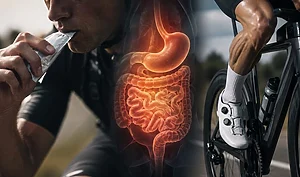
The stomach isn’t fat. It’s an annoyed intestine.
This unusual, tight, almost uncomfortable stomach? It’s not abdominal fat that appeared in four days. It’s:
- salt
- digestive inflammation
- slowed transit
- extracellular water retention
In short: a digestive system that didn’t like the chaos. And no cyclist interprets that correctly.
We think “I’ve gained weight”. While the body says: “I’m managing what you put me through”.
The simplest proof: riding
Paradoxically, cycling is the best indicator. That day, while riding, the sensations are there. The heart rate rises normally. The legs respond. As if these 3 kg didn’t exist. Because in reality, they don’t exist in performance. It’s not useful weight. It’s not metabolic weight. It’s water weight.
What you absolutely must not do
The classic reflex:
- fast even more
- eat less
- train harder
This is exactly what prolongs the phenomenon:
The body remains in stress mode → prolonged retention.

What makes everything go back down (and quickly)
The solution isn’t spectacular…
It’s almost frustrating:
And in 48 to 72 hours… You “lose” 2 to 3 kg. As if by magic. |
Except it’s not a loss. It’s a return to balance.
The lesson all cyclists should know
We spend our time chasing grams on the bike. But we don’t understand the body’s phantom kilograms. These kilograms that are neither fat, nor performance, nor fitness. Just a perfectly logical protective mechanism.
So next time the scale goes wild after a period of excess, remember: You haven’t gained weight. Your body is just doing its job. And that’s rather reassuring.
=> To go further and better understand an athlete’s nutritional balance, consult the clear and accessible resources of Benoît Nave
Share the post "I gained 3 kg in 4 days. Or so I thought."