Share the post "Lightening up to ride better, the paradox of cyclists"
It’s often where it all begins: in the early morning, helmet still cold on the head, hands sliding on the bar tape, tires barely crunching on the wet asphalt. We mechanically adjust a strap, check one last detail, fill a pocket “just in case”… then we set off. And already, something feels off: we’re heavy, loaded, a little tense. Yet the road ahead of us is empty, the day is breaking, the world is open. And what if, deep down, our biggest hindrance wasn’t the wind, the climb, or fatigue… but everything we impose on ourselves to feel reassured ? Through the journeys of Stéphane Loth, a nomadic cyclist by necessity, and José Lopez, a coach who advocates adaptation over control, this text questions our rituals, our fears, and our “just in case” obsession. Because on a bike, as in life, we often ride better when we learn to leave lighter.
By Jeff Tatard – Photos: DR
The quirks that reassure us
All cyclists have their little quirks. The one who pinches their tires three times before leaving, the one who turns their saddle half a millimeter as if their life depended on it, the one who stuffs their pockets with bars, gels, inner tubes, mini-pump, chain tool, multitool, patches, zip tie and “just in case”. The one who categorically refuses to change pedals because “I know these by heart”.
We call them rituals. Repeated, almost superstitious gestures, which give us the illusion of mastering what is never truly mastered: the road, the wind, the body, the mechanics, the weather… and our own fears.
Because on a bike, the unexpected is part of the game. A crosswind gust, a degraded road, a sneaky puncture, a steeper climb than expected, a bonk that arrives without warning. And faced with this permanent uncertainty, the cyclist develops a strange strategy: they weigh themselves down to feel reassured.
We add equipment, layers of precautions, “just in case” items. We multiply checks, we rigidify our habits, we freeze our settings. We sometimes become more attached to our rituals than to our pleasure of riding. And the more we fear the unexpected, the more we load ourselves up, as if the extra weight would protect us from the outside world.
Yet, the paradox is there, obvious to anyone who takes a step back: the lighter we are, the more capable we are of adapting.
Stéphane LOTH: train everywhere, clutter nowhere

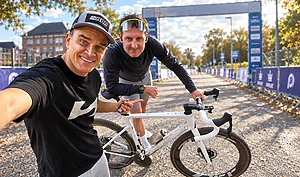
Let’s take Stéphane LOTH. Commercial director for an American giant in the dental industry, he spends his life on planes, in hotels, and in meeting rooms. His schedule is a mosaic of travel, time zones, and professional contingencies. And yet, he rides. Often alone, sometimes at dawn, sometimes late at night, sometimes on an indoor trainer squeezed between a suitcase and a hotel desk.
Stéphane doesn’t have the luxury of “his” route, “his” coffee, “his” roads. He has to train wherever he is. One week in Germany, the next in the United States, then in Singapore or Dubai. And it is precisely this constraint that has made him more adaptable than most of us. No fixed ritual, no sacred equipment, no immutable routine: he makes do with what he has, where he is.
He often says with a smile: “When you live on the road, you quickly understand that it’s better to be light in mind and in your bag. Otherwise, you don’t do anything.”
Opposite to absolute control, Stéphane has learned to work with the environment. To accept that a session might be different from what was planned. To ride less, but better. To improvise rather than to be stubborn.
| => Discover the life of Stéphane Loth in this story dedicated to him Between two flights, Stéphane Loth’s 50 km/h life |
José Lopez: learn to adapt rather than to control
In another vein, José Lopez embodies an even more radical philosophy of adaptation. A former very good national-level cyclist, an excellent marathon runner, he is today a man in the shadows: coach of champions, talent developer, movement strategist. Not a guru, not a theoretician, a practitioner.
His maxim is simple: “It’s not the world that has to adapt to you. It’s you who has to adapt to the world.”
With his athletes, José doesn’t seek to create ideal conditions, but flexible minds. Not machines calibrated for a single scenario, but athletes capable of performing in the rain, in the wind, with different equipment, on unknown routes.
He often repeats that too many cyclists want to control everything: the perfect setting, the perfect weather, the perfect route, the perfect gear ratio. And that in reality, this quest for perfection weakens them.
Because true strength, according to him, lies in the ability to make do with what you have, and not to demand that everything be aligned before acting.

Why we weigh ourselves down when we’re afraid
This is where psychology comes into play.
Faced with anxiety or apprehension, human beings tend to over-equip themselves rather than simplify. It’s true when we go on a trip, we fill the suitcase “just in case”, and it’s true on a bike. We accumulate to compensate for a diffuse fear: that of not being ready, that of losing control, that of finding oneself vulnerable.
Yet, it’s often the opposite that works. Fewer things, more clarity. Less weight, more agility. Fewer certainties, more sensations.
Our habits reassure us… but they trap us
The cyclist, by nature, is not always the champion of adaptation. We love our habits: same coffee, same route, same settings, same equipment, same favorite outfit. We hate being destabilized. Changing saddle, handlebars, shoes, position, it’s almost a small existential crisis.
And yet, it is precisely in these moments of discomfort that we progress the most.
Trying a new route, riding lighter, accepting not to control everything, leaving with a little less “material security” and a little more self-confidence… it’s often then that cycling becomes an adventure again, not a checklist.
Lightening up to rediscover freedom
Imagine a ride where you leave with only the strict essentials. No mental or material overload. Just you, your bike, the road, and the wind. You don’t control everything, but you are present, attentive, alive. You read the terrain, you adapt, you improvise. And you realize that you are much more capable than you thought.
So perhaps our true challenge as cyclists is not to buy more, plan more, control more… but on the contrary, to learn to lighten up. Lighten our pockets, but also our fears. Lighten our certainties to make way for instinct.
As José Lopez would say to his athletes:“Stop trying to tame the world. Instead, learn to dance with it.”
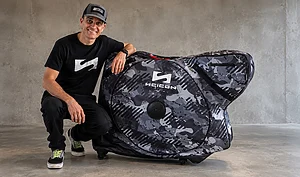
And as Stéphane Loth shows, sometimes stuck in a hotel room with his disassembled bike: “It’s not the place that makes the cyclist… it’s their ability to adapt.”
Next time you check your bike for the fifth time before leaving, ask yourself a simple question: am I preparing… or am I reassuring myself?
And what if, for once, you tried to leave a little lighter to ride a little freer?
=> Discover all our Mental Coaching articles
=> Mental load: how to free yourself from it thanks to minimalism
Share the post "Lightening up to ride better, the paradox of cyclists"