Share the post "Why is the road bike handlebar round?"
Every Sunday, whether on a small, bumpy country road or gravel along a canal where you see more herons than cars, there’s always that silent moment: the cyclist who, between two pedal strokes, glances down slightly at their handlebars. Not really to admire them… but rather to gauge them. A micro-second of hesitation where the question arises almost despite themselves: “Why this shape, exactly?” After being gripped in our hands, this round handlebar becomes so familiar that we no longer truly see it, a bit like the nose in the middle of the face, but in carbon or aluminum. And as often with cycling, it’s when we stop, take a sip, catch our breath, that the real questions appear. So let’s take two minutes to look differently at this simple curved piece of tubing that connects us to the road, the wind, and speed… and which, subtly, tells a whole story.
By Jeff Tatard – Photos: DR and Maryline Photos
An almost immutable shape… and for good reasons
Yes, you’ve noticed: the classic road handlebar, in its drop bar shape, has been around for decades. It has changed little in its general form, as if the design were “set in stone.” But is that really the case?
No. Behind this continuous curve lies a logic that is at once anatomical, mechanical, and, above all, aerodynamic.
Aerodynamics, the great forgotten factor
We often discussed it with Séb, an MTB specialist, also a triple national champion in the discipline on his resume, but an excellent road rider too, during a chat after a long ride. For him, it’s no coincidence that pros adopt a particular shape. According to Séb, aerodynamics is a dominant constraint: “In a race, every reduction in wind resistance counts. The round + curved handlebar allows you to lower your torso, to somewhat erase your silhouette against the wind, and that changes everything.”
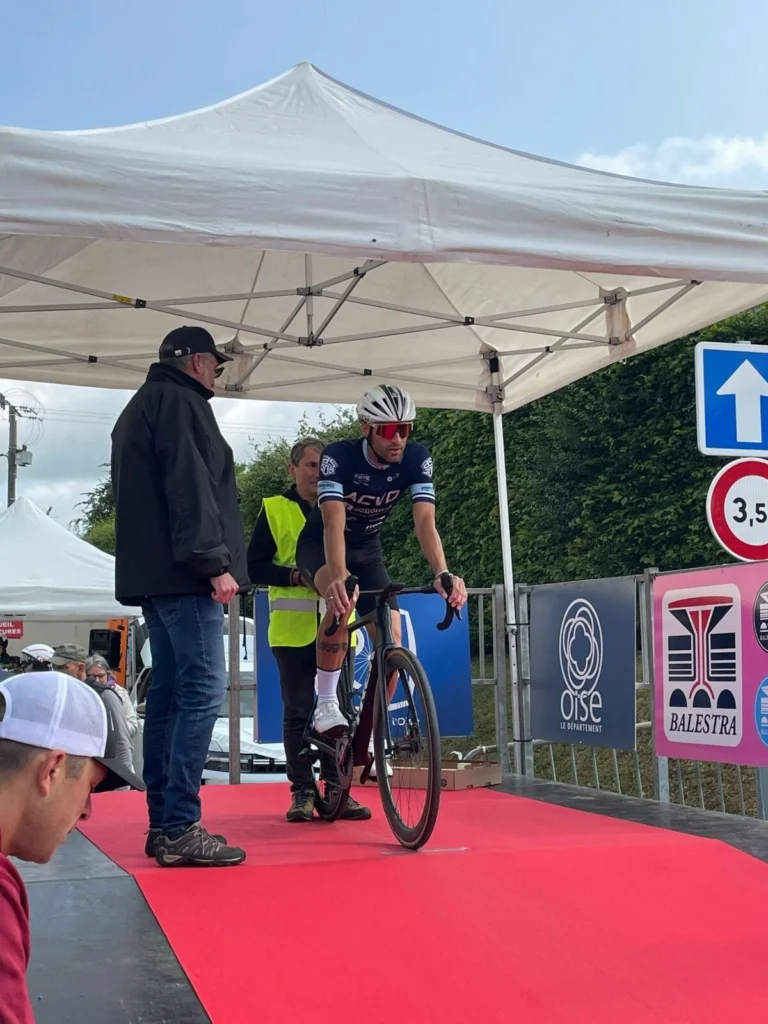
And he’s right. The handlebar isn’t just a bar to hold; it’s the anchor point for the cyclist’s position in the air. By maintaining this round-curve shape, we optimize airflow around the body, open the chest on descents, close it a bit in the wind… benefiting speed and endurance.
A period of decisive trial and error
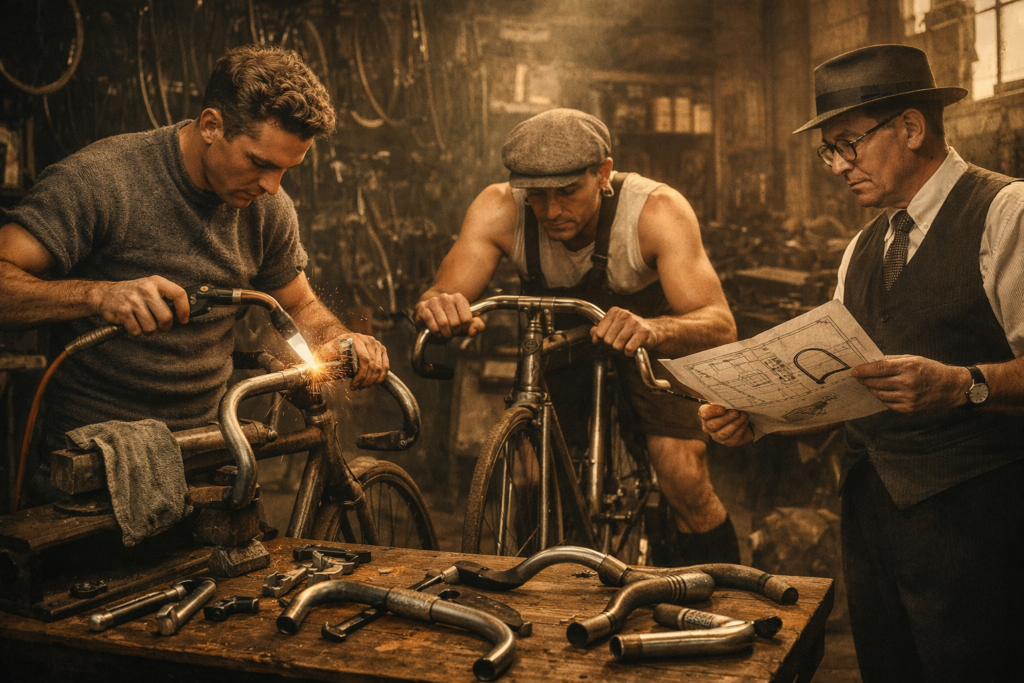
Between the original straight handlebars and the modern drop bar, there was a fascinating, and often forgotten, period of tinkering and experimentation. In the 1920s-1930s, many riders twisted, bent, or modified their own handlebars to lower their position without losing control of the bike. Hybrid shapes appeared, neither truly straight nor yet fully drop bars, shaped more by use than by design offices.
This trial-and-error phase is nevertheless fundamental: it shows that the road handlebar was not born from an engineer’s pencil stroke, but from a prolonged dialogue between cyclists’ bodies, speed, and wind.
The multiple hand positions
What’s also clever is that you don’t hold these handlebars always in the same place:
- on the hoods for accelerating,
- on the tops for cruising,
- on the drops for attacking or resting against the wind.
This ability to subtly change grip and thus modify body position is almost as important as aerodynamics itself for many of us.
Séb emphasized it again: he finds that the ability to place your hands here, there, and there is a real asset on a long ride or in a race. And that’s something a straight handlebar, which he’s very used to, simply can’t offer you.
Hands in the drops, a different kind of power
And then there’s that small detail we too often forget: the force you can exert when you’re “in the drops”.
For an MTB rider like Séb, used to pumping, accelerating in singletrack, looking for grip, he noted a simple thing: “When you put your hands in the drops, you engage your body differently. You can push and pull more aggressively, a bit like an MTB sprint.”
This feeling, more control, more support, is also found on the road. Especially when approaching the next level of speed.
And the width? That has changed too
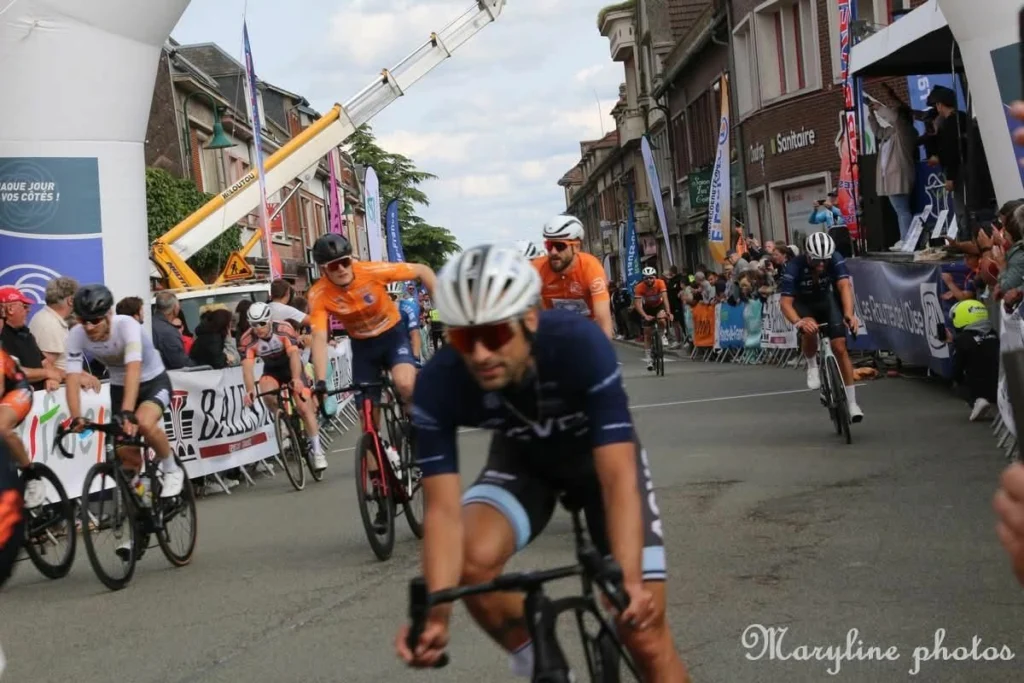
Now, take a critical look: compare a road drop bar of today to one from 15 years ago. At first glance, you might think they all look alike… and yet, something has indeed changed.
Contrary to what is often imagined, the recent trend has not been towards ever wider handlebars, but rather towards better-sized and sometimes even narrower handlebars than before. Brands are working more on ergonomics, reach, flare, and consistency with the cyclist’s morphology, rather than just a simple question of raw width.
Perfect example: Dany, our beloved mechanic, and incidentally one of the best cyclists in Île-de-France, never far from the heart of the peloton, rides with handlebars at the lower limit of the UCI standard. And when you see the build of the man, built like a Spartan, you understand that width is not just a matter of shoulders, but above all of position, handling, and sensations on the bike.
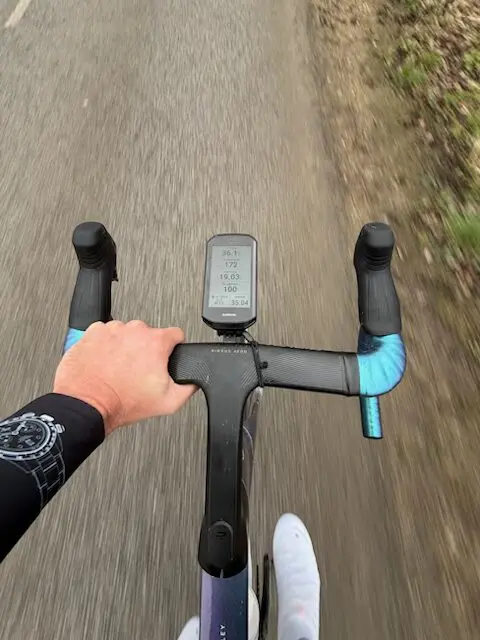
In the 2000s, many rode with very narrow handlebars, designed primarily for “competition profile.” Today, the focus is more on finding the right compromise between aerodynamics, control, and comfort, without questioning the historical shape of the drop bar.
So, why is it still round?Because this shape is the best known compromise between:
Yes, some details have evolved: materials, slightly more ergonomic shapes, cable integration, adapted width. |
So the next time you adjust your grip or look at your handlebars before heading out, think about this: it’s not just a round tube.
It’s the result of a century of small innovations where human factors, air, speed, and mechanics all had to agree for this shape to endure.
And as always, if you want to delve deeper into the technical aspects or explore a variation, let’s talk about it…
=> To go further, GCN traces the history of the handlebar in this video and explains how this simple curve became one of the most decisive parts of the modern bicycle.
Share the post "Why is the road bike handlebar round?"