Share the post "Weight loss on the bike: what training often forgets"
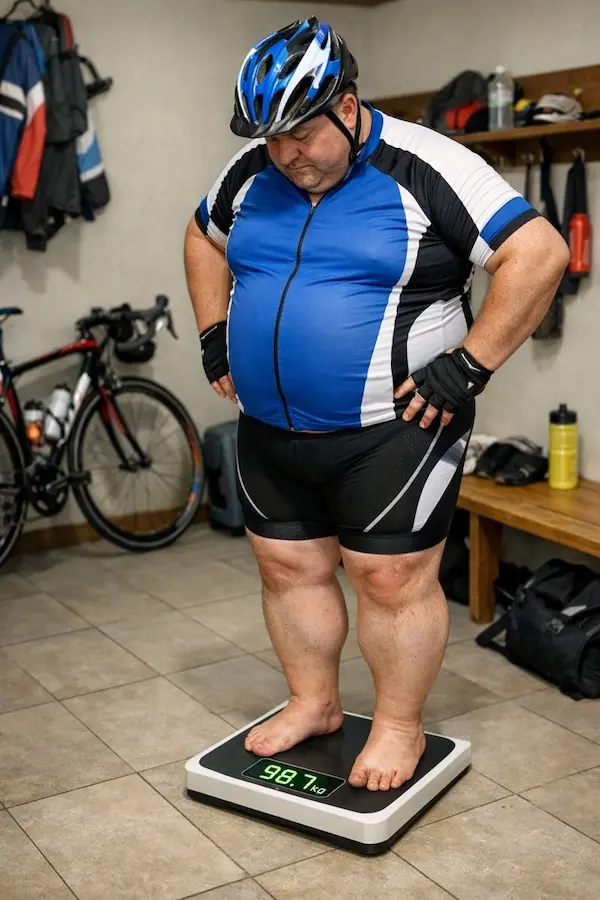
The holidays are over, but their effects can sometimes still be seen on the scale. However, for many competitors, the season begins in four to eight weeks. Sportive riders have a slight reprieve, but their first objectives are also not so distant anymore. If losing weight is part of the early season equation, now is when it all comes down to it. You still need to know how to ride to achieve it effectively.
By Guillaume Judas – Photos: depositphotos.com
At low intensity, the body primarily mobilizes fats to cover its energy needs. And when you want to lose the few kilos accumulated during the off-season, it’s obviously body fat that you want to get rid of. In the collective imagination, the recipe is simple: ride long, slowly, and let lipolysis (the use of fat reserves as an energy source) do its work. Physiologically, the reasoning is not wrong.
If you read us regularly, you know that we often revisit the absolute importance of dedicating time to endurance riding, because we are convinced of the benefits it brings for long-term progress. But cycling is not limited to a laboratory equation, and for losing weight, the reality on the ground is more nuanced.
In pure endurance, energy expenditure generally plateaus between 200 and 400 kcal per hour. At moderate intensity, it climbs between 400 and 600 kcal, and can reach 600 to 800 kcal during sustained efforts. However, weight loss obeys a simple and unavoidable law: over time, you must expend more calories than you consume. Ultimately, the exact proportion of lipids used during the effort matters little.
The Limits of Long Rides
As soon as weight loss is mentioned, the idea of multiplying hours in the saddle naturally comes to mind. The longer the effort, the more the body is led to draw on its fat reserves. On paper, the argument is consistent. In practice, it works mainly for beginner or less trained cyclists.
For the experienced cyclist, maintaining a good level of endurance throughout the year meets other needs. Because in terms of energy expenditure, the body adapts quickly. It becomes more economical, optimizes its energy pathways, and reduces caloric expenditure relative to a given intensity. If you spent the winter doing long, easy rides and the extra kilos are still there as spring approaches, you have the answer before your eyes when you look at the scale: this method, used alone, is no longer enough.
Intensity, an Often Underestimated Lever
Conversely, many cyclists continue to think that an intense effort only burns glycogen reserves (or in other words, carbohydrates), whereas fundamental endurance would be the only way to burn fat. The physiological reality is much more complex. With training, the body learns to mobilize lipids at increasingly higher intensities, including during sustained efforts.
And above all, intense sessions offer a decisive advantage: energy expenditure does not stop when you dismount. After a sustained effort, and even more so after a competition, the body takes several hours to return to its resting state. During this recovery phase, it continues to consume energy to regulate body temperature, stabilize heart rate, and repair stressed tissues. Metabolism works at full throttle. That’s even more calories burned, without even pedaling.
Moreover, this phenomenon is observed when the cyclist engages in activities unusual for their well-trained body, such as an intense running session or even weight training. The effort generally lasts less than an hour and is even very far from an endurance effort for weight training. And yet, this type of activity in addition to cycling allows one to melt away more quickly, because the body continues to consume calories even after the session, in order to recover faster.
When the Numbers Speak for Themselves
This explains why the right recipe for losing weight is to vary the types of sessions and intensity in order to consume more calories than you consume. Simple. Basic. Obvious.
Let’s take a deliberately simplified example. During one hour at low intensity, energy expenditure can be around 200 kcal, 80% of which comes from lipids, or about 160 kcal of fat. Over one hour at high intensity, total expenditure climbs to 600 kcal, with perhaps only 30% coming from lipids. But that already represents 180 kcal of fat. And this calculation doesn’t even include post-effort energy expenditure, which is much more pronounced after an intense session than after an endurance session.
A parallel that is enough to debunk the idea that riding slowly would systematically be more effective for losing weight.
Fasted Training: Effectiveness and the Downside
It’s impossible to address the question without mentioning fasted training. The principle is clear: in the absence of carbohydrate intake, the body is forced to turn to fat reserves to sustain the effort. In the medium term, the strategy can prove effective, provided the body is given time to adapt and efforts remain controlled.
The danger appears when the session drags on or increases in intensity. Hypoglycemia lurks, as does excessive fatigue, and above all, appetite can be tenfold once the training is over. In this case, the meal directly after the session can quickly cancel out the desired caloric deficit. Fasted training is therefore neither a miracle recipe nor a practice to be trivialized: it requires caution, progressiveness, and a good understanding of one’s own reactions.
The Last Kilometer is Also Won at the Table
Finally, no weight loss strategy can ignore nutrition. In the absence of any particular pathology, the principle remains simple: create a reasonable and sustainable caloric deficit. There’s no need to succumb to the siren call of drastic diets, which are often counterproductive. Common sense, a balanced diet, a well-structured training plan, and a minimum of discipline are usually enough to achieve concrete results, without compromising future performance.
A Global Approach, Far from Shortcuts
In fact, losing weight on the bike is not limited to a single method. Endurance, regularity, intensity, and recovery must interlock intelligently to shape your cyclist’s body. Focusing exclusively on long, slow rides amounts to adopting a reductive vision, often ineffective in the medium term.
One must also accept an obvious truth: not all bodies react in the same way. What works for one may fail for another. Observation, adaptation, and consistency remain the best allies for the cyclist seeking lightness.
Share the post "Weight loss on the bike: what training often forgets"