Share the post "ROTOR UNO GRAVEL electronic groupset review"
Winter, mud… and a drivetrain that thinks differently. When conditions deteriorate and trails become demanding, gravel reminds us of a simple truth: not all equipment is created equal. Winter tolerates neither approximations nor makeshift solutions. It demands consistency, reliability, and a truly comprehensive approach. The ROTOR UNO GRAVEL electronic groupset fits precisely into this logic: a drivetrain that doesn’t seek to copy established standards, but to offer a different interpretation of gravel, more refined, more intelligent, and designed for riding when conditions get serious.
By Jeff Tatard – Photos: ©3bikes.fr
Winter as the ultimate judge
There are tests you choose.
And then there are those that winter imposes.
When days shorten, fingers become clumsy, mud sticks to shoes, and gravel rides turn into long introspective journeys between two soaked forest paths, equipment no longer has the right to approximation.
Winter is a harsh judge.
It forgives neither poorly finished concepts, nor capricious systems, nor beautiful marketing promises that melt at the first high-pressure wash.
It is precisely in this context that we decided to test the ROTOR UNO GRAVEL electronic groupset, accompanied by its logical ecosystem: ALDHU Carbon crankset, Q-Rings 1X chainring, specific gravel thru-axle, and BIKONE DCTech BB86-92 bottom bracket shell in 30 mm.

A complete, consistent, and confident setup, assembled and adjusted by Dany, our usual bike mechanic, who sees bikes every day and has little patience left for complicated systems “just for show.”
And let’s be clear right away: this test is no showroom trial.
This groupset has lived through winter. The real one.
The one that infiltrates everywhere.
ROTOR, the outsider who doesn’t play the same game
ROTOR is not a brand that shouts louder than others.
It’s not Shimano. It’s not SRAM. And that’s precisely what makes it interesting.

ROTOR has always advanced with a different philosophy:
questioning assumptions (cranks, round chainrings, standards),
offering mechanically intelligent solutions, sometimes unsettling,
and accepting to be a bit apart, even if it doesn’t please everyone.
The UNO GRAVEL electronic groupset fits exactly into this logic.
It’s not “a GRX like”.
It’s not “an AXS killer”.
It’s a different vision of gravel, where mechanical simplicity, modularity, and ergonomics take precedence over the race for speeds and numbers.

ROTOR and Wheeltop: an acknowledged resemblance, a clarified strategyIt’s difficult, when observing the ROTOR UNO GRAVEL electronic groupset, not to notice certain aesthetic and functional similarities, particularly with electronic groupsets of Asian origin like Wheeltop. The design of the levers, the derailleur architecture, and certain electronic logics clearly recall this universe, an impression that prompted us to delve deeper into the subject rather than settling for assumptions. And after research, things become much clearer. ROTOR Bike Components officially announced, on October 10, 2024, a strategic agreement with Wheeltop Cycling, materialized by a minority stake acquisition by Wheeltop in ROTOR’s capital. The stated objective is clear: to unite the forces of the two companies within a Hispano-Chinese consortium to gain competitiveness in a global market largely dominated by two historical giants. As part of this agreement, Wheeltop becomes the official distributor of ROTOR products in Asia, while ROTOR, through its Spanish subsidiary Bikemotiv, will distribute certain Wheeltop products in Europe. Beyond the commercial aspect, this partnership is also based on industrial, technological, and logistical synergies, allowing ROTOR to secure its development in a particularly tense market context. The statements from the executives also point in this direction. José Luis García-Alegre, CEO of ROTOR, speaks of a complex but necessary path to remain competitive on a global scale, while Song Fujiang, President of Wheeltop, emphasizes the common desire to build a strong, innovative, and credible brand in the long term. In other words, the observed resemblances are neither a coincidence nor a simple “rebadge”. They are part of an assumed industrial strategy, where ROTOR retains its DNA, design, product philosophy, and integration into a coherent ecosystem, while relying on a solid Asian partner to accelerate its development and ensure the reliability of its productions. In the field, and this is the essential point, this changes nothing to the observation: the ROTOR UNO GRAVEL electronic groupset works, endures winter, and delivers exactly what is expected of a modern gravel drivetrain. This industrial transparency primarily provides a more accurate reading of the product, far from fantasies and overly hasty accusations. |
Assembly: when experience makes the difference
Let’s start with an essential point, too often relegated to the background in tests: assembly.
Dany, him again, because in situations that really matter, he’s always the one we turn to, receives the groupset.
He unpacks.
He observes.
He analyzes.
And… he doesn’t sigh. Which, for him, is already a positive sign.

A generally sound installation, with a few peculiarities
The ROTOR UNO GRAVEL Electronic Shifting-Brake Set hides no major pitfalls. The standards are clear, the interfaces consistent, and the whole exudes a true design logic. We are far from a makeshift or approximate assembly.
However, Dany points it out directly: the assembly requires a little more attention than with the two giants he is used to, SRAM and Shimano. Nothing prohibitive, but a different approach, which requires taking one’s time and fully understanding the system’s logic.
And that’s precisely where the comparison ends.
Because when we say “a little more involved,” we are very far from the still painful memory of the first Campagnolo Record electronic groupset. The one that, at the time, turned us into apprentice mechanics on the verge of a nervous breakdown, oscillating between incomprehension, cold sweat, and a gradual loss of composure.
Three hours.
Three long hours.
Just to adjust a derailleur.
A memorable mechanical battle, fought alongside JC Savignoni, where even the patience of a saint would have thrown in the Allen keys. The kind of moment where mechanics cease to be a passion and become an initiation. The 1995 European MTB champion still remembers it; yes, ask him, his gaze slightly clouds over before he changes the subject.
Here, none of that…
“The ALDHU Carbon crankset in 170 mm naturally finds its place,” he explains to us.
The ROTOR ROAD Diam30 Offset Gravel thru-axle allows for a Q-Factor of 152.5 mm, perfectly suited for committed gravel riding, a detail that shows that the thinking goes beyond a simple road adaptation.
For this specific assembly, the BIKONE DCTech BB86-92 bottom bracket shell in 30 mm was chosen. Not by default, but for consistency. As Dany summarizes: “It’s the most reliable and durable solution for adapting a 30 mm axle in a BB86-92 frame intended for year-round riding, in mud and humidity.”
Thanks to its Dual Cup Technology (DC Tech) and its steel bearings, the bottom bracket ensures precise alignment, solid lateral rigidity, and constant fluidity, even in difficult conditions. No parasitic noise, no creaking : it does exactly what is expected of it, and above all, it knows how to be forgotten.
Dany’s verdict, our mechanic
“Honestly, it assembles well. It’s a bit more involved than with SRAM or Shimano, but once you understand the logic, it’s done without a problem. And I’ve seen worse, even from much more common brands.”
And when a bike mechanic accustomed to daily assemblies says that without irony, it’s information that deserves to be taken seriously.

The scale doesn’t lieBefore even riding, we took the time to weigh each component individually, one by one, during assembly. No marketing spec sheets, no approximate estimates: only values from the scale, as measured on our setup.
To this, we can add the weight of two other components that are not from Rotor: with gearing 11 – 12 – 13 – 14 – 15 – 17 – 19 – 21 – 24 – 28 – 32 – 38 – 46 |

In total, the components listed above represent just under 2 kg on the scale: 1,991 g to be precise without the chain or cassette. By adding a SRAM Force cassette and chain, the total groupset weight thus reaches 2,579 g, a value deliberately presented according to the most commonly used standard in technical specifications and market reports, to allow for direct and clear comparison with competing groupsets. An honest figure, without cheating, reflecting a deliberate choice of components designed for reliability, consistency, and winter gravel use, rather than for gram-chasing.
With a LYTI frame weighed bare at 980 g and a pair of handmade carbon wheels (45mm rim depth) for an additional 1,530 g, to which are added Vredestein Aventura Tubeless tires at 470 g each (i.e., 940 g per pair) and 160 g of sealant, the tire setup brings the total to 1.10 kg. The bike thus displays a final weight of 8.48 kg, ready to ride.
This figure is the result of a controlled balance, serving a gravel bike designed to be ridden hard, long, and without compromise, whatever the conditions.

For comparison, our previous setup with SRAM Force mechanical 11-speed displayed exactly the same weight, to the gram. Yet, we have here moved to a 13-speed drivetrain, with an extended cassette from 11×42 to 11×46, and especially to an electronic groupset. Maintaining an identical weight under these conditions is therefore a small feat, especially since SRAM is already recognized as a benchmark for lightness. The gain is therefore not on the scale, but rather on the overall consistency of the setup and the consistency of use, which here take a clear step forward.
Compatibility and mounting on the LYTI frame: an obvious match
The LYTI frame, we know it well. We know what it accepts, but above all what it deserves. The ROTOR groupset was mounted on this frame without compromise, without tinkering, without hazardous adaptations.
The lines are clean, the integration is natural, and the whole gives the impression of having been conceived as a coherent whole. The bike maintains its balance, its healthy behavior, and that feeling of overall fluidity that defines the LYTI’s personality. Nothing protrudes, nothing clashes, nothing seems forced.
The BIKONE DCTech BB86-92 bottom bracket shell fits perfectly into this logic. It fully contributes to this impression of a full, silent, and homogeneous drivetrain, which reinforces the overall consistency of the assembly.

The ROTOR app: simple, clear, efficient
Then we enter the digital world.
And there again, a pleasant surprise.
The ROTOR app does exactly what is asked of it:
quick connection, immediate component recognition, intuitive settings, stress-free updates.
No need for a 45-minute YouTube tutorial.
No need to re-pair three times.
Everything is logical.
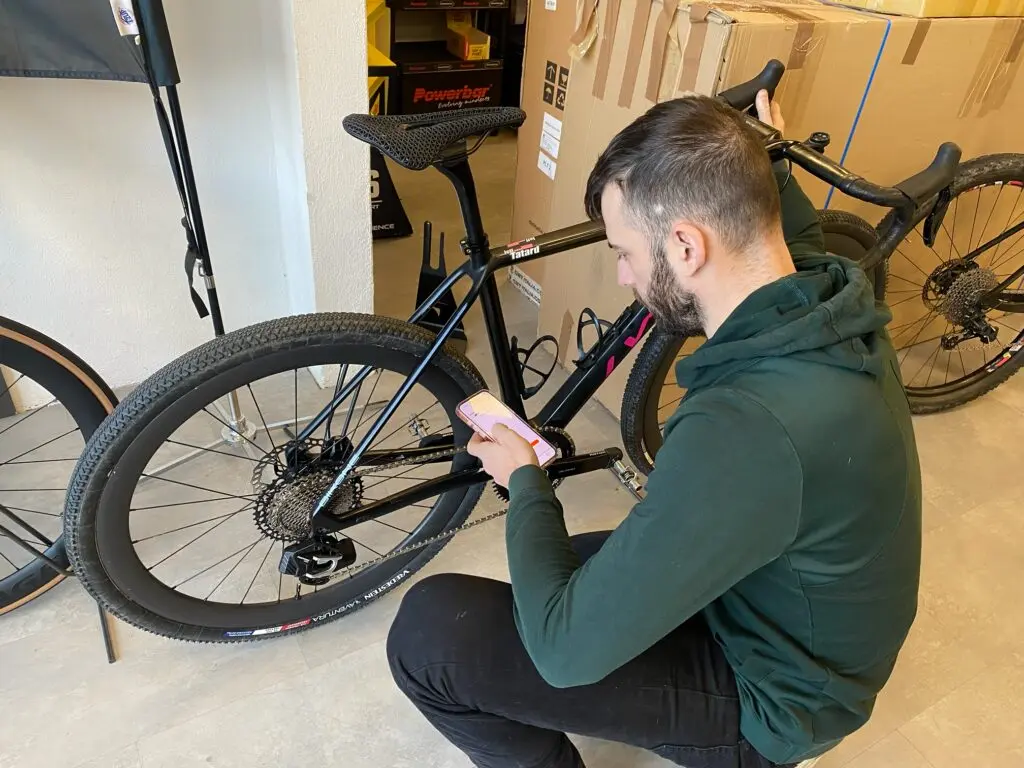
But above all, the application undoubtedly hides one of the groupset’s greatest strengths: the ability to individually adjust each possible gear speed. Where competing systems like Shimano Di2 or SRAM eTap offer a global adjustment applied to the entire cassette, ROTOR here allows for fine-tuning, cog by cog. A much more precise approach, which will delight meticulous cyclists as well as demanding mechanics.
Another particularly appreciated detail in use: the precise display of the battery charge percentage. No simple approximate indicator or vague estimate, but clear and reliable information, which allows you to know exactly where you stand before going for a ride, a real plus, especially in winter use.
And once the adjustment is made, you almost never go back to it.
That’s perhaps the best compliment one can pay to a drivetrain application.
Battery life and charging: a constraint… that isn’t one
In terms of battery life, the ROTOR UNO GRAVEL electronic groupset proved particularly reassuring in use. The manufacturer announces approximately 15,000 gear shifts, which corresponds, in a context of committed gravel riding, to fifteen to twenty 3-hour rides, depending on the terrain profile and frequency of changes, an estimate fully consistent with our observations in the field.
A full charge requires about two hours, a reasonable time given the observed battery life. Without intentionally trying to drain the system completely, everything indicates that it is possible to ride for several weeks, or even nearly three months, before needing to recharge with regular use.

For the derailleur, there is no truly precise way to know the battery status without using the app. We looked for a dedicated button or indicator, without success, which we initially regretted a bit.
Recharging, however, is very simple: it is done via a magnetic connector directly on the rear derailleur, without disassembly or special handling. And therefore the battery level can be checked via the ROTOR app, which displays the percentage of remaining battery.
For the brake levers, each of them also contains a CR2032 battery. Its status can be easily checked by simultaneously pressing both control buttons: a green indicator confirms that everything is operational.
In practice, the battery life is such that one quickly stops thinking about it, which is undoubtedly one of the best indicators of a mature, reliable, and well-controlled electronic system.

Finally, despite the absence of direct feedback on the derailleur itself, power management never becomes a constraint in use. The system operates transparently, without untimely alerts or the need for constant checks. We focus on riding and the terrain, which remains, ultimately, the essential.

| Why is this groupset gravel? What this winter test teaches us, even before facing mud, cold, and degraded trails, is that the ROTOR UNO GRAVEL electronic doesn’t seek to shine with numbers or spectacular effects. It stands out primarily for its overall logic and the technical choices that structure it.
These intentions are not merely theoretical. They will be very concretely verified in the rest of the test, as you will see. It is therefore not a road groupset adapted for gravel. But there’s still one thing left to do: go ride it… |
On the trail: when gravel gets serious
Time for the real test.

The one where mud comes up to your knees.
The one where the paths disappear under a layer of greasy moisture.
The one where you ride because you love it, not for a photo.
Gear shifting
Gear shifting is:
- crisp,
- direct,
- without hesitation, even under moderate load.
It’s not brutal.
After a long discussion with Dany, we chose a custom configuration via the ROTOR app: the two buttons on the left lever are dedicated in our setup to shifting up, while the two buttons on the right lever are used to shift down. A simple setting, done in a few seconds from the app, and which proved to be an obvious choice in use.
Why this choice? To eliminate any ambiguity, especially in winter conditions, with thick gloves, numb fingers, and attention often focused on the trajectory rather than the drivetrain. No matter which button you press: the result is always the same. You gain in instinctiveness, fluidity, and above all, peace of mind.

In short, it’s not “flashy.” It’s not demonstrative. It’s simply effective.
Braking
Progressive.
Modulable.
Reassuring.
Even with fingers numb from the cold, confidence is there.
And in winter gravel, confidence is a luxury.
The ALDHU Carbon crankset: intelligent stiffness
The ALDHU Carbon crankset deserves a chapter of its own.
It’s not brutal stiffness.
It’s useful stiffness.
Every watt seems to go where it needs to go.
Without a “block” sensation.
Without unnecessary fatigue.
Coupled with the Q-RINGS chainring and the BIKONE DCTech bottom bracket, pedaling becomes smoother, more consistent, almost soothing, a real plus on long winter rides where you ride more on mental strength than on performance.
The assumed single chainring: a real choice, not a constraint
The choice of a single chainring in gravel is now widespread, but not all systems exploit it with the same relevance. Here, the combination of a 13-speed 11×46 drivetrain clearly changes the game: with a 1:1 ratio, the 46-tooth single chainring is by no means a limitation, quite the opposite. A fully assumed choice, validated by our faithful mechanic Dany, whose practical intelligence inspires as much as it reassures.
With the Q-RINGS 1X DM in 46 teeth, ROTOR doesn’t just simplify the drivetrain: the brand relies on the founding principle that made its success since 2005, namely the ovalization of the chainring, to concretely optimize pedaling.
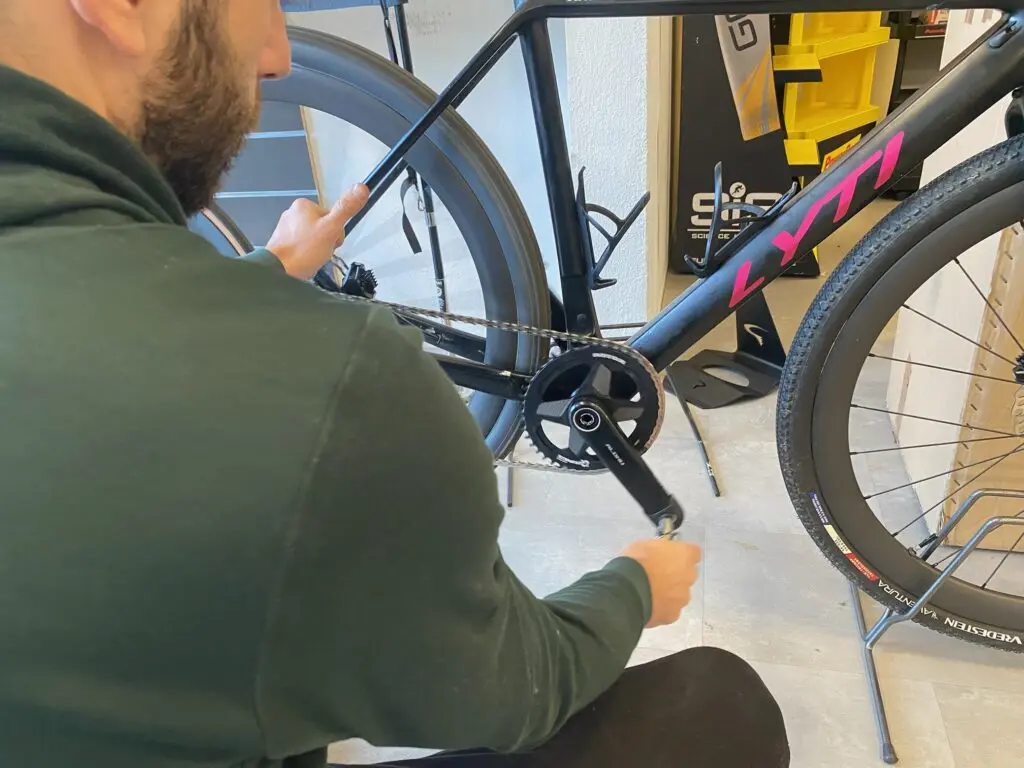
In climbs on loose terrain, accelerations after a tight turn, or the endless false flats typical of winter rides, this ovalization creates a very appreciable sensation of continuity. The effort is better distributed throughout the pedaling cycle, smoother and less abrupt at dead spots. It’s not an immediate spectacular effect, but over time, efficiency and comfort clearly improve, exactly what allowed ROTOR to establish itself from its beginnings.
Winter, a revealer of consistency
This ROTOR groupset, tested in the middle of winter, reveals one thing above all: its overall consistency.
Nothing seems oversized.
Nothing seems like a gadget.
Every component has a reason to be.
And above all: nothing has faltered.
Neither the drivetrain.
Nor the electronics.
Nor the braking.
Nor the crankset.
Nor the bottom bracket shell, despite being on the front line against mud, water, and repeated washings.
Durability and winter use: when equipment is truly put to the test
A groupset can be convincing for a few rides. But winter insists. It repeats. It wears down. Abrasive mud, constant spray, frequent washings: these are the conditions that reveal a system’s weaknesses.
Throughout the test, the ROTOR UNO GRAVEL electronic remained consistent. No misalignment, no loss of precision, no strange electronic reactions. The BIKONE DCTech BB86-92 bottom bracket perfectly withstood these conditions, maintaining smooth and silent rotation, ride after ride.
Maintenance: simple, rational, without pretense
Clean, check, ride again. On this point, the ROTOR groupset immediately reassures. Clear architecture, simple access, components that inspire confidence. After washing, no unpleasant surprises, no hazardous reconnection. Wash, dry, ride again.
Over time: what the long-term test reveals
Ride after ride, one thing becomes clear: this groupset doesn’t tire its user. You don’t think about it. It works, and it makes itself forgotten. In a world where technology can sometimes be intrusive, this discretion is a real luxury.

3bikes Verdict
Mounted on our LYTI frame, which we know by heart and love for its versatility and balance, the ROTOR UNO GRAVEL electronic groupset found an ideal playground. The bike gains in consistency, fluidity, and serenity, especially in winter conditions where every detail counts. Nothing disturbs the riding, nothing distracts from the essential: riding long, riding right, riding true.
This groupset doesn’t seek to impress on the first touch. It gradually seduces, ride after ride, with its global intelligence, ease of use, and impeccable behavior when conditions get complicated. On the LYTI, the whole works as a homogeneous, almost obvious unit.
Our opinion
The ROTOR UNO GRAVEL electronic is clearly aimed at curious, demanding gravel riders who are willingly outside of established standards. For those who like to understand what they’re mounting, why they’re mounting it, and who ride all year round, whatever the conditions.
The technical and industrial link with Wheeltop may legitimately raise some questions among the most conservative, and initially led us to observe this groupset with some reservation. But in use, this affiliation quickly fades behind a consistent, stable, and convincing experience.
This test, conducted in the middle of winter, primarily allowed us to understand one essential thing: while this groupset could technically work on a road bike, it clearly doesn’t perform at its best there. Its single-chainring logic combined with a wide range of gears, its ergonomics designed for riding with gloves, its tolerance to degraded conditions, and its consistency over time naturally place it in the gravel universe. It doesn’t seek instant performance, but continuity, serenity, and efficiency when the terrain ceases to be predictable.
It is therefore not a groupset “adapted” for gravel. It is a groupset designed for gravel.
It’s not a mass choice. It’s a thoughtful choice. Almost militant.

Conclusion: a connoisseur’s choice
The ROTOR UNO GRAVEL electronic is not a groupset for everyone.
And that’s precisely why it’s interesting.
Tested in the middle of winter, assembled without difficulty, adjusted without fuss, it proved it was ready for real gravel.
And that, at 3bikes, we respect immensely.
The ROTOR UNO GRAVEL electronic groupset in brief…The + : intelligent and coherent overall concept, easy assembly and adjustments, clear and stable smartphone app, impeccable manufacturing quality, excellent pedaling sensations with Q-Rings, reliable and silent BIKONE DCTech bottom bracket, perfectly suited for committed, winter, and real gravel, cog-by-cog gear adjustment via the app, much more precise than a global cassette adjustment and particularly appreciated by meticulous cyclists and demanding mechanics. The – : Still a confidential brand image, more limited after-sales service network than market giants, link with Wheeltop may raise questions among the most conservative users, no way to check derailleur battery status without using the app, requires a minimum of curiosity, open-mindedness, and user involvement. Prices:
And the little extra, Supacaz – Super Sticky Kush – Classic (Black) handlebar tape: €40.00 Contact: Alternativsport |
Share the post "ROTOR UNO GRAVEL electronic groupset review"