Share the post "In trouble, how Campagnolo can still bounce back"
Campagnolo is one of those names that resonate like a Proustian madeleine in the world of cycling. A legendary brand, synonymous with innovation, Italian elegance, and top-level performance. However, the brand’s recent news is darker: financial difficulties, persistent rumors of layoffs, and uncertainties about the future. A painful situation, both for cycling and for Italian industry, of which Campagnolo remains one of the historical pillars. But the company can still revive itself, provided it evolves its strategy.
By Guillaume Judas – Photos: depositphotos.com, 3bikes.fr
Campagnolo is approaching its centenary, and its history is marked by major innovations that have profoundly transformed cycling practice. As early as the late 1920s, the invention of the quick-release wheel established the Italian brand among the industry’s leading players. In the late 1940s, Campagnolo launched the first modern parallelogram rear derailleur, before integrating, in subsequent decades, new materials such as magnesium and then titanium to lighten and optimize its components.
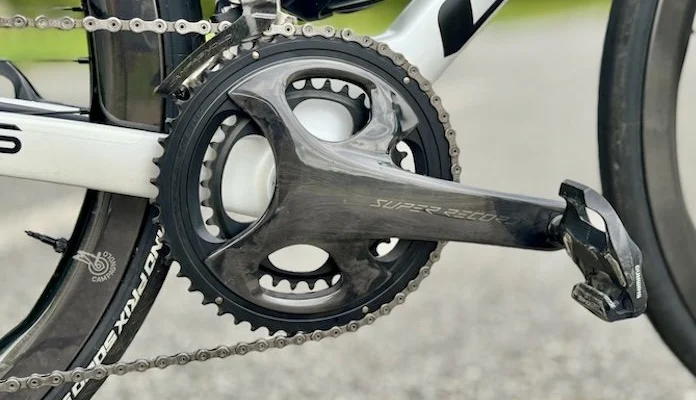
The brand is also behind the concept of the high-end complete groupset, embodied by the mythical Super Record, which remained at the top of the hierarchy between the mid-1970s and the mid-1980s. A name that still today remains synonymous with absolute excellence, including on the most recent productions. Finally, Campagnolo distinguished itself by being the first to successively introduce 10, 11, 12, and then 13-speed transmissions, each time maintaining a technological lead over the competition. Successive revolutions that no cyclist has ever complained about.
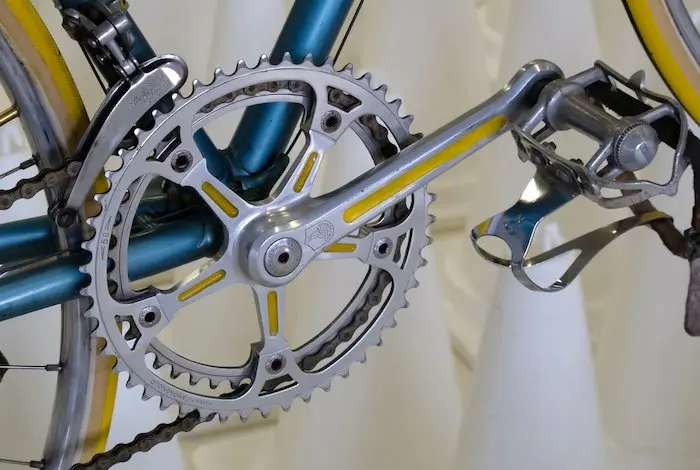
Facing its most direct competitor, the Japanese giant Shimano, Campagnolo nevertheless missed a first industrial turn in the late 1980s by under-investing in the MTB market. While the brand remained very present in high-level road cycling until the mid-2000s, another strategic decision, even more questionable, ultimately weakened it permanently.
By choosing, from 2007, to reposition itself exclusively as an elitist brand, Campagnolo abandoned its entry-level groupsets, cutting itself off from both beginner cyclists, who are nevertheless potential future customers for more prestigious products, and the OEM market, that of original equipment. The brand then gradually disappeared from bicycle manufacturers’ catalogs, surviving almost exclusively in the custom-build universe, with rare and expensive products. A risky gamble, in an industry where the first experience often conditions a cyclist’s entire life.
Producing in Italy, a courageous but restrictive choice
It would be unfair not to recall an essential point: Campagnolo continues to produce a large part of its components in Italy, and another part in Europe, particularly in Romania. The brand has made the deliberate choice not to offshore its production to Asia and to stay away from mass OEM assemblies. This is a strong, almost militant commitment, at a time when many emblematic Italian brands have largely outsourced their manufacturing. This positioning obviously has a cost, but it also constitutes one of the pillars of Campagnolo’s identity.
However, this philosophy contributed, for many years, to a certain disaffection on the part of potential customers. The Super Record groupset, the brand’s technological showcase, was long sold for up to €1,000 more than its direct competitors (SRAM Red and Shimano Dura-Ace), which were comparable in terms of weight, functionality, and reliability.
With the brand new Super Record Wireless 13-speed, Campagnolo has repositioned itself at a price level now equivalent to that of these two high-end benchmarks. It remains to be seen whether this adjustment will be enough to allow it to regain significant market share, even though these components use noble materials such as carbon and titanium and display an exceptional level of finish.
Winning back the crowds
Campagnolo also means wheels, whose quality and reliability have always been unanimously recognized, regardless of the range level. Yet, here again, the brand has not really invested in recent years in the development of accessible models, while many competitors now offer carbon disc brake wheels around €1,000. This segment has become strategic, both in terms of volumes and visibility.
Conversely, the Italian brand continues to offer rim-brake and mechanical transmission groupsets, as it did ten or fifteen years ago. A real pleasure for purists or for those who wish to update an old-school frame, but an offer largely disconnected from current market expectations, now dominated by disc brakes, electronics, and standardization.
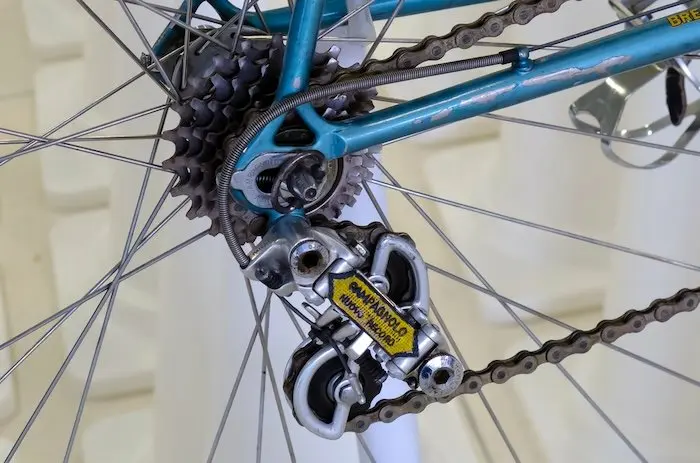
To survive and reconnect with its aura, Campagnolo will undoubtedly have to undertake a profound change in strategy. The current range, particularly with the multiplication of Super Record variations, blurs the message and dilutes prestige. Too many versions, too much complexity, for a market that primarily demands clarity and coherence.
Beyond the excellence of its high-end groupsets, which no one disputes, the return of a true mid-range appears indispensable. This is where the volumes are, what some call the fat of the market. Offering a modern, reliable, and competitive groupset, capable of being sold in large quantities, especially if bicycle brands agree to put Campagnolo back on models assembled and sold complete in stores.
The brand would thus benefit from developing a groupset capable of rivaling the Shimano 105, or even a true entry-level groupset, currently absent from Shimano’s offering but occupied by SRAM Apex. With talented engineers and know-how forged by nearly a century of history, Campagnolo undeniably has the means. It remains to be seen whether the strategic will follows.
A legend that must endure
Campagnolo makes no secret of its financial difficulties, with significant losses recorded in recent years despite substantial investments. The company announces approximately 120 layoffs in the coming months, out of a workforce of about 300 people. This is certainly not a good sign, but it also mentions an ambitious recovery plan.
We are convinced: if Campagnolo manages to combine its heritage, its European industrial know-how, and a more accessible offering, the brand can still write beautiful pages of its history.
Share the post "In trouble, how Campagnolo can still bounce back"