Share the post "Cycling, the sport that makes muscles… stupid (and us with them)"
In the world of cycling, there are two schools of thought: those who believe that the more you put in, the more you get out; and those who wonder if the body isn’t actually a kind of Ferrari that needs direction, not just infinite mileage. Spoiler: the peloton has been going full throttle for decades with a surprisingly simple, and not necessarily the smartest, answer.
By Jeff Tatard – Photos: DR
Where it hurts (and not just the thighs)
When you observe a cyclist off their machine, lying on a sofa, standing in front of a fridge, or simply trying to touch their toes, one observation is striking: many are extraordinarily good at turning their legs, but absolutely mediocre at everything else.
Why? Because, historically, cycling has been elevated to the rank of a metabolic art. FTP is measured as if it were the mastery of life, training zones are cockpited as vectors of salvation… and the richness of the body off the saddle is ignored.
And that’s where the myth takes hold: The more I do, the stronger I become.
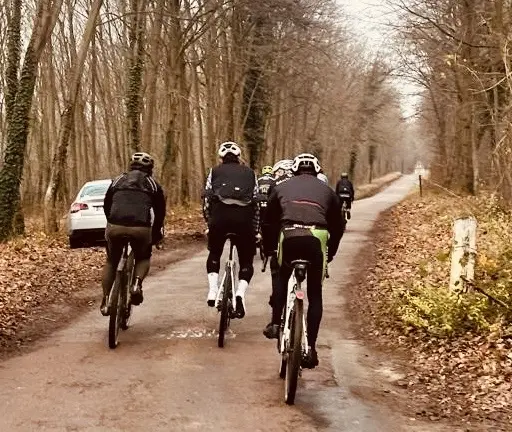
A slogan that strongly resembles a prayer to justify a kilowatt of kilometers… even if scientific data questions this magical equation. There is no guarantee that high volume alone improves performance more than well-structured training.
When the muscle becomes… one-dimensional
Imagine a rider who pedals 15,000 or 20,000 km per year but never lifts anything other than their water bottle. Their body may resemble an exceptional endurance machine, but also a neurological system stuck in a repetitive postural routine.
This is what some ironically call a dumb muscle: it knows how to turn, it knows how to repeat, but it no longer knows how to think outside its unique task. And this “closure” of the muscular system comes at a price: reduced mobility, stiff joint chains, glutes that fall asleep, and posterior chains working in survival mode… exactly what ABD described in his approach in the article “rebuilding the athlete before the cyclist”, when we met him for 3bikes last November.
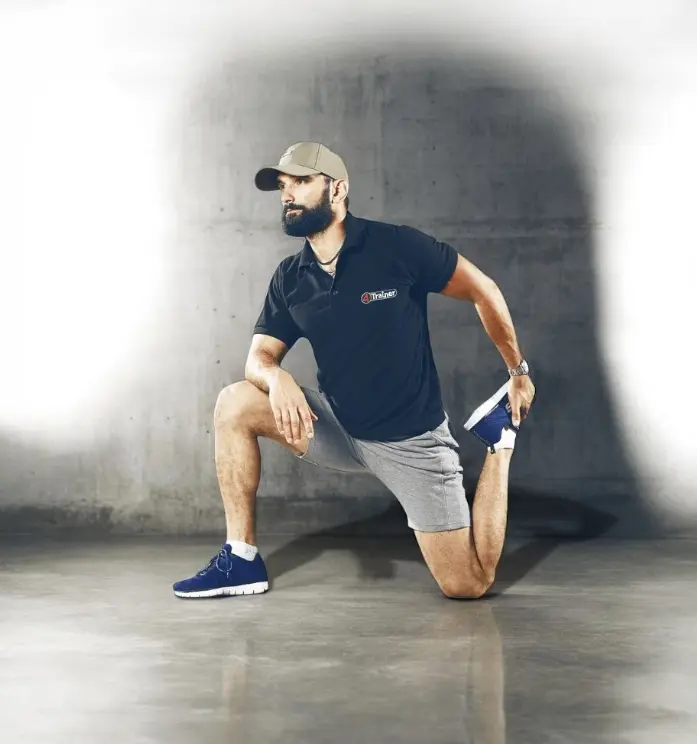
This is not a caricature: it is a logical mechanical consequence of single-task and undiversified training. In nature, a body that only moves in one plane eventually loses its adaptive beauty.
Volume, overtraining, and the lair of pain
Ah, the famous “more kilometers, more gains” – an equation that looks suspiciously like a recipe for:
- Chronic fatigue
- Muscle overwork
- Performance plateau
- Mental and physical accidents and injuries
Sports science has a term for this: overtraining, literally, too much training, not enough recovery. When you exceed what the body can handle, it protests… and eventually reacts with a drop in performance.
And let’s not kid ourselves: in amateur cycling, cyclists are often taught to ride long distances, but we forget to teach them to prepare their bodies to handle that long distance. As if learning to read a GPS map without ever learning to walk was still wisdom.
An invitation to think differently
So, rather than turning your program into a marathon of numbers based on cumulative hours, perhaps the real question becomes: Does my training make my body smarter or just more tired?
And the answer begins by recognizing that:
- Volume is never an end in itself, but a means.
- Strength, mobility, neuromuscular variability are not accessories, but foundations.
- A rider can be metabolically sharp but mechanically infantilized.

Conclusion: smarter than just more
Cycling is a magnificent sport, a subtle alchemy of technique, endurance, effort, and strategy. But when this beauty transforms into a culture of volume without reflection, then the muscle becomes dumb, performance plateaus, and the mind gets exhausted.
If you want to leave this paper with a new perspective, remember that progress is not measured in cumulative kilometers, but in diversity, movement intelligence, and thoughtful recovery.
The body is not a machine that you fill with hours.
It is a living system that adapts, learns, and… gets bored if you stop giving it things to think about.
=> And if you want to know more about the school of excellence in sports coaching, visit Aurélien Broussal-Derval’s website
Share the post "Cycling, the sport that makes muscles… stupid (and us with them)"