Share the post "Why massage is (still) the top recovery method"
And why masseurs are clearly not close to being unemployed? Every year, cycling (and endurance sports in general) promises us the ultimate recovery revolution. A new gadget. A new technology. A new machine that vibrates, compresses, electrifies, or freezes. And yet…
By Jeff Tatard – 3Bikes.fr / Photos ©3Bikes
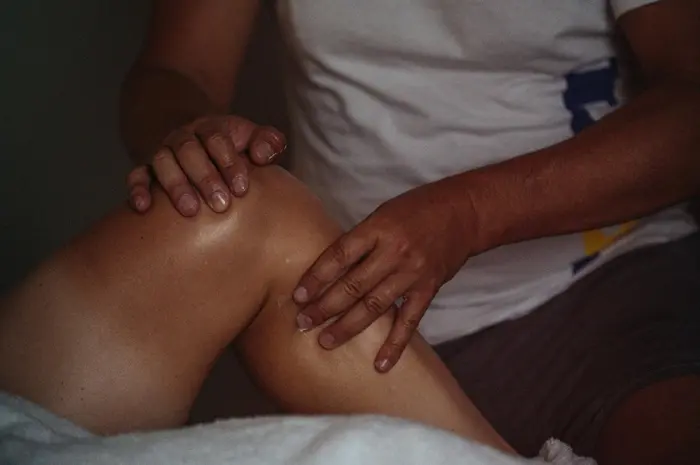
At the end of the day, when the watts have been delivered, the legs are hard as concrete, and the brain begs for mercy… we always come back to the same point: a table, oil, two hands, and someone who knows how to use them.
Despite Compex electrostimulators, whole-body cryotherapy, Theraguns that make more noise than a helicopter, or state-of-the-art pressotherapy, massage remains the absolute benchmark. Simple. Basic. Terribly effective.
Technology progresses, muscles too… but not in the right direction
Let’s be clear: All these technologies have their place. They help, complement, optimize. But none truly replace the intelligence of human touch.
Because a muscle is not just an electrical signal or uniform pressure. It tells a story. Fatigue. Tension. Imbalance. And no machine can yet read that as finely as a good masseur.
In the World Tour, the return… to basics
A few months ago, Stéphane Gicquel gave us a behind-the-scenes look at the Alpecin-Deceuninck team. And the observation was clear: the trend is not towards less massage, but more massage.
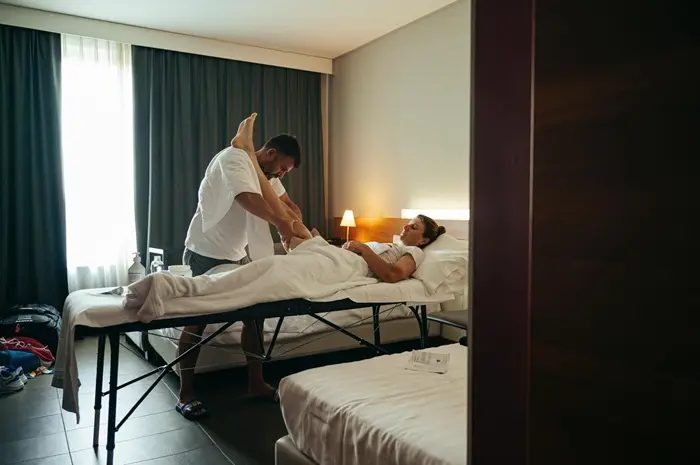
“Today, we are moving towards one masseur per rider. Not just to avoid waiting, but because the effectiveness of the massage decreases with the masseur’s fatigue. About an hour a day is the limit to remain truly effective.”
Translation: massage is so important… that the human organization is adapted around it. Not the other way around.
Massage is not just a pleasant moment
What makes massage so powerful is not just relaxation. It’s its immediate adaptability.
As Guillaume Lange, a renowned physiotherapist in endurance sports, summarizes it very well: “Massage is the only tool that allows you to evaluate, treat, and adjust in real time. You feel what’s happening under your fingers, and you adapt instantly.”
No fixed protocol. No standard program. Just a fine reading of the body.
The same goes for Mathieu Moretti, another expert in the field: “Machines do what they are asked. The masseur, however, understands what the body needs, sometimes even before the athlete verbalizes it.”
And that’s the whole difference.
The machine tires less… but it understands nothing
The irony of it is: we often invest in technology to save time or energy.
But in the case of massage, the human remains irreplaceable, even if they too have their limits.
A tired masseur massages less effectively. An overloaded masseur loses precision. Hence this logical evolution in high-level teams: more masseurs, better distributed, to maintain maximum effectiveness.
Meanwhile, machines do what they know how to do: repeat. Always the same. Without nuance.
Conclusion, the future is high-tech… but hands remain ahead
Recovery is evolving, that’s undeniable. But if there’s one certainty, it’s that massage has never been so central.
Not because we are nostalgic. But because no innovation has yet managed to beat the ultimate combination: experience, touch, adaptation, intuition.
So no, rest assured: masseurs are not close to being unemployed. And seeing the direction high-level sport is taking, they are likely to be in even greater demand.
Which just goes to show, sometimes the best technology… is just two well-placed hands.
=> Find all our societal articles: All our Coaching articles
=> And since good recovery is essential for road cyclists looking to improve their performance, watch this video from the Arkéa team masseur
Share the post "Why massage is (still) the top recovery method"