Share the post "Kinesiology: the science of movement… or a way of life?"
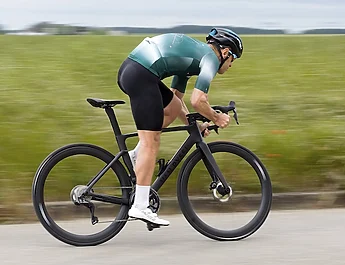
There are disciplines you encounter in lecture halls like flipping through a chemistry textbook: with curiosity, respect… and sometimes a slightly perplexed smile. Kinesiology, is a bit like that. A word that sounds like a voodoo spell, that you hear in class, that you read in revision notes… but which, when you scratch beneath the surface, reveals a whole world. So we took the time to look closer, to discuss it with some bright minds, and to understand what it really is, and why it matters, even when you just want to cycle at a steady pace. Because ultimately, movement is life. And cycling is movement with handlebars.
By Jeff Tatard – Photos: All rights reserved
Pauline: “I’m taking my exams and I haven’t fully understood kinesiology…”
Meeting Pauline, a first-year anatomy student. She arrived at our editorial office with a question that sounded obvious after a few coffees: « But what exactly is kinesiology? And why can’t my professor explain it to us simply? »
And right then, we immediately understood that this word is better understood when seen in motion, not just on a whiteboard.
First axis: biomechanics, the engines of movement
If you’ve ever raised an arm, gritted your teeth on a climb, or cursed a stubborn derailleur, you’ve done biomechanics without knowing it.
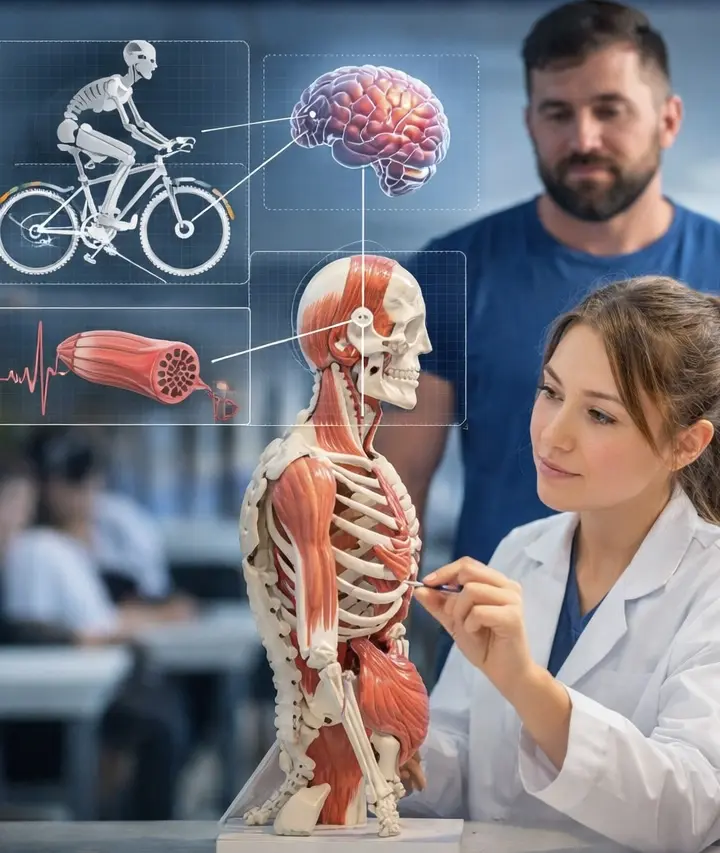
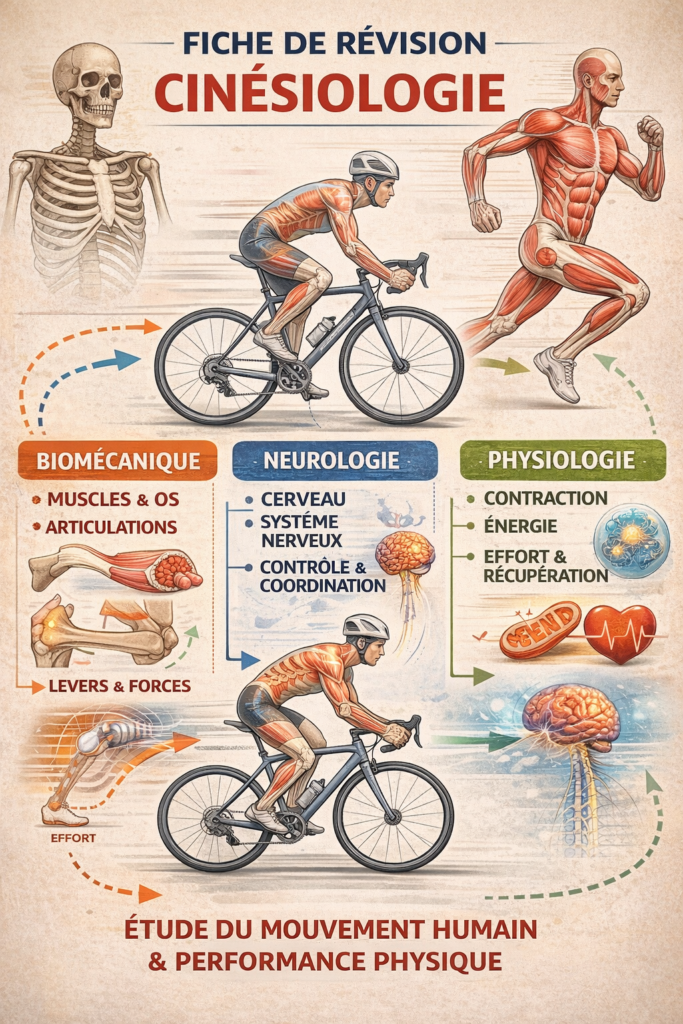
Biomechanics is the study of forces and levers: how a muscle moves a bone, how a joint pivots, how a chain of movements transforms watts into speed.
For Guillaume Lange, a physiotherapist for high-level athletes and a biomechanics expert, it’s the foundation of everything.
« Without understanding how muscles work together, you can have the heart of a lion… but a crankset that ticks. »
So we’re talking about what makes things move, literally, and, sometimes, what seizes up when nothing is really running smoothly.
Second axis: neurology, the conductor
If biomechanics is the engine, neurology is the conductor.
Without a signal from the brain, the muscle remains silent. So we’re no longer just talking about levers and mechanics, but about networks: brain, spinal cord, peripheral nerves. For a movement to be precise, powerful, and safe, communication must be crystal clear.
Mathieu Moretti, another brilliant physiotherapist from our valuable network and a passionate physical therapist, summarizes it very simply:
« It’s like Strava and your 4 or 5G connection: if it lags, things quickly get complicated. »
And he’s right. The brain constantly coordinates, anticipates, and adjusts. It’s often the brain, more than the legs, that explains why the first turn is sometimes the trickiest part of your Sunday morning ride.
Third axis: physiology, the energy at play
So here’s the third leg of the stool: physiology. Here, we look at how the muscle functions from the inside: fibers, energy systems, fatigue, recovery. Because without energy, even the most beautiful biomechanical diagrams remain drawings on a page.
That’s where Pauline starts to smile : « Okay, now I see it better. It’s like… understanding how and why my body responds when I say “come on, let’s go!”. »
Exactly. And that’s also what makes some mountain bike trails seem easier than others, even when they look similar on a map.
A word on “wellness kinesiology”
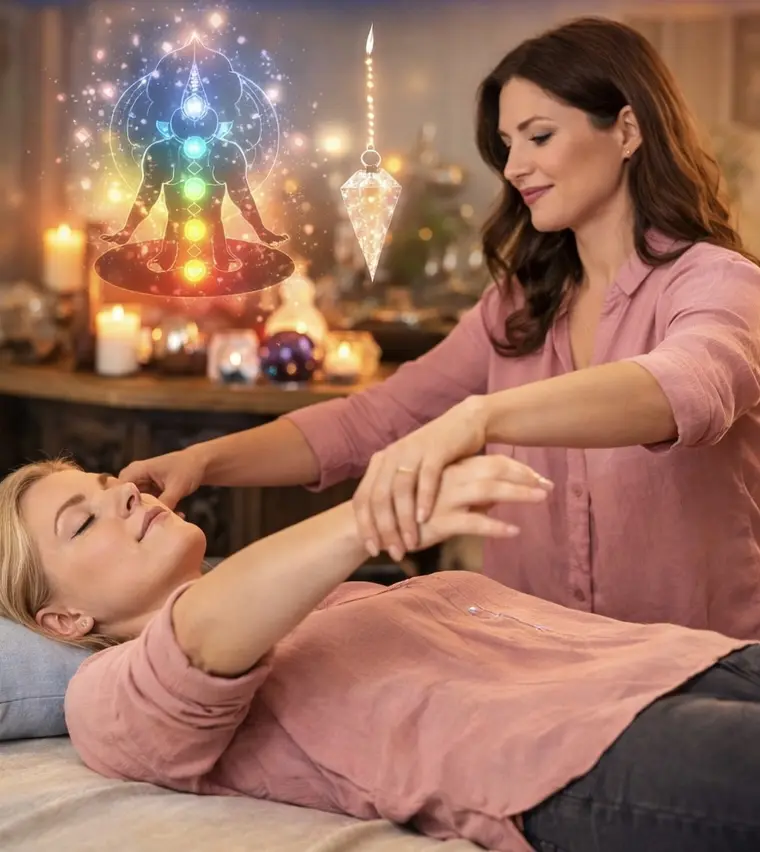
But beware: there is a “wellness” version of kinesiology that uses muscle tests in emotional or energetic contexts, you know, those somewhat mystical things you sometimes see on Insta.
We’re not going to judge them here, but in anatomy exams, that’s not what’s expected. Here, we’re talking about science, anatomy, forces, movement, not muscular dowsing rods.
So yes, what is kinesiology?
As often on 3Bikes, it’s less mystical than it seems, and much more useful when you put concrete examples into it. |
The epilogue (but not a court)
Ultimately, kinesiology, the scientific kind, not the spiritual, is a bit like cycling: Every pedal stroke is supported by mechanics, a nervous signal, and energy. It’s simple on paper. It’s subtle and profound as soon as you try to truly understand how it works.
And if your anatomy professor doesn’t explain it well… tell them we’re ready to help.
Because ultimately, understanding how the body moves isn’t just for exams: it’s for moving better, longer, and especially without stressing out at every turn.
=> Discover what Kinesiology is on PASSEPORT SANTE
Share the post "Kinesiology: the science of movement… or a way of life?"