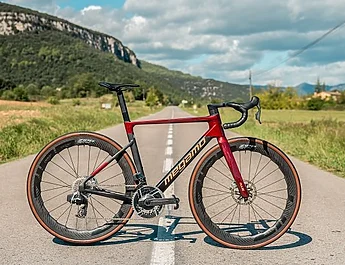
Share the post "Long-term test of Oquo RP50 LTD and RA57 LTD wheels"
For those who don’t know yet, Oquo is not the wheel division of a bike manufacturer (although it is part of the Orbea group). It is, on the contrary, an independent wheel manufacturer. With this test, which spanned nearly four months of riding in all conditions, it was not one pair but two that underwent regular rides in very varied weather conditions and on diverse routes. At first glance, while the 50 and 57 mm profiles may seem very similar, on the road their behavior is sufficiently different to merit their joint presence in the catalog and to cause potential users to hesitate. But these kilometers covered should allow a decision to be made, depending on the chosen orientation and, of course, the cyclist themselves.
Text: Olivier Dulaurent – Photos: 3bikes.fr, oquowheels.com/fr

Oquo is therefore a Basque brand, just like Orbea, which is at the origin of this entity. In mid-2025, Oquo rethought its wheel range, introducing lighter proprietary hubs and new carbon rim profiles.
LTD models were previously equipped with the Zipp Cognition hub. Oquo also offers the Team range, mid-range wheels retaining the Zipp ZR1 hub, and the Pro range, entry-level aluminum wheels.
The wheels are produced in Oquo’s new, ultra-modern R&D and manufacturing facility, located in Bizkaia (Biscay), in the Spanish Basque region.
Oquo has achieved notable success since its launch in 2022, securing podiums in the Tour de France and the Downhill MTB World Cup.
As already discussed in the article’s introduction, Oquo is a wheel brand within the Orbea group, operating independently. These are referred to as “sister brands,” meaning related brands within the same group but independent.
Oquo rims are 100% designed in-house, which distinguishes them from many other brands. Many brands rely on rims from open molds and content themselves with building wheels around them, without bringing real added value in terms of design or development.

A factory capable of producing 1500 pairs of wheels per day
The new R&D and production facility allows assembling up to 1500 pairs of wheels per day, while creating over 100 skilled jobs.
For this new generation, Oquo has redesigned the rim profiles, created a new lightweight hub, and expanded the range with a race-oriented aerodynamic option while being adapted to a road/Gravel mix and represented here by the RP50 LTDs in the test.
As mentioned previously, Oquo designs and manufactures the wheels. They design the rims using CFD (Computational Fluid Dynamics) calculations and wind tunnel tests to measure drag (aerodynamic resistance), airflow, areas where turbulence occurs, and the influence of crosswinds on wheel behavior. They also perform FEM (Finite Element Method) calculations, a structural analysis of the rim design allowing them to understand how loads affect different areas of it.
The “mini hook” concept
Oquo has retained the same rim and mini hook design it introduced on the first generation. Unlike Hookless rims, the mini hook preserves compatibility with tubed tires, while allowing the use of tubeless tires, which appears to represent the best of both worlds.

The mini hook is approved for up to 6.5 to 7 bars on the road, a higher pressure than Hookless rims, which are limited to 5 bars.
While the tire/rim interface remains similar, the rim shapes and profiles are entirely new. Their development spanned three years, with the participation of riders from the Orbea and Lotto teams sponsored by Oquo.
Road tests, combined with wind tunnel validations, were essential according to Oquo.
Different rim references
The RA80 and RP50 are entirely new rims, while the RA57 has been updated compared to the first generation. The specific design improves crosswind performance thanks to a wider rim, which also allows increasing the internal width, going from 21 mm to 23 mm, to accommodate a wider range of tires, now very trendy.
The references are first distinguished as RA (Road Aero), thus with aerodynamic profiles and a balance between lightness and high-speed efficiency. Then, we find the RP (Road Performance), which combine aerodynamics, lightness, and comfort, regardless of the surface.
New lighter and simpler hubs
Oquo previously used Zipp Cognition hubs in its LTD range and Zipp ZR1 hubs in its TEAM range. For the second-generation LTD models, the brand designed a new hub: the Q10.
The hub body is CNC machined from 7075 T6 aluminum, a material that Oquo claims is more durable than steel, while being lighter and stiffer.
The new ratchet freehub system, called Shark Ratchet, combines a 45-tooth engagement with a full ceramic treatment, reducing friction and offering a fast 8° engagement angle.
The hubs use custom stainless steel bearings, low-friction seals, and proprietary water-resistant grease. Oquo claims they remain performant down to -50 °C.
The announced weights are 175 g for the rear and 104 g for the front. For comparison, DT Swiss’s lightest road hub, the DT 180, weighs 192 g for the rear and 93 g for the front. The Q10 has thus become one of the lightest CenterLock hubs on the market.

Tool-free maintenance
The assembly uses a threadless interface, allowing disassembly, inspection, and maintenance without any tools.
Oquo has therefore reinforced the quality of the seals, announced as very effective and resistant, preventing water and dust infiltration. Even the freehub body change (Shimano ↔ SRAM) is done without tools, by simply replacing a part.
Customization
Oquo offers a rim customization program that includes 11 colors as well as the graphics used by the professional teams that race with the Basque brand. This customization was made possible by the complete internalization of assembly and manufacturing.

Oquo wheels stamped LTD
The LTD range thus includes on one side of the “spectrum” the RP35 LTDs, designed for the hilliest profiles with their 35 mm rim depth and a weight of 1244 g. At the other end are the RA80 LTDs, the model dedicated to time trials and triathlon with its 80 mm rim (weight of 1626 g).
In the middle of the wide gap between these two pairs of wheels, we find the two tested models:
– RP50 LTD
The RP50 LTD (thus 50 mm depth) is designed as much for Gravel as for cobbled classics. Initially, these wheels were developed to meet the needs of the professional Lotto team riders in the context of the Flemish classics. They thus allow naturally using large tire widths, thanks to their 25 mm internal width. They also adopt the mini hook principle. Their weight is 1420 g.

– RA57 LTD
This is a direct competitor to the well-known Zipp 404, Roval Rapide, and ENVE SES 4.5. With their 57 mm rim depth and 23 mm internal width (i.e., 2 mm less than the RP50 LTDs), they are limited to 1460 g. According to Oquo, in the range, this is the model offering the best compromise between lightness, aerodynamic stability, and speed.

On the road
In total, approximately 2000 km were covered with the RP50 LTDs and 1000 km with the RA57 LTDs, and some rides were split into two parts, switching from one pair of wheels to the other halfway through the ride in order to highlight the differences. The tires used were identical so as not to add this parameter to the comparison.

RP50 LTD
As noted above, the wheels were equipped with Continental GP 5000 tubed tires in 28 mm. It should be noted that Oquo recommends using this model with tires from 29 mm width given the 25 mm internal width of the rim, but the 28 mm tires did not pose any problems during the test. Due to the significant volume induced by the rim width, pressures could be lowered, i.e., with tubed values close to what they would have been in tubeless – in this case 4/4.5 bars front and 4.5/5 bars rear.

Thus, the characteristic felt from the first pedal strokes on roads in average condition is the excellent comfort precisely linked to the tire volume and lowered pressure. And yet, this quality was felt with “only” 28 mm tubed tires, while they probably show their best in 30 or 32 mm or even Tubeless (not tested). However, I was even able to test the RP50 LTDs on about fifteen rides on a light Gravel section like Strade Bianche, starting from/returning to accommodation, while gaining confidence with each passage. And Guillaume had successfully tested them during his review of the Orbea Terra Race (Gravel). Therefore, one understands the interest of the professional Lotto team riders for this particular model for cobbled Flemish Classics.
At the other end of the usage spectrum, the wheels were subjected to long climbs, even climbing Mont Ventoux twice.


In any case, in terms of dynamic behavior, these are wheels that are both stiff and responsive.
The RP50 LTDs then truly seem to accompany the cyclist in the pursuit of performance, on very varied terrains, from very rolling terrain to very hilly profiles.
But if performance is sought, they are more suited to a fluid and round pedaling style – which does not exclude high power outputs – rather than with force and in a jerky manner, especially with a stiff frame such as the Factor Ostro which was used during the test. In case of fatigue, with the increased difficulty in maintaining a sufficiently high cadence, these stiffness characteristics are even more noticeable and can be penalizing. Because contrary to what one might initially believe for stiff equipment, the best performance is achieved with a fairly high cadence. But unless choosing a lower profile, it is difficult to have this type of behavior (fast and stiff as with these RP50 LTDs) when feeling strong and to have wheels that are very easy to live with in case of a drop in form or lower power output, such as for long and steep climbs (high mountains). For these scenarios, the RP35 LTDs (see photos below) are probably more suitable, especially if you are not among the strongest riders.

On descents, the behavior of the wheels was also highly appreciated. Indeed, the lower tire pressure provides grip and makes it easier to smooth out road imperfections at high speed, benefiting road feel precision and relaxation, thus confidence.
And due to the wider rim width, Oquo announces less sensitivity to crosswinds. In use, this width also brings serenity when entering corners, where it becomes less necessary to “force” the bike. In any case, concretely, the cyclist becomes more serene without necessarily checking wind strength on weather apps before going for a ride. However, in some cases, such as descending Mont Ventoux with “only” about 50 km/h wind, the bike becomes more difficult to handle than with the 30 mm deep wheels I also use in parallel.

Finally, it should be noted that due to the rim width itself and as mentioned above, it is possible to consider purchasing the RP50 LTDs for their road/Gravel duality; in other words, they can be used as performance wheels for two bikes in one’s garage, even if regular tire changes can become tedious when used with Tubeless tires in both cases.
RA57 LTD
With the same tires as during rides with the RP50 LTDs, to achieve the same road feel, it was necessary to adjust the pressure with an additional 0.5 bar, always due to that famous volume obtained thanks to the 25 mm internal width in the case of the RP50 LTDs. This immediately resulted in slightly lower comfort, a phenomenon amplified by the higher profile, which therefore deforms less over road imperfections and impacts.

Without real surprise, there are obviously many similarities in terms of dynamic behavior with “the little sister.” We therefore find significant stiffness but which does not make it a “piece of wood.” In some ways, and again, this could be expected, it is the “plus version”: the stiffness slider is moved upwards, the speed gain at the start of a false flat descent is slightly improved, and sections ridden at maximum power seem even more beneficial. These points make it a very effective pair of wheels when performance is sought, such as when regularly pinning on a race number on Sundays.

Moreover, in the presentation of this product, Oquo announces the following points: the wheel with a 57 mm profile is the most versatile in the aero range. It offers a perfect balance between lightness, high-speed efficiency, and increased comfort compared to the 80 mm profile. The rim design is optimized to improve stability in crosswinds. This wheelset is perfect for cyclists looking for a fast and responsive ride without sacrificing versatility on varied routes.

However, if Oquo here evokes the versatility of the aero range (consisting of 80 and 57 mm), the best compromise for versatility in general is indeed the 50 mm version. This one proves slightly more agile in tight corners, more comfortable, more forgiving when strength runs out, less tiring when the wind blows sideways, and easier to live with on climbs, and thus generally on routes with elevation. It remains that it will be possible to fall for the higher of the two versions, for its racy look and even more muscular aesthetic.
Two pairs of wheels more distinct than expected
Upon receiving these two pairs of wheels for testing, I thought I would have to compare two products difficult to differentiate. But concretely, while certain characteristics are common, such as excellent performance, the ability to ride hard by combining power and cadence, certain difficult situations such as strong crosswinds, tired legs, or riding on bad roads, were able to highlight two sometimes more distinct behaviors. In this game, the 50 mm version was a pleasant surprise and proved very enjoyable to ride, thanks to its greater ease of riding everywhere and increased comfort, while it still has “more to give” when riding with 30 or 32 mm tire width and Tubeless. Certainly, this would have added a little extra weight, but their silky feel would have been even more highlighted. As for the RA57 LTDs, they are primarily wheels designed for fast riding, whether in competition or even with friends for a Sunday ride where riders know the last hour will be the fastest.
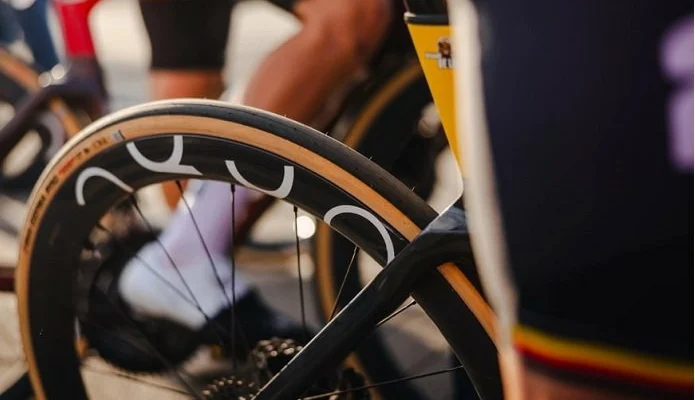
In any case, the very successful aesthetics of the wheels should also be noted, as here with the Oquo branding or differently using a very comprehensive configurator to match the chosen color for a part of the rim sidewalls with that of one’s bike or club equipment.
The Oquo RP50 LTD and RA57 LTD in brief…Pros: Successful aesthetics and interesting configurator, stiffness, responsiveness, comfort (especially with the RP50 LTDs), versatility, possibility of Gravel riding (RP50 LTD), supposed durability with Gravel use Wheels compatible with tubed tires and tubeless – Rim depth: 50 and 57 mm – Rim width: 25 mm internal for RP50 LTD and 23 mm for RA57 LTD – Spokes: Sapim CX-Ray, 24 in number (front and rear) – Hubs: Q10 (175 g rear and 104 g front) – Brake disc mounting: Centerlock – Weight: 1420 and 1460 g per pair – Price: €2399 per pair (or €1200 front and €1200 rear, individually) – Customization option (branding and color of part of the sidewalls) using the configurator – Delivered with wheel bags, Tubeless valves, sealant. Contact: oquowheels.com/fr |
Share the post "Long-term test of Oquo RP50 LTD and RA57 LTD wheels"