Share the post "Cycling and holidays: should you really train on Christmas and New Year’s Day?"
Between turkey, Yule log, and champagne flutes, the end-of-year holidays disrupt training habits. At a time when kilometers are scarcer and the weather more capricious, one question tirelessly returns: should one continue to train on holidays, such as December 24th and 25th, or accept a break from cycling? The answer often lies between athletic discipline and common sense.
By Guillaume Judas – Photos: depositphotos.com
For many practitioners, Christmas falls in the heart of a pivotal period. The season is over, the next one still distant, but winter training has already begun. Taking a complete break from training can seem tempting, but maintaining some regularity is reassuring. However, December 24th and 25th impose their own constraints, between family obligations, copious meals, and sometimes difficult weather conditions.
Training during the holidays, a choice with its advantages
Riding during the holidays is not absurd, provided you choose the right time and intensity. December 24th is particularly suitable. The morning or early afternoon often offers an ideal window before the Christmas Eve dinner. The mind is freer, the roads sometimes quiet, and available time more generous. A long ride, at a controlled pace, then allows you to stimulate endurance while preparing the body for the upcoming excesses. It also helps maintain a training routine, which is valuable mentally, even when goals seem distant.
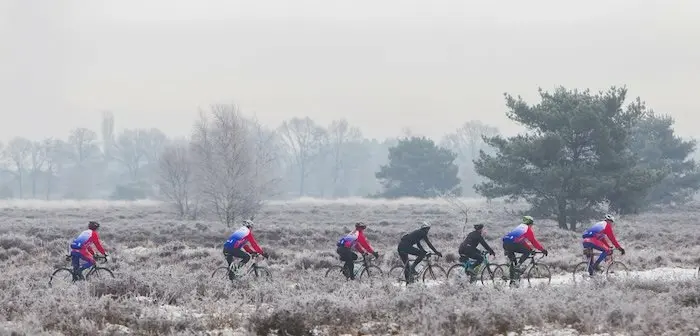
For me, it has been a ritual for at least 25 years. On the 24th, we organize a big ride with a group of friends. No question of racing up every climb, but of riding a lot of km at a steady pace, riding side by side two by two. Back when I was Elite, five or six hours were on the program. Today, I settle for 100 kilometers, more than enough to enjoy Christmas Eve with a clear conscience.
The next day, a very light activity can also find its place. A short and easy ride, or simply an opener ride, promotes blood circulation and helps the body cope with two close holiday meals, that of the 24th evening and that of the 25th at noon. In this context, cycling becomes a tool for well-being more than an instrument of performance. For my part, I prefer jogging on the morning of the 25th: 45 minutes in nature, without looking at the pace, solely by feel.
https://www.3bikes.fr/2025/11/25/gagner-des-watts-a-3-c-lavantage-cache-de-l%E2%80%99hiver/
Limits not to ignore in mid-winter
Training at Christmas, however, has drawbacks that it would be unwise to neglect. The weather, first of all, can turn a ride into a real ordeal. Cold, humidity, slippery roads, and low light increase risks and sometimes diminish the interest of riding long distances outdoors. Added to this is the question of recovery. Nights are often shorter, sleep less restorative, and food richer. Training too intensely under these conditions can disrupt overall balance and leave traces for several days.
In these cases, I prefer the indoor trainer, if possible connected. I have thus climbed the virtual Alpe d’Huez on Zwift on a December 24th, while it was raining cats and dogs outside. A great effort, which also allows me to spend Christmas Eve with the feeling of a job well done. It’s obviously not as convivial as an endurance ride with friends, but sometimes, you don’t really have a choice.
Digestion is also a key point. Two successive holiday meals heavily tax the body. Imposing a significant effort at the same time can lead to discomfort, heaviness, and excessive fatigue, whereas the goal should be to support, not thwart, the body’s natural processes.
It is for this reason that, for my part, I do the short session on the morning of the 25th, or January 1st, on an empty stomach, with just a coffee. And I don’t forget to hydrate properly, with water of course, especially if a little alcohol accompanied the previous day’s meal.
Anticipate rather than endure
The most coherent strategy is to anticipate the constraints of the holidays. December 24th, like the 31st, is perfectly suited for a long endurance ride, performed without excessive intensity. This type of session creates an interesting stimulus while leaving the next day free. And it’s a good way to limit the effects of the caloric excesses of Christmas Eve. December 25th, on the other hand, benefits from being approached with restraint. A very light activity, or even complete rest, allows for better digestion and recovery without unnecessary guilt.

This approach has a double advantage. It respects the physiological demands related to meals and sleep while maintaining a connection with the practice. You remain active without compromising your overall balance.
So, should you ride at all costs during the holidays?
The answer is clearly no. Holidays are an integral part of the season, just like periods of load or recovery. Allowing yourself to ease off for a day or two will never jeopardize a year of training. Conversely, absolutely wanting to maintain demanding sessions can alter pleasure, recovery, and, paradoxically, long-term motivation. On Strava, you sometimes see those who go for a hundred kilometers on the 25th at nine in the morning. At that level, one is not far from exercise addiction.
In cycling as elsewhere, consistency trumps excess. The end-of-year holidays remind us that sustainable performance also involves the ability to adapt, listen to your body, and preserve the pleasure of riding. Ultimately, it’s all about balance.
Share the post "Cycling and holidays: should you really train on Christmas and New Year’s Day?"