Share the post "Why riding in a group really makes you go faster"
On a bike, the wind is never just scenery. It is a permanent adversary, invisible but voracious, that captures most of the energy produced by the cyclist. Cyclists have always understood that it’s better to face it together. A scientific study shows how accurate this intuition is, and how much it can transform cycling practice, even far from the professional peloton.
By Guillaume Judas – Photos: depositphotos.com
You’ve probably noticed that as soon as your speed exceeds 25 km/h, air resistance becomes the main limiting factor in your cycling progress. In reality, it’s even when the speed of movement exceeds 15 km/h that air resistance becomes predominant, even if it’s not immediately noticeable. In theory, drag increases with the square of speed, and aerodynamic power with its cube. In practice, other resistances slightly mitigate this effect, but the trend remains very strong. That’s why going faster or facing a strong headwind always requires more effort. This is where group dynamics come into play.
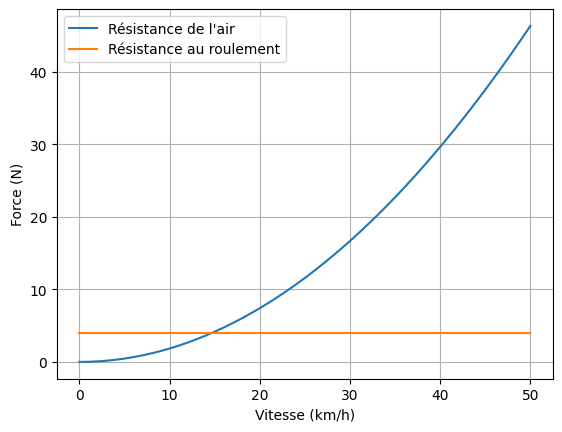
Because here we’re talking about a cyclist riding alone. As soon as a second cyclist positions themselves in their wheel, the resistances are no longer the same. The rider positioned behind immediately benefits from the draft and sees air resistance drop dramatically. And the greater the number of cyclists in the line, the more we observe a decrease in the power required for propulsion, depending on the placement within the group.
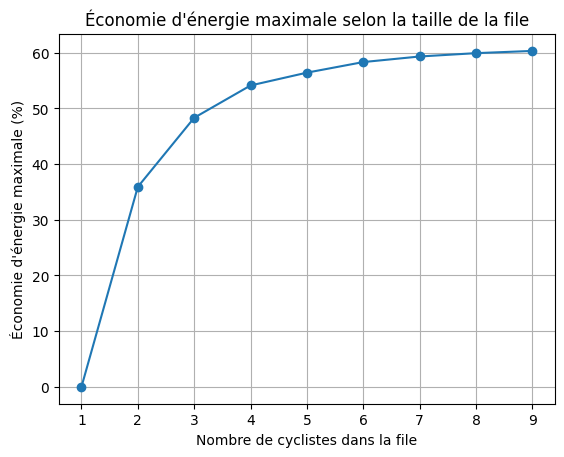
According to a study published in 2018 in the Journal of Wind Engineering and Industrial Aerodynamics, based on CFD (computational fluid dynamics) simulations, what is even more surprising is that the lead cyclist also benefits from the presence of the other cyclists following them. They do not face exactly the same air resistance as when they are alone. Because the turbulence generated by those following them slightly reduces the low pressure behind them, thus decreasing the necessary effort by 2 to 3%. Little in absolute terms, but what is most striking according to this study is the average reduction in aerodynamic drag for cyclists within the entire group.
As the line lengthens, the effects become more and more pronounced. Riders positioned in the middle of the group ride in extremely favorable aerodynamic conditions, sometimes with drag reduced by 40 to 50% compared to a solo cyclist. Furthermore, the average drag of the group continuously decreases with each new rider added. With eight or nine cyclists, the average aerodynamic effort is almost halved.
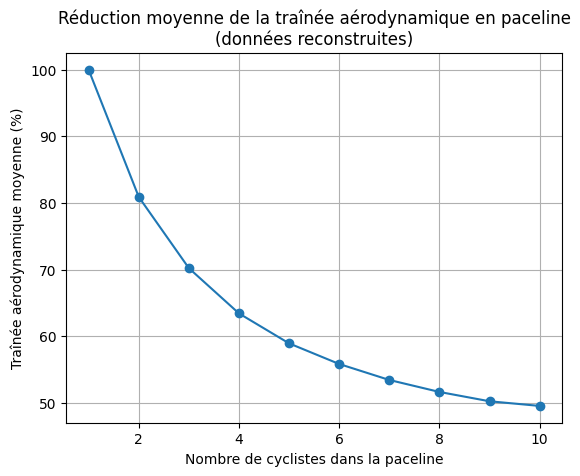
The Strength in Numbers
These results, stemming from advanced numerical fluid dynamics simulations, confirm that riding in a group doesn’t just redistribute fatigue. The movement of a group of cyclists following each other genuinely alters air behavior. The peloton becomes a collective aerodynamic object, more efficient than the sum of its parts.
To this, of course, is added the behavior and tactics of the riders within the group. As we’ve seen, the lead cyclist already saves 2 to 3% with one or more riders in their wheel. These riders save 30 to 60% of energy by benefiting from the draft of the lead rider, or those preceding them depending on the size of the group. If they are well organized, all these riders can therefore take turns at the front, to share the effort against the wind, and the recovery phases sheltered behind wheels.
Cycling is a sport where cooperation allows one to push personal limits, and where intelligent positioning can sometimes be worth more than raw power
What This Represents in Watts
To concretely measure what this means, these percentages must be translated into watts. Let’s take an average amateur cyclist riding at 32 km/h on flat terrain. Solo, maintaining this speed requires approximately 230 to 250 watts, depending on body type, position, and equipment. Most of this power is used to overcome air resistance.
In a well-organized group, this same cyclist positioned in the heart of a line of cyclists can see drag drop by around 40 to 45%. In other words, instead of supplying 240 watts, they can maintain the same speed with only 140 to 160 watts in a dense and well-organized group. The saving is impressive: almost 100 watts, simply thanks to positioning.
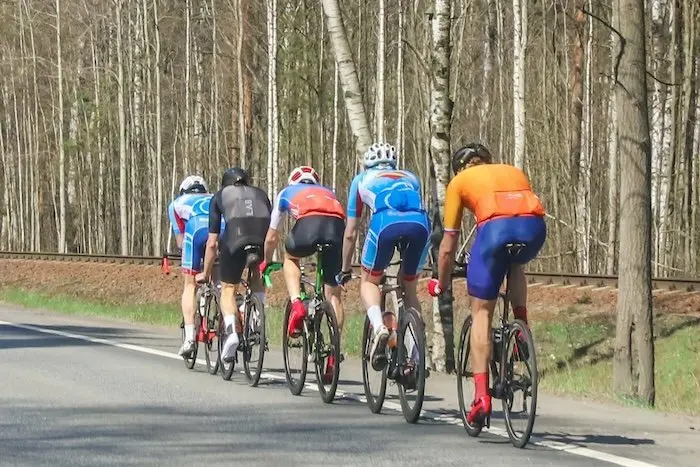
Even the cyclist taking a turn at the front is not losing out. Where it would take 240 watts to ride alone, the group effect can bring the effort down to about 225 watts in relatively stable wind conditions. Over a few tens of seconds, the difference seems modest, but repeated throughout a ride, it allows one to last longer, recover faster, and take more turns without blowing up.
It is precisely this mechanism that explains why a group can ride fast for hours, while a solo cyclist inevitably ends up losing ground, even at equivalent power.
What This Changes for an Amateur Cyclist
For an amateur cyclist, these figures have immediate consequences. They explain why a pace that seems unsustainable solo becomes almost comfortable in a group, and why one can return from a group ride tired but rarely drained. Riding in a group is not cheating on effort: it’s optimizing it.
This also means that the key to performance lies not only in individual training or increasing power thresholds, but in the ability to effectively use the group. Knowing how to stay close to the wheel ahead, avoid sudden accelerations, and accept taking short turns at the front is as important as gaining a few watts on a power meter.
Conversely, riding poorly positioned, too far from the wheel, or at the front longer than necessary amounts to wasting precious energy. For the amateur, this can make the difference between finishing strong and struggling through the last kilometers of a ride, or a race.
Another Way to Think About Effort
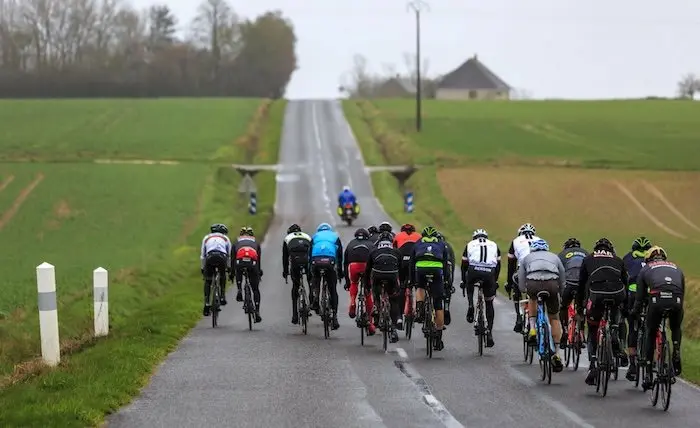
This scientific interpretation of a single file of riders changes the perception of effort in cycling. It reminds us that performance is not only individual, but collective. In a well-organized group, everyone rides above their actual level, without necessarily realizing it. This is also what makes cycling beautiful: a sport where cooperation allows one to push personal limits, and where intelligent positioning can sometimes be worth more than raw power.
The group is the cyclist’s most effective weapon against the wind. For professionals, it’s a matter of victory. For amateurs, it’s a simple and powerful way to ride faster, longer, and with more enjoyment. On a bike, the wind is rarely fought alone, and science confirms that we are right to be wary of it.
Share the post "Why riding in a group really makes you go faster"