Share the post "Single-chainring setup on the road: 2,500 km of calculated compromises"
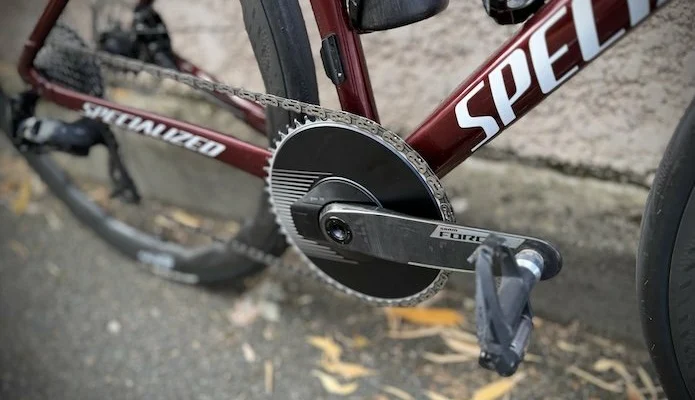
Imagine this: you’re pedaling down a winding road, the wind in your hair (or under your helmet—let’s be realistic), and your bike seems to float like a silent ghost. No suspicious rattling, no chain dancing the salsa between two chainrings. Welcome to my single-chainring world, where I’ve traded the complexity of a double drivetrain for the Zen-like simplicity of the SRAM Force AXS by testing its single-chainring version. After two months of winter training—on flat pavement in gusty winds and up grueling climbs—here’s my verdict: it’s a revolution… or almost!
By Guillaume Judas – Photos: ©3bikes.fr

Let’s start with the good news, because—let’s face it—in cycling, we’d rather talk about gains than suffering (we’ll save that for the 12% climbs). First, the weight: 210 g lighter! Yes, you read that right. By removing the second chainring and its front derailleur, my bike has become as light as a pro rider after a detox. That’s the equivalent of two fewer energy bars in your pockets. Or, for those with a bigger appetite, an entire croissant. It won’t change your life, but it will change your bike. And the cyclist’s ego—that very particular muscle always quick to get excited over a weight savings comparable to half a chocolate bar.
That said, the weight savings with the mono setup should be put into perspective: it depends on the groupset (there’s less to gain with a high-end groupset than with an entry-level one, since the front derailleur is lighter) and the choice of rear cassette to compensate. Because a cassette with a lot of teeth is heavier.

But the real masterstroke is the efficiency. With the chain line centered exactly in the middle of the cassette, unnecessary friction and energy loss are greatly reduced. It’s as if your pedaling had been recalibrated by a Swiss engineer: smoother, more efficient. The noise has also all but disappeared. There’s far less of that annoying clack-clack that makes you sound like a novice mechanic. The SRAM Force AXS single-chainring groupset purrs like a well-fed cat, leaving only the sound of the tires gripping the asphalt. And I noticed the same thing on a Rival AXS groupset mounted on a test bike. I like it.
Sleeker, smoother
Add to that a theoretical aerodynamic gain (impossible to measure without a wind tunnel, but in cycling, we believe in invisible miracles). Fewer protruding parts mean less wind resistance—and potentially a few saved watts for that final climb.

Maintenance is also a breeze. No more front derailleur to adjust, less dirt accumulating in the nooks and crannies. The chain stays clean longer, as if it had a subscription to the Blue Elephant. And aesthetically, it’s pure minimalism—though that’s largely a matter of perspective. The bike looks like a work of contemporary art: sleek, elegant, without those unnecessary protrusions that make double drivetrains look like a poorly decorated Christmas tree.
12 gears that are actually used
But the very first advantage I see is the optimal use of the cassette. On a typical 80-km ride on flat terrain with a reasonable elevation gain of 600 to 700 m, I can make use of nearly every sprocket on a well-spaced 12-speed cassette. Unlike a double chainring setup, where certain sprockets gather dust forever (you know, the ones designed for “versatility” but never used, like that overly fancy suit at the back of your closet), here, everything gets used.

Well, I don’t often use the 10-tooth sprocket with my 50-tooth single chainring, I’ll admit. A 50/10 gear ratio is the same as 55/11 for those who don’t yet have the equivalents in mind. It’s huge, and no doubt the 48-tooth chainring would be better suited to my (aging) skill level. But there’s no getting around it: I prefer the feel of pedaling with a “big” chainring and more teeth in contact with the chain. So I don’t regret my choice. And it’s still economical and logical, while giving me the impression of being an efficient cyclist, not a tooth-waster.
A cassette to choose with care
Of course, nothing is perfect in this cycling world, where even the most high-tech carbon can crack under pressure. Among the drawbacks is, first and foremost, the limited gear range. With a 12-speed cassette optimized for flat terrain or gentle inclines, you’ll quickly find yourself running out of gears when the slopes get steeper. Not ideal for an impromptu mountain ride, unless you enjoy pushing your bike while doing the waltz with your thighs on fire.

As a result, I had to stock up on three cassettes and even two chains of different lengths (because, yes, changing the cassette means adjusting the chain; otherwise, the rear derailleur gets forced into a split). I use the 10-28 for serious rides, where I love cruising on the 15, 16, and 17-tooth sprockets—no gaps to disrupt my metronome-like cadence, honed by 40 years of cycling habits. The 10-30 is a bit more practical for tackling the few hills around my house that have a 15% grade over a few hundred meters—hills I never tackle for fun anyway. But I lose the 16-tooth sprocket, the one I love. The 50/30 is the equivalent of a 40/24. On my other bike, with its Shimano 2×12-speed drivetrain, I still have two extra sprockets in the rear at that point. It’s tough going, but it works. Finally, the 10-36 gives me roughly the same gear range as a 54-40 and 11-30 on a Shimano setup. But watch out for the gaps between the sprockets. You’re already jumping from 13 to 15, then from 15 to 17. So it’s not ideal for anyone who wants to ride fast on the flat.
But just for the record, Jonas Vingegaard won the last Vuelta by riding 16 out of 21 stages on a single chainring, using a 10-36 cassette. The gaps in the gear range don’t seem to bother him, just as they don’t bother new riders too much. It’s probably a generational thing. The Dane did, however, switch back to a double chainring for the five stages with the most elevation gain. Because a 12-speed cassette paired with two chainrings generally gives you 15 different gear ratios that don’t overlap. There’s no getting around it: it’s more versatile. Even with a single chainring and 13 speeds—as seen in SRAM’s gravel drivetrain or Campagnolo’s new version of its 13-speed groupset—it still doesn’t quite measure up.

Basically, the single chainring forces you to plan ahead. It makes you wonder where you’re going to put your wheels on your planned ride. So it’s essential to choose your setup carefully before setting off, unless you want to bitterly regret it while riding. It’s like going on a hike in flip-flops: it’s fun, but not always practical.
Not the perfect solution
In the end, I loved this experience. The SRAM Force AXS single-chainring setup has converted me to cycling minimalism. It’s clean, streamlined, almost philosophical. I’m even wondering if I shouldn’t adopt this type of drivetrain permanently, just to simplify my life as a cyclist and focus on what matters most: pedaling and enjoying the ride. But be warned—it’s still a compromise. In a world where terrain changes faster than trends, you’ll always have to juggle your options. After all, cycling is like life: lighter is better, but sometimes a little more versatility prevents regrets at the top of the pass.
Share the post "Single-chainring setup on the road: 2,500 km of calculated compromises"