Share the post "ABD, rebuilding the athlete before the cyclist"
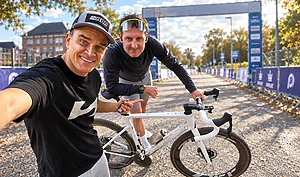
When we step into his gym, what strikes us first is neither the decor nor the equipment. It’s the movement. Nothing spectacular, no gratuitous display of strength. Just precise, controlled, almost understated gestures. One athlete finishes a series of pulls, another chains together weightlifting movements, a third focuses on a mobility exercise that, let’s admit it, would make more than one amateur cyclist, accustomed to straight lines and the indoor trainer, sigh. At the center of this ecosystem is him: Aurélien Broussal-Derval. We came to meet him to talk about cycling, physical preparation, and performance. We leave with a persistent impression: we didn’t just discuss sessions, sets, and planning. We talked about what it truly means to make a body progress. At 3bikes, we had already read his books, seen his videos, and heard his name associated with Olympic champions. But there’s a difference between knowing a track record… and spending two hours in his world.
By Jeff Tatard – Photos: All rights reserved
“Always return to movement”
When asked how he would introduce himself today to someone who doesn’t know him, he speaks neither of ego nor status: “I am a physical preparation coach and trainer, passionate about everything that helps an athlete, amateur or professional, to move better, train better, and perform better. I have been teaching for over twenty years, I have written 11 books on sports science (including 3 international bestsellers), and I have coached 10 Olympic champions. Today, I dedicate myself to my own school for coaches to train or upgrade colleagues and future colleagues.”
The scene is set. But what gives coherence to this journey is a common thread he repeats like a mantra: “Always return to movement. Whether in strength, prevention, or performance, everything starts with the quality of the gesture.”
It’s not just an effective phrase. In his mouth, it’s a method, almost an ethic.
We feel that for him, movement is not the “logical next step” of training. It is the starting point. Everything else—planning, cycles, load, recovery—is grafted onto this simple idea: a body that moves well is a body that progresses better, longer, with less breakdown.
And behind the coach, we discern the teacher. “You are only a reference if you manage to make things useful for others. What is well conceived is clearly stated. So 1. Practice towards expertise. 2. Justify and structure this practice with science. 3. Compile everything into a restitution that everyone can understand.”
At 3bikes, we know how much the discourse on “training science” is sometimes brandished as a banner to justify anything and everything. Here, we have the opposite impression: science as a backbone, but never as an argument of authority.
A body mechanic, but without dogma
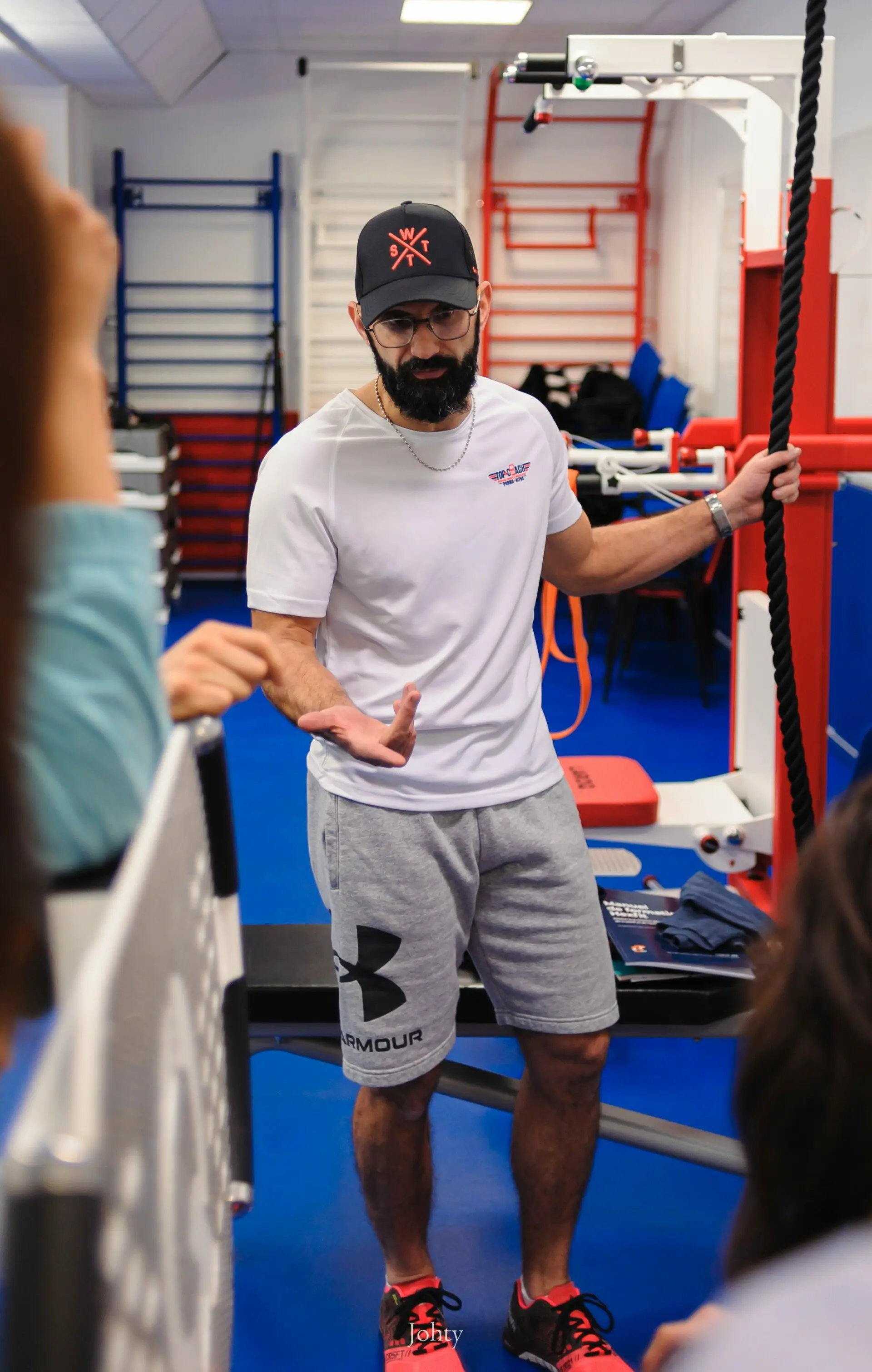
When the conversation drifts to what distinguishes his vision of physical preparation, the answer is clear: “I have a very mechanistic vision, in the noble sense: understanding how the body produces, absorbs, or transmits force. No dogma, no fads. I’m not here to represent a franchise, a school, or a trend, but to achieve performance. Just well-executed movement, individualization, and an obsession with sustainable AND OBJECTIVE progression. What you can measure, you can improve.”
What strikes us at 3bikes is this rare blend…
|
Many “modern” discourses on training get lost in concepts, Anglicisms, and buzzwords. Aurélien, on the other hand, brings everything back to the mechanics of reality: how a body absorbs, produces, and transmits force. How a movement is built, corrected, and repeated without degrading.
He doesn’t seek to be the flag-bearer of a method. He seeks to produce measurable, reproducible results and make them transferable.
And above all, he acknowledges something that many coaches dare not say aloud: “No one wants to give a recipe. Officially? ‘Teach a man to fish, and you feed him for a lifetime.’ But that’s because they’re afraid to give recipes, to expose themselves to criticism. Nothing prevents you from being a hunter, a cook, and still going to a restaurant. I give everything: the recipe and the manufacturing secrets. I think that’s what makes the difference.”
For our part, we see a form of courage: accepting to provide things that can be used tomorrow by any coach or athlete, therefore open to criticism, probably copyable… but fully embraced.
A journey made of layers: tatamis, bars, gliding, and laboratory
To understand where this philosophy comes from, one must go back to his own athletic background. He doesn’t hide it: his approach wasn’t built solely from books.
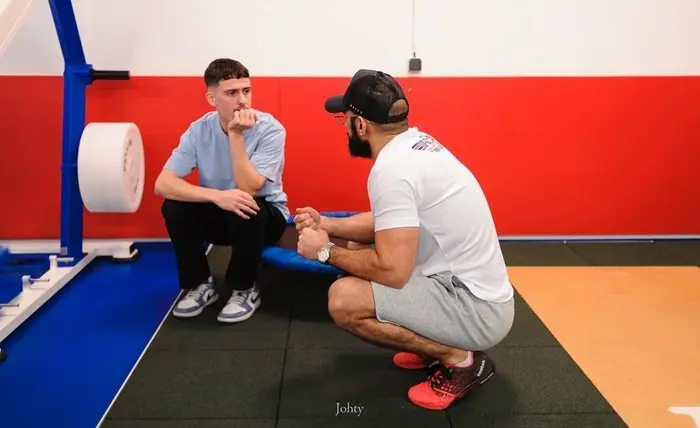
“I grew up with a very varied practice: combat sports, which taught me coordination and timing; weightlifting and bodybuilding, which structured my understanding of strength and movement; gliding sports, which develop balance and body awareness in space; swimming, which demands impeccable technique; and running, which teaches endurance and effort management.”
This mix results in a coach who doesn’t think in terms of “disciplines”, but in principles. A pedaling movement, a rowing pull, a judo throw, or a sprint push are not, for him, separate universes. They are configurations of forces, levers, and constraints.
He doesn’t hide his influences either. They are multiple, acknowledged, sometimes very technical, sometimes cultural:
- mentors like Christian Thibaudeau or Olivier Bolliet,
- researchers like Jean-Benoît Morin or Christophe Hausswirth,
- organizations like NSCA, Exos, FMS,
- and, more surprisingly for many cyclists, the Brazilian influence of jiu-jitsu and its ginastica natural, ancestor of many current trends (Animal Flow, GFM, etc.), distant heirs of Hebertism.
We sense that his philosophy was not built on a rupture, but on successive layers. Each encounter, each institution, each trend added a piece to the puzzle. It is not a closed system; it is an ever-expanding architecture.
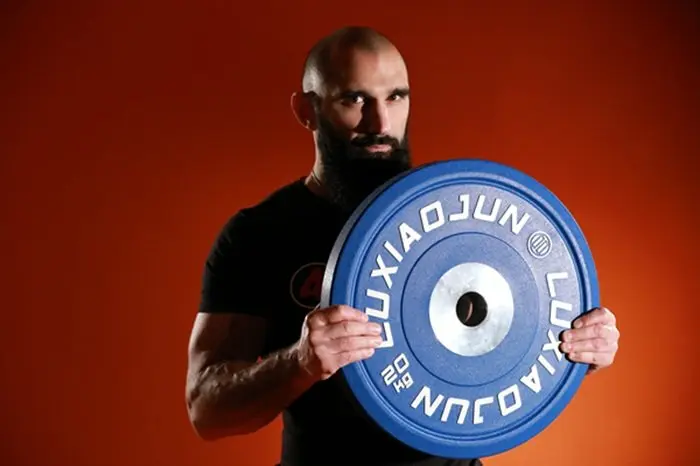
The “coach of coaches”: when pedagogy becomes a high-level sport
In the field, he is often presented as a “coach of coaches”. One might think it’s a slogan. In reality, it’s an observation.
“I am often described as a ‘coach of coaches’ because I have spent a large part of my career not only training athletes, but especially training those who train them.”
He has led structuring training programs at the Weightlifting and Bodybuilding Federation, helped establish pedagogical standards, and contributed to professionalizing the physical preparation profession. Today, he runs his own training organization, with 14 schools in France and certifying courses for coaches.
When he talks about it, it’s not to check a box on a resume. It’s because it profoundly influences his way of conceiving coaching: every session, every method, every protocol must be transferable.
In this logic, his greatest pride is not where one would expect it…
Yes, he has supported remarkable athletes: Gemma Gibbons, Kilian Le Blouch, Ben Quilter, Norman Nato… behind these names, we find stories of resilience, surpassing oneself, pushing limits despite injuries, doubts, and sometimes unfavorable structures.
But when asked what he is most proud of, the answer extends far beyond the podiums: “I am undoubtedly most proud of the conversion stories: these athletes, Russian, French, British, whom I accompanied during their careers and to whom I, in a way, passed on the sacred fire. Today, they are in turn coaches, physical preparation specialists, trainers. To see them prolong this passion, to perpetuate a culture of movement and high standards, is for me the greatest success.”
At 3bikes, this sentence stays with us for a long time. It says something essential: for him, performance is not an endpoint. It is a culture that is transmitted, that extends from one athlete to another, from one coach to another.
This also explains why coaches, and cyclists who come to him, often speak of this famous “sacred fire”.
“What athletes and coaches feel most is the sacred fire. […] Performance is an act of faith. My role is to light that flame, to nurture it, and to remind them that behind every protocol, every session, every test, there is an intention: to move forward, to build, to surpass oneself.”
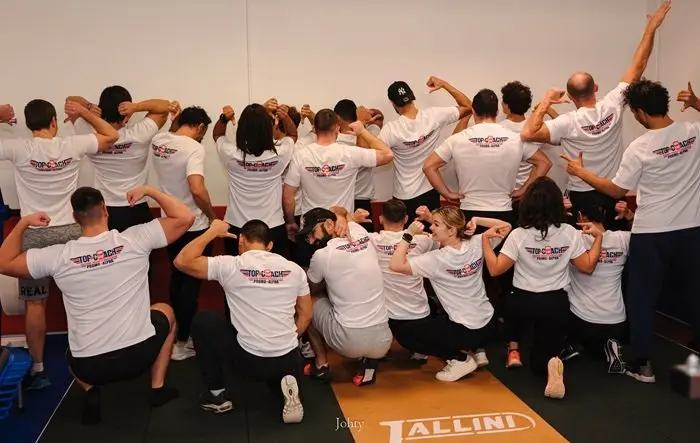
Cycling: an advanced sport… but only halfway
We hadn’t come just to talk about principles. At 3bikes, one question obsesses us: why does amateur cycling, for the most part, remain so off-track when it comes to physical preparation?
On this point, Aurélien doesn’t beat around the bush…
First, he knows cycling. He speaks of it with respect, but also with lucidity: “What immediately strikes you about cycling is that everything revolves around an empire of metabolism. Performance is primarily physiological: VO2max, FTP, pedaling economy, ability to sustain high intensities for a long time… The engine takes precedence over everything else.”
He acknowledges it: on the metabolic aspect, cycling is a laboratory of excellence. Few sports have pushed the quantification of effort, the understanding of energy systems, and the modeling of loads as far.
But this “omnipresent engine” comes at a price.
“Cycling is extraordinarily advanced metabolically, but it still has much to gain in everything related to movement, strength, and intelligent management of mechanical stress. There is almost no culture of strength training, even though it could change the game in terms of power, posture, and joint longevity.”
In his view, it’s not an external judgment. He sees the cyclist as a partially developed athlete: very sharp on some parameters, very vulnerable on others.
The blind spots are clear…
- a near-absence of strength culture,
- little work on power surges,
- “outdated” recovery and load management methods,
- a tradition that values volume over quality.
And what applies to pros applies, amplified, to amateurs.
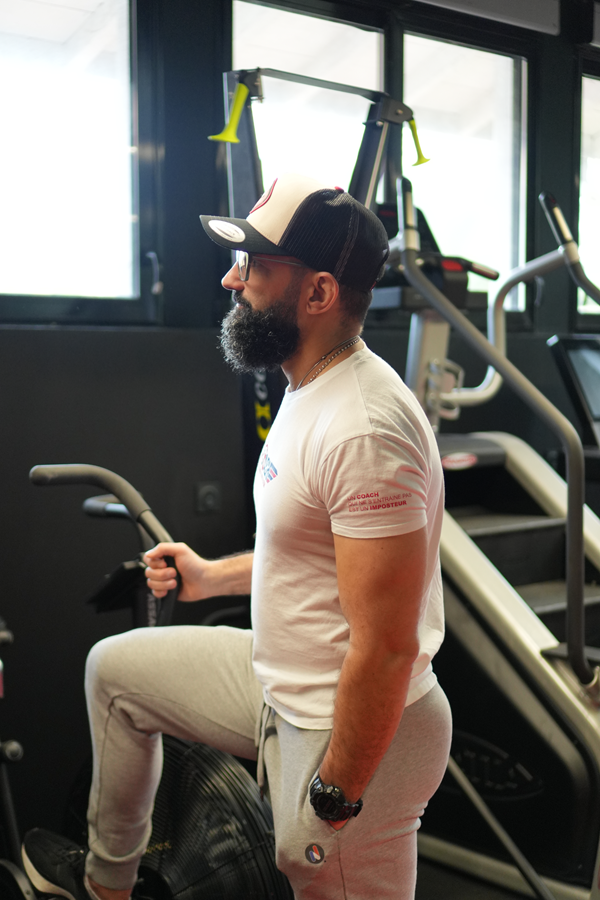
Why amateurs still ignore physical preparation
His answer to this question is uncompromising, but it has the merit of clarity. First, there is a simple factor: if the pros themselves are not yet aligned, it’s difficult to expect amateurs to be.
“The world peloton is only just beginning to seriously integrate strength, mobility, and postural work, whereas in other sports, these have been standards for twenty years.”
Then there’s the time constraint… or rather the perception of this constraint. A cyclist who already rides 10 to 15 hours a week often feels that every minute spent on something other than cycling is a potential loss.
Aurélien summarizes this in one sentence: “We do more volume instead of better preparing the body.”
Finally, there is the weight of tradition. We reproduce what the elders did, we perpetuate habits, sometimes beliefs… even when science has long since debunked these certainties.
Among the myths he points out, we find classics…
- “Strength training makes you heavy.”
- “Mobility is for yogis.”
- “Strength is useless on climbs.”
- “Core training is 3 x 30 seconds of plank.”
His conclusion is unequivocal: “Science has proven the opposite for each of these points.”
At 3bikes, we could add: field practice too. We see it clearly in high-level pelotons, on Grand Tours, among the best teams: strength and physical preparation are no longer options. They are becoming a standard.
The challenge remains to convey this message to clubs, passionate practitioners, and those who juggle a professional life, a personal life, and increasingly demanding training regimens.
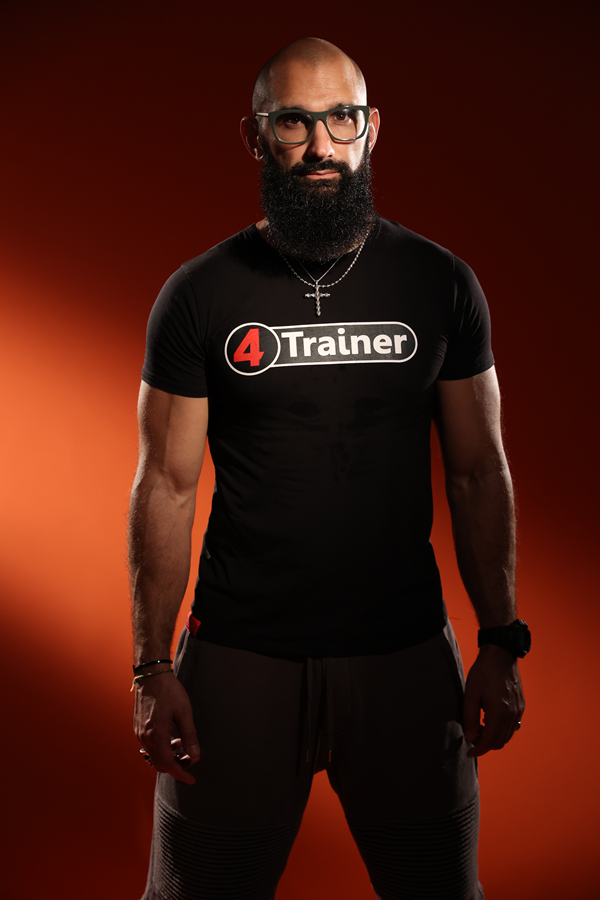
What General Physical Preparation (GPP) could change in amateur cycling
When asked what would happen if physical preparation—strength, mobility, postural work—finally became a pillar in amateur cycling, his answer consists of three “revolutions”…
|
His formula summarizes everything: “Ride better, stronger, and longer.”
And we, at 3bikes, can’t help but connect this to what we observe in the field: cyclists burned out by volume, but still “green” muscularly; recurrent lower back pain; knee pain that returns with each season’s restart; cervicals on fire after every ride over four hours.
By constantly seeking progress solely in the dimension of time spent in the saddle, amateur cycling has built a glass ceiling. Aurélien proposes to attack this ceiling… from below, by rebuilding the body.
Rebuilding the athlete before the cyclist
When asked how he would rebuild cycling’s physical preparation from scratch, his answer is clear: “I would start by rebuilding the athlete before the cyclist.”
Cycling, he explains, is a magnificent sport… but also a sport that constrains the body: closed posture, dormant glutes, lack of rotation, limited hip, ankle, and thoracic cage mobility.
His plan has four steps
|
His vision could be summarized as follows: first, a body that knows how to move; then, a body that knows how to push; finally, a body that knows how to absorb.
It is only then that the hours spent on the bike yield their full potential.
Degrees, field experience, think tank: a three-tiered expertise
Aurélien doesn’t hide his academic background: two master’s degrees in sports science, state diplomas, international certifications like NSCA, years spent on professional team staffs, in laboratories, and in the field.
But what catches our attention at 3bikes is how he evaluates these elements.
“The least one can say is that I didn’t learn much there. I clearly learned more from books. State diplomas structured me, international certifications like NSCA, and especially my years on pro team staffs, in laboratories, and in the field.”
Above all, he emphasizes a little-known initiative: a think tank of physical preparation coaches with whom he spends a full week each year training, followed by bi-monthly meetings to exchange, practice, and confront ideas.
Here again, we find the same triptych: “True expertise comes from the blend of all three: theory, practice, and pedagogy.”
This blend, we feel it in every answer: an idea is never validated solely because it is “in the literature.” It must pass through the filter of the field, then be translatable into concrete, transferable tools.
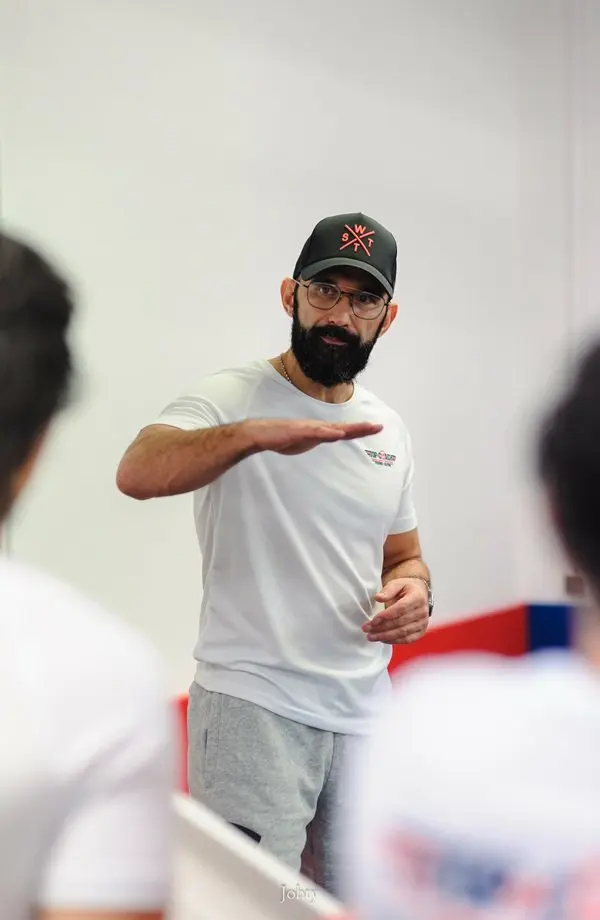
Science, field, intuition: a triangle to guide training
To the question of the balance between science and field experience, the answer could have been conventional. It is not.
“For me, science provides the framework, but it doesn’t always provide the answer. I rely heavily on data, studies, models… but I keep in mind that field experience and intuition have exactly the same weight. Because an athlete is not an Excel spreadsheet. It’s a body, a history, fatigue, psychology.”
What he describes is a demanding coexistence:
- science structures and prevents deviations;
- field experience validates or invalidates models;
- intuition refines in real-time what the other two cannot capture.
We feel like we’re hearing the opposite of what sometimes circulates in amateur cycling:
on one side the “all data” crowd, on the other the “all sensations” crowd.
Aurélien rejects this false choice. For him, true physical preparation is a triangle where each of the three vertices—science, field, intuition—plays its role. When all three are aligned, he says, coaching becomes simple… and above all, effective.
In the context of amateur cycling, where many practitioners juggle watches, sensors, platforms, but also busy schedules, daily fatigue, and personal constraints, this vision seems more valuable than ever.
Embracing digital without losing nuance
One point we wanted to address remains: his presence on social media. Because he is not just a field coach or a gym trainer. He is also a voice listened to on Instagram, YouTube, in podcasts, and at conferences.
He smiles at our (my) legendary superlatives, and in this case, when we talk about “hundreds of thousands of subscribers”: “Tens of thousands is already pretty good!”
Digital, far from distorting him, has forced him to be even more precise.
“When you speak to a room of 200 coaches, you have time, you can elaborate, nuance, go back. On Instagram or YouTube, you sometimes have ten seconds to hook someone and make them think. That pushed me to clarify my messages: get straight to the point without losing the substance.”
For him, short formats are not an end, but gateways.
“On social media, I create gateways: a strong idea, a principle you can grasp in a few seconds. That’s the surface. But behind it, there’s an ecosystem: my books, my training courses, my podcasts, my conferences… The short format is never the end: it’s the beginning of the conversation.”
We were particularly struck by this sentence: “Modernity must never crush truth.”
In other words: accepting to be punchy does not mean giving up nuance. The condition, he explains, is to practice before speaking. It is experience, he believes, that prevents simplification from turning into caricature.
Ultimately, he approaches social media exactly as he approaches a training session:
a clear intention, useful content, a demand for consistency between what he does, what he says, and what he shows.
Faith, sacred fire, and a message to amateur cyclists
On several occasions, Aurélien returns to a notion that transcends technique and science: faith. Not vague belief, but a deep conviction in the trajectory.
“What I seek to transmit first is not a method, nor a technique. It is faith. Not hope: a deep conviction. ‘I don’t think you’re going to succeed… I know it.’ The athlete feels it. The coach too. Performance begins there.”
At 3bikes, we see a very strong meeting point here with amateur cycling.
Because behind the FTPs, training plans, and Sunday rides, there are people who ask themselves: Can I really progress? Do I really have potential? Can my body still change?
His answer, for amateur cyclists, is disarmingly clear: “Stop believing that progress means adding hours.”
Cycling, he reminds us, is a tricky sport: the more you ride, the more you think you need to ride even more to progress. However, he says, you don’t progress by exhausting yourself, you progress by becoming more complete.
This is perhaps where the heart of his message for our community lies:
- the room for improvement is not just in kilometers;
- it is in movement, in mobility, in strength, in short power, in the way one recovers;
- it is, above all, in the ability to believe that one can truly change level, provided one accepts to train differently.
“Most amateurs lack neither talent, nor condition, nor will. They only lack method… and sometimes faith.”
What we take away at 3bikes
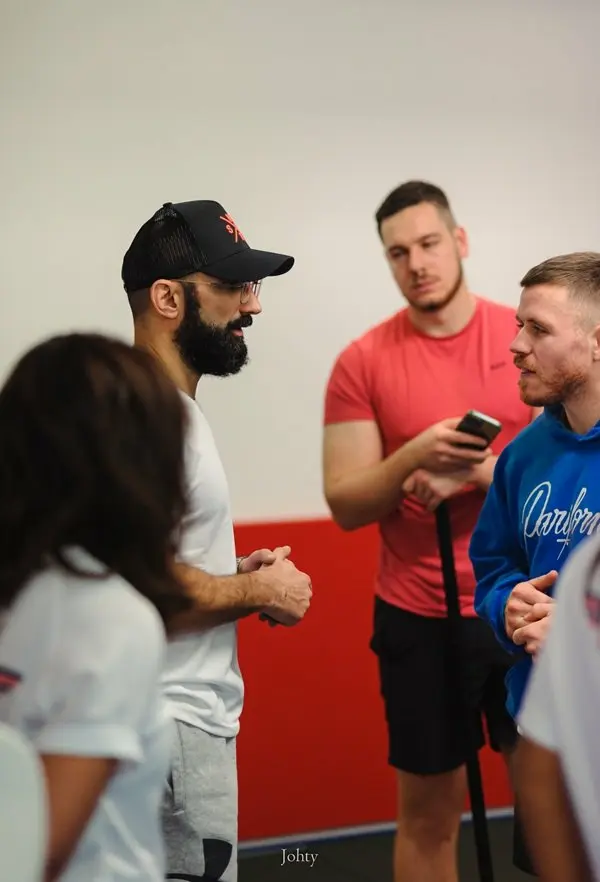
When we leave the gym, we feel we have put our finger on something essential for today’s amateur cycling.
What we take away from Aurélien Broussal-Derval is not just an impressive CV, nor a brilliant discourse. It is the articulation of three dimensions which, combined, can transform our way of approaching progress…
A keen understanding of movement
The cyclist is not just an engine on a frame. It is a body that produces, absorbs, and transmits forces. As long as this body remains confined by its limitations—lack of mobility, weakness of the posterior chain, absence of functional strength—the engine cannot fully express itself.
Scientific rigor… but never disembodied
Data is not the problem. The problem is isolating it from everything else: the athlete’s history, their fatigue, their psychology, their context. For him, science provides the framework, field experience brings reality, and intuition makes the connection.
A contagious pedagogy
He doesn’t just train athletes; he trains coaches, who in turn will train athletes. He provides recipes, but also the way to adapt them, understand them, and transmit them. He lights fires, to use his expression, that continue to burn elsewhere.
For us, at 3bikes, the message is clear… Yes, amateur cycling can, and must, move beyond its exclusive obsession with volume and watts.
- Yes, physical preparation, mobility, strength, short power, and better load management can change the trajectory of an amateur cyclist, whatever their current level.
- And yes, this will require shaking up habits, myths, and reassuring routines.
But what this meeting reminded us is that the potential is there.
“Train your body, train your movement, train your mind. Cycling will give you everything – and even more.”
The phrase is Aurélien’s. The responsibility, now, is in our hands… and under our pedals.
=> And if you want to know more about the school of coaching excellence, visit his website
Share the post "ABD, rebuilding the athlete before the cyclist"