Share the post "Helmet use: protection or infantilization?"
The debate that tightens the jugular… It seems that in Spain, helmets are mandatory outside urban areas. Not for going to get bread – which will reassure cycling enthusiasts of baking traditions – but for those discreetly called “sporting cyclists”. In other words, the guys with sharp legs who ride fast, for a long time, and often straight enough that the probability of hitting the ground is almost nil… until the day a wild boar, a car door, or their own ego decides otherwise.
By Jeff Tatard – Photo: Nico & JL
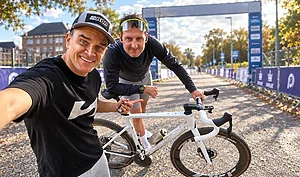
In short: wearing a helmet, protection or infantilization? This is a question we thought was dated from the time of GoPro cameras fixed on helmets that weighed 5 or 600 g, but apparently not. The 3bikes editorial team occasionally loves seemingly consensual topics that we then manage to make controversial (it’s one of our favorite intellectual exercises). So we dove in. And we asked the opinion of two profiles who embody two types of cycling, two eras, and two philosophies: Jean-Loup, the immutable disciple of the wind in his hair, and Nico Meunier, the man who “fell on the side of the helmeted” after a pro career in the early 2000s.

And then, the debate came alive on its own.
Jean-Loup: the helmet, yes… but only when he wants to!
Jean-Loup is the type who experienced the competitions of the 80s, those where helmets were as present as SPF 50 sunscreen: practically never. Another era. Another relationship with risk. And above all, a hair elegance that even modern manufacturers of “aerodynamically optimized” ventilation will never be able to restore.

When asked why he often rides bareheaded, he answers with adorable frankness: « Previously I didn’t wear it frequently, mainly out of habit, a bad one, I’ll grant you… Now, when I choose not to wear it, it’s for comfort… or in good weather… or in cold weather because I like my beanie. »
He also adds: « For me, the helmet is very uncomfortable: it tends to tip forward and hit my prescription glasses. I haven’t had many that suited me. »
Rural common sense in all its splendor.
For him, the helmet is not an enemy. Nor is it an ideological principle. It’s a tool you use if you feel the need:
« Obviously it’s a real safety element, but I wouldn’t want to see it become mandatory… Everyone should be free to wear it or not. »
In a group or in the city, he puts it on automatically « for fear of being hit ». Alone, in the open countryside, he prefers « to watch out for wild boars ». We don’t judge: everyone has their priorities.

And above all, this sentence that summarizes his state of mind: « I like this possibility of being able to choose. »
For Jean-Loup, cycling is freedom. Freedom of outing, freedom of pace… and freedom of natural ventilation.
| And since we’re talking about freedom, we must mention the third party: Émilien Clère. He too experienced the almost mandatory helmet, but admits that in summer, he often prefers his cap… and in winter, his beanie. A disarming simplicity. He also adds that in the Netherlands, where he goes regularly, very few people are seen riding with helmets, even in traffic that is otherwise much denser than in France. His opinion is clear: « For daily use, I think everyone should be allowed to choose. » A French champion who advocates for free will: that matters in the landscape. |
Nico: the helmet as an act of exemplarity
At the opposite end of the hair spectrum, Nico Meunier.
Former pro, now a convinced helmet advocate in all circumstances. He knew the years without, then the years with, then the years where the question is no longer even asked.
And for him, the turning point is clear: « The arrival of children and setting an example for all practitioners changed my view on wearing a helmet. »

That, and the fact that modern helmets no longer look like compacted polystyrene half-melons. The technological argument is also very strong: « With technological advancements, we no longer feel it. »
For him, making helmets mandatory in all circumstances would be excessive, he even agrees with Jean-Loup on the bread question – but in a group, there’s no room for discussion: « Wearing a helmet during group training should be mandatory, both for reasons of exemplarity and due to the risks associated with collective practice. »
And regarding the prevailing safety atmosphere: « The aspect can seem moralizing. »
You can tell he’s the kind of guy who rode in the rain, against the wind, averaging 38 km/h in training, but never needed to be lectured.
Infantilization or responsibility?
Between these two visions, there is actually the heart of the debate: Should we protect cyclists from themselves, or can we leave them responsible for their own heads?
Those who want to impose helmets everywhere say: « We save lives. »
Those who refuse the obligation reply: « We also protect freedoms. »
In an ideal world, everyone would wear a helmet when it’s relevant, and no one would need a legal constraint to understand that asphalt is hard and the skull is fragile. But in the real world, some find that prevention sometimes turns into moralizing, and others that freedom sometimes turns into recklessness.
Jean-Loup doesn’t want to be told what to do. Nico wants to set an example. Both ride, both exist, both are consistent.

And what if the real problem wasn’t the helmet after all… but that we always try to resolve a deeply cultural debate by decree?
The Epilogue, without judge or court
The helmet is not just an object: it’s a symbol. For some, it protects. For others, it restricts.
But what emerges, ultimately, is that cycling remains a rare space of freedom. Freedom of movement, pace, solitude, or sharing. And that we instinctively want to preserve it.
So yes, the helmet question will remain a debate. And that’s perfectly fine.
Because a debate is life.
And that cycling should always remain alive.

Essential rules for cycling in Spain (…and which could well inspire France)
|
=> And if you want to avoid a €200 fine in Spain The rules for cycling in Spain
Share the post "Helmet use: protection or infantilization?"