Share the post "Power on the indoor trainer: pitfalls to avoid"
It’s the season for indoor training sessions, using increasingly sophisticated equipment. A more or less advanced, or even connected, indoor trainer can be a good solution for precise power training. However, there are pitfalls to avoid so that sessions don’t turn into a long ordeal. We explain.
By Guillaume Judas – Photos: depositphotos.com
More and more of you are riding on indoor trainers to compensate for outdoor rides that are often very difficult or even impossible at this time of year. You also take the opportunity to train very precisely with power, a data point that is essential in all connected applications on the market (Zwift, MyWhoosh, BKool, Rouvy…).
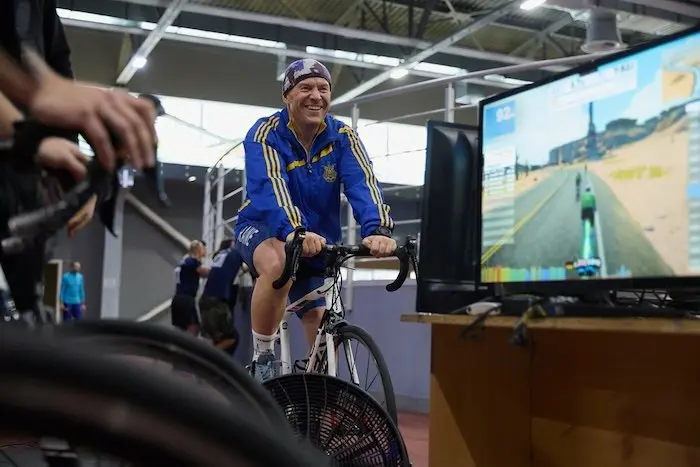
The indoor trainer has the advantage of forcing you to pedal throughout the session (without coasting) and allowing you to perfectly frame your exercises, without taking into account external factors such as weather or traffic. So, theoretically, we’re talking about precise and well-framed exercises. To do this, many have either an indoor trainer that measures power, a power meter on the bike, or software that estimates this power based on various parameters such as speed, cadence, and simulated gradient. The intention is commendable and stems from a desire to do well. But beware of excesses or misinterpretations…
Different power between road and indoor trainer
The power produced on an indoor trainer is different from what you can produce on the road. There isn’t the same friction or the same resistance to forward motion. However, the indoor trainer presents its own difficulties, with a more constant effort, more dehydration, and consequently a more sustained heart rate that has more difficulty decreasing during the session.
Power on an indoor trainer, whether measured by a power meter on the bike or by the device itself, can only be compared to power on an indoor trainer. If you want to define a point of comparison, you would need to perform a test with a stable heart rate on the road and on the indoor trainer, and try to extract a standard deviation.
In other words, it’s a big mistake to try to reproduce the power thresholds you know on the road on an indoor trainer. You risk overtraining by aiming for power zones that don’t truly correspond to the effort provided. To give you an idea, the difference between road and indoor trainer is estimated at around 10%. This means that if you have an FTP estimated at 250 watts on the road after a field test, it is only about 225 watts on the indoor trainer.
An imbalance that promotes overtraining
When you think about indoor trainers or optimizing the time associated with this practice, you tend to forget the essential factor for progression in an endurance sport like road cycling: training in the aerobic zone, i.e., in “base” mode. Cycling, even competitive cycling, is 95% aerobic. To perform well, very intense efforts are of course necessary, but above all, it is essential to push back the transition zone between aerobic and anaerobic mechanisms as much as possible, in order to still be present at the end of the event.
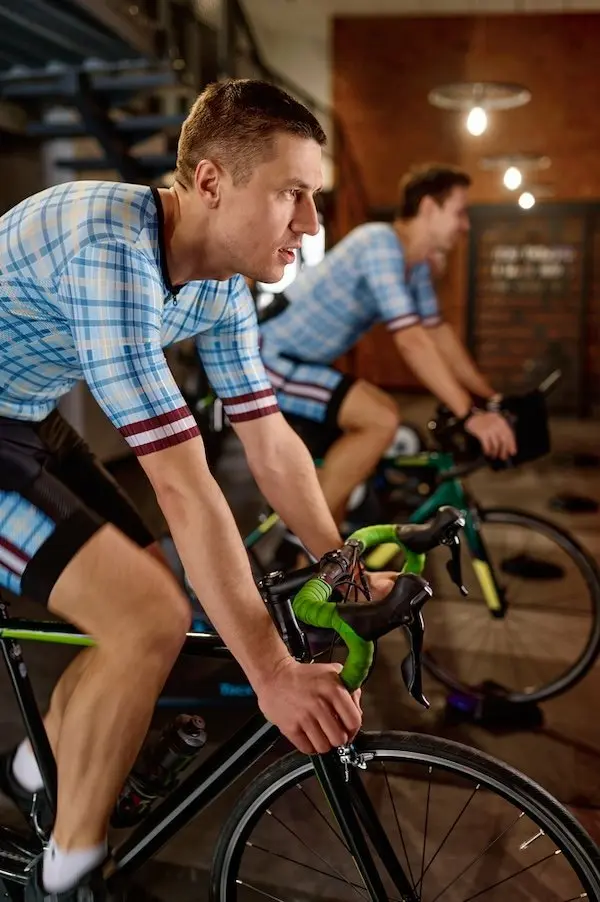
And since progression in one of the two areas comes at the expense of the other, according to the principle of communicating vessels, you understand that unbalanced training, without a large proportion of aerobic work, does not allow for progress, and sometimes even leads to overtraining, with a generalized state of fatigue. As for the expected benefits, it’s quite simple to understand the interest of a high aerobic level: during a competition, each attack, acceleration, or difficulty on the course requires power production for a few seconds. The one with a superior endurance level does not “go into the red” and produces almost no lactic acid, thus conserving their meager reserve of “super fuel” for the decisive effort at the end of the event.
Conversely, someone who can be powerful and explosive but has a lower level of endurance will “go into the red” faster with the same efforts, and will have no energy left at the end of the event, with their muscles full of lactic acid, which limits their function. We also know that “medium” efforts, such as Zone 3 (below the anaerobic threshold), allow for rapid initial progress but quickly become quite draining, which severely limits their usefulness. Therefore, the model that works well consists of spending at least 80% of one’s weekly time in the basic endurance zone, and dedicating 20% of the remaining time to higher intensities, whether it’s threshold, FTP, or short or long sprints. In the case of training exclusively based on indoor trainer practice, you have to push yourself a bit to do 4 out of 5 hours or 8 out of 10 hours in the same week riding quietly!
So, is the indoor trainer good or not?
What you need to remember is that the indoor trainer is only a substitute for road training. It is useful for maintaining a minimum level of physical condition and for preserving the basics, but you must remain cautious about its practice and duration, and also pay attention when doing power-related exercises on this type of device, which could quickly prove counterproductive…
Share the post "Power on the indoor trainer: pitfalls to avoid"