Share the post "When the mind warms your hands on the bike"
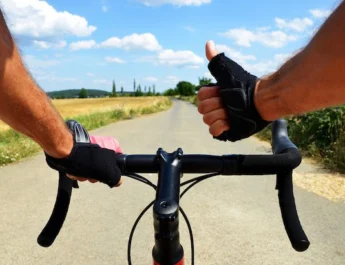
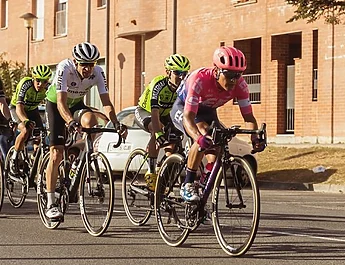
We all know someone like him. The one who turns every setback into an opportunity. His bike breaks? Perfect: an opportunity to learn its inner workings, to tinker, or to write a new chapter in terms of gear. An injury? A time to probe the body, understand its limits, come back smarter. A sprint defeat? A handshake later, the opponent has become a riding companion. And it’s often the same person who, in the middle of January, rides without gloves, rain lashing across their face, as if their body had signed a pact with the cold. Where does this strength come from?
By Jeff Tatard – 3Bikes.fr / Photos ©3Bikes
The Story We Tell Ourselves
Our mind has its shortcuts. If it hears « don’t fall », it mainly retains « fall ». As if, behind the negation, the primary image remained.
Conversely, saying « I’ll hold on » is often enough to reorient the body: thought doesn’t just precede action, it shapes it. Words become points of support. They give direction, an angle of attack, a breath.
In an illuminating podcast, psychiatrist Christophe André reminds us that our thoughts don’t just describe the world: they invent it a little. What we tell ourselves in silence, even fleetingly, ends up shaping what we perceive and how we engage with it.
The old Coué method is therefore not a bar superstition, but a way of agreeing with oneself: when an idea takes hold, the body eventually follows suit. Not by magic, but by intimate coherence: belief opens a path.
On the bike, we see it clearly. This friend we’re talking about doesn’t set off dreading the cold. He doesn’t create a shadow. He simply slips into the phrase: « I’m going to feel it. I’m going to experience this fully. » And everything adjusts: the movement, the breath, the attention.
So, each pedal stroke becomes a confirmation of his story. He doesn’t try to self-persuade. He inhabits what he tells himself.
Active Optimism: What Sport Reveals
Cycling is a discreet master, who speaks without words. It simply shows that effort always leaves a trace, that difficulty is not a wall but a door, and that the body, as soon as you listen to it a little, learns quickly.
We all know that type who goes out no matter what. 6:30 AM. Incomplete night, biting air, a veil of fog. He doesn’t question the cold he’ll experience, but how to be with it: embracing the stinging air, smelling the wet earth, distinguishing his own breath in the silence. His first goal is simple: to get moving. The second, more intimate: to choose the words that will guide his ride.
Therein lies the nuance. He doesn’t seek to erase discomfort, but to overcome the flood of comments that amplify it. He tells himself: « I’m moving forward. I’m outside. That’s already a victory. » And something falls into place.
The body follows. By facing the crisp air, it adjusts to it, tames it. Not that the cold disappears, but because the perspective changes before it does.
Blaise Pascal had seen it: « we suffer not so much from things in themselves as from the story we associate with them. The world is the same; it is our way of thinking about it that shifts the emphasis. »
Why Are Some People Happier?
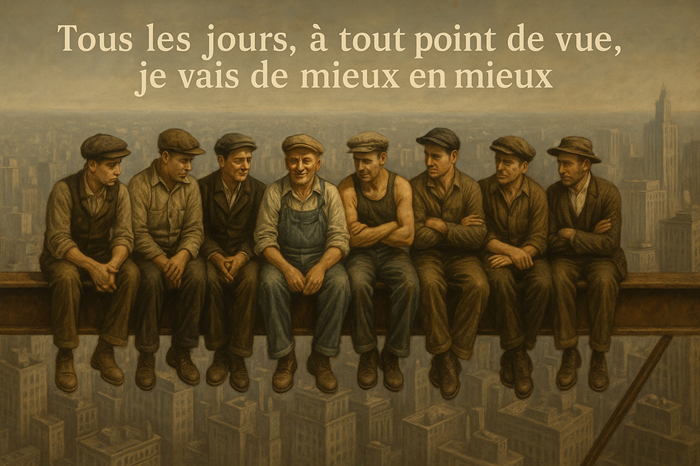
Because they cultivate the art of naming things differently. What seems « difficult » becomes fertile ground; « failure » is recycled into raw material; « rain » is no longer an obstacle, just an atmosphere.
We are not necessarily born with this perspective. We learn to apply it to things, like adjusting a camera lens: nothing changes around us, but everything becomes more legible.
So, phrases gently shift: « It’s too hard » gives way to « I’m making progress here ». « I can’t do it » softens to « I’m taking a step forward ». « I don’t want to fail » opens up to « I’m going to try ».
These are small inflections, almost nothing, but they reorient the ridge line.
Cycling, for its part, gives us tangible proof. Nothing abstract: « I held on. I started again. I changed. » We feel in our legs what, elsewhere, would only be an idea.
What accumulates then is not just fitness, but an inner capital: concrete memories where we surprised ourselves by exceeding what we thought we were. From this is born a personal fable, not an invention, but a story true enough to carry us through days of doubt.
The 3 3bikes Keys to Take Away
3bikes Key Number 1 – Phrase it DifferentlyWords are not decorative: they direct attention. Choose those that open rather than those that close.
What you say becomes the first trace of your movement. |
3bikes Key Number 2 – Keep a RecordAfter a tough ride, write down one sentence, just one. Like placing a white pebble on the path.
These micro-victories, once written, stop fading away. They transform into small certainties: « I can, I’ve done it before, I’ll go back. » They add substance to courage. |

3bikes Key Number 3 – Experience ItWords guide, but experience anchors. By staying in your head too much, you end up going in circles: you need to put the body back at the center. So, even when the sky is heavy, even when the desire grumbles, go out, if only for twenty minutes. No noble goal, no announced feat: just the simple act of going. Because movement has this virtue: it cuts short inner chatter. Cold becomes a sensation, no longer a threat. Rain, a texture, no longer a complaint. Wind, a somewhat rough but honest partner. And very quickly, something clarifies. Attention narrows, the body finds its rhythm, and the head, perched at the top, follows the pace without struggling. What seemed complicated becomes livable, because you are in it. Not in the idea, but in the situation. Coming back, Gabba soaked or cheeks flushed, with that subtle feeling of having chosen, of having gone through that morning, of having kept your own promise, that’s what builds inner endurance. A modest ride is enough. It’s not the distance that matters, but the tiny commitment that says: « today again, I was there. » It is this silent accumulation, day after day, that shapes a more stable perspective and a confidence that is not invented. |
In Conclusion,
This friend who sees everything positively doesn’t ignore reality; he doesn’t float above things. He simply holds an inner pen and chooses the words in which he wishes to move forward.
He has understood that happiness is neither a finish line nor a permanent state, but an orientation, a way of putting one’s foot on the ground, of looking at the sky, of welcoming what comes. A bias, yes, but voluntary, conscious, worked on.
By striving towards it, the landscape eventually changes: the same roads, the same seasons, but a different, more habitable terrain.
So perhaps everything starts there: in the way we talk to ourselves, tell our story, keep ourselves company.
And what if we, too, tried to write an inner story warm enough to accompany us outside, even without gloves?
=> Find all our societal articles: All our Magazine articles
=> And to further nourish your joy, discover this inspiring video: How to finally be HAPPY? (with Christophe André)
Share the post "When the mind warms your hands on the bike"