Share the post "Resuming and relearning to run with progression"
November is coming. The days are getting shorter, miles in the saddle are harder to come by, and many cyclists swap their bikes for a pair of running shoes. A well-established winter tradition: running makes its way into the off-season. But every year, the scenario repeats itself: we put our running shoes back on as if summer had never existed. We go for 45 minutes, sometimes at 14–15 km/h, because we feel “in shape”. And, almost always, the pains arrive: Achilles tendons, shin splints, creaky knee, TFL, deep fatigue…
By Jeff Tatard – 3Bikes.fr / Photos ©3Bikes
So: Why?
Because running is not cycling. Running stresses the body’s weight-bearing structures: muscles, tendons, fascia, bones, and much more intensely. Cardiovascular fitness doesn’t change anything: the heart knows, but the tissues aren’t ready anymore.
The greatest champions apply this gradual approach. And if they take it slow… why shouldn’t we?
When the greatest female champions remind us that “getting back into it” means starting low!
To better understand, we spoke with Christelle Daunay, multiple French champion (cross country, 10 km, 10,000 m, half-marathon, marathon) and European marathon champion in 2014.
Her message is clear: “We start back very gradually, sometimes alternating running and walking.”
The same message from Mekdes Woldu, 20th at the Paris Olympic Games, current French record holder for 10 km, 10,000 m, half-marathon, and marathon. An athlete averaging 180 km per week, weighing a maximum of 40 to 45 kg, overtrained, adapted to impact… and yet: “When I start again, it’s 10 minutes, and not all at once. I walk.”
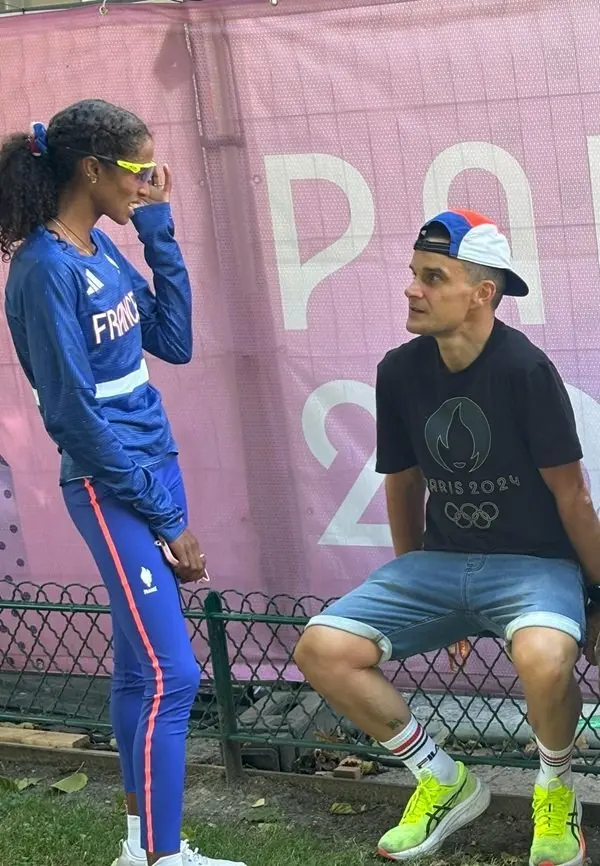
Yes, you read that right: an Olympic marathoner starts… by alternating running and walking.
While many cyclists, convinced of their aerobic fitness, imagine they can jump straight into a 45-minute jog at 13 or 14 km/h, and sometimes even more for some…
That makes no sense. And that’s precisely where the problems begin.
Running: a biomechanical stress very different from cycling
On the bike, the body is supported. When running, each stride generates 3 to 4 times body weight on impact. Tissues must absorb, release, re-absorb… thousands of times.
A cyclist’s cardiovascular fitness helps prevent breathlessness, but the rest of the body isn’t ready. Hence the importance of a slow and structured build-up…
- Smart return: the 3 sessions / week protocol
- Goal: run 45 min continuously, at ~6’/km
- Duration: approximately 6 to 8 weeks
- Rule #1: finish each session with some energy left.
- Rule #2: don’t run too fast.
- Rule #3: accept feeling like you’re “doing too little”. It’s normal.
3bikes’ proposed return to running planWEEK 1
WEEK 2
WEEK 3
WEEK 4
WEEK 5
WEEK 6
|
And now? Build without skipping steps
At this stage, you are able to run 45 minutes continuously, at a comfortable pace, approximately 6 min/km for 80% of the time.
In other words: you run without being out of breath, with a relaxed stride.
You have already integrated three essential ingredients :
- Pace variations
This is called interval training or fartlek.
The idea: run a little faster for very short periods (+50% of base speed, but never more than 1 minute continuously) to energize your stride and vary your movement.
- Light threshold
A little more sustained than your usual pace (approximately +20% of base speed), but always controlled.
You learn to be comfortable “a little fast”, without forcing it.
- Short playful work
Small, fast, short, fun blocks → ideal for breaking monotony, developing coordination, and learning to run “well”, without tension.
The logical next step
Once these basics are integrated, you can gradually:
- Lengthen the duration of your outings
- Make pace variations more structured (e.g.: 45’’/45’’, 1’/1’, 2’/1’…)
- Slightly lengthen the blocks near threshold
This isn’t about going faster. It’s about teaching the body to absorb, to take the impact, to strengthen itself naturally. The idea is never to perform immediately, but to adapt without getting injured.
Why play with paces?
To progress… and never get bored. Pace variations (20/40, 30/30, 45/45…) are simple to understand: a fast time / a slow time. They have two major advantages…
- Effective without being exhausting: Short accelerations are enough to stimulate the body: the heart, coordination, stride… Without accumulating too much fatigue.
- Fun and dynamic: They create rhythm in the session → time flies by.
They also promote:
- A more efficient stride (you learn to run “cleanly”)
- Better running economy (less energy for the same speed)
- A different distribution of impacts
→ the body alternates stresses, instead of always enduring the same repetition
In summary,
You progress more, get bored less, while getting injured less.
→ Hard to get a better win-win.
Strength Training: The Runner’s Life Insurance according to 3bikes
Running imposes stresses. A minimum of strength training changes everything… 1 to 2 sessions / week are enough:
- Planking/Core work
- Hamstrings
- Calves
- Glutes
- Feet/ankles
- 5 -15 minutes, no more.
It’s a minimal investment for maximum benefit:
- Better posture
- Injury prevention
- Efficiency
Cyclists often lack this → high priority ++ (or even +++)
Psychological and Social Benefits
Getting back into running:
- Reconnects you to your body
- Stimulates the mind
- Improves sleep
- Helps with self-efficacy
- Brings a sense of freedom
- Allows you to train in a group, quickly, close to home
Little equipment, few constraints → great rewards.
The Essential Message: Humility as an AcceleratorIf Christelle Daunay and Mekdes Woldu, champions, record holders, Olympians, start again by alternating running and walking… …then a cyclist, even a very fit one, must start low. The secret to progress is humility. You never accelerate as much as when you start slowly. |
In summary
- The cyclist has the heart, but not the tendons
- Starting again = alternating running + walking
- Absolute gradualness
- Goal: 45’ easy at 6’/km
- Pace variations afterwards
- Minimal strength training is essential
- Benefits: physical, mental, social
To conclude
Getting back into running when you come from cycling isn’t “doing cardio differently”. It’s relearning to absorb the ground. The good news? By going slowly, by building patiently, the pleasure comes very quickly.
And with it, a new, complementary, powerful fitness.
Running is putting your body on the ground. Running well is giving it time to get back to it.
So, this winter, keep it simple: slowly, for less time, more often. And remember: even the greatest start small.
=> To concretely understand how to transition from cycling to running without injury, discover this excellent practical article: Transitioning from Cycling to Running: Start Slow and Build Smart.
Share the post "Resuming and relearning to run with progression"