Share the post "On the table, they lay everything down: confidences of a soigneur"
3bikes took advantage of the pro peloton’s break to meet Stéphane Gicquel, a long-serving soigneur, the ear of champions and a cornerstone of their victories… We catch up with him in that very particular in-between time of the season, when the buses cool down, when the suitcases still half open on their own, out of reflex, and when bodies are suddenly no longer squeezed by the succession of airports, briefings, stages and bike-washing at midnight. For 3bikes, the break is the ideal moment to push open the door of a life we celebrate too rarely: that of Stéphane Gicquel, a professional cycling team soigneur for more than two decades. A behind-the-scenes job, a position without a podium, but without which many podiums would not exist.
By Jeff Tatard – Photos: Stéphane Gicquel
The man who welcomes us has the firm handshake and the precise gaze of those who know, instinctively, where fatigue hides. He speaks with the enthusiasm of a lover and the organisation of a logistician. Above all, he talks about others: champions returned to their humanity, when “the table” becomes the only place of truth.
“The massage hour is the moment when the rider is finally calm. He is settled, the body is bare – figuratively and literally. There, he talks to you about everything: his car, his family, his contract, his doubts. On the table, they lay everything down.”

From the 90s to the elite: a thread stretched by hand
Cycling, for him, began early, back when you learned trajectories on roads without earpieces and came home from races with scraped knees and dreams too big for a schoolbag. As a child he rode everywhere, then stopped after a move to the Val-d’Oise. He resumed as a junior at Beauchamp, passed through Gonesse, and slipped through the narrow door of sports-study. He retains an intact indignation: “Frankly, it’s a scandal that there aren’t two or three high-level structures per region to allow champions to ride properly.”

The class is strong. Saugrain, Lorgeou, Djouadi, Coutif,… The names snap like race numbers you have already read in the results pages of Île-de-France cycling. Cyril Saugrain above all (whom he will never stop thanking), and a generation obsessed with detail. Stéphane continues his studies – a BTS in sales – without letting go of the handlebars. He then moves on to the Paris Fire Brigade, becomes a “lord” at heart but with a helmet on his head, and races world championships for the BSPP, until the phone call that forks a life.“It’s Cyril who calls me: ‘Stéphane, we’re looking for a soigneur at Big Mat Auber.’ I was in my second year with the firemen. My father, mad about cycling, says: ‘You’re not going to quit the fire brigade!’… And I chose cycling.”
Auber first, on the amateur side and then a ready ear among the pros. The apprenticeship is brutal, direct, concrete. After three years, he asks for a raise: “I still remember it. I come to talk salary, and they tell me: ‘I’m not keeping you.’ It vaccinated me: since then, every summer, I first ask whether they want to keep me next year. The answer is your compass.”

He bounces back, goes through French teams, then adventure calls. Linda McCartney – yes, that one, linked to the name of the Beatles. Set up in England, introductions, promises… and the icy announcement: the funds have vanished, the team stops dead, in February. A professional cold snap. So he gets back in the saddle elsewhere, Rouen, a season “where we win everything among the amateurs”. His English, incidentally, becomes solid: “On the table, I had bilingual guys. They made me progress. Massage is also a language.”
The network works: AG2R opens a door (Vincent Lavenu, of course), then abroad draws him like a magnet. He wants to rub shoulders with the summit, where the Tour and the Monuments are won. He talks to Kim Andersen, to other directors, and chooses the one who says “come” first. That’s the leap. The Schlecks, the Classics, the pressure of a Luxembourg sponsor convinced you can win everywhere, everything and everything right away. “We podium in all the Classics, Oliver Zaugg wins Lombardy, the Tour ends with two riders on the podium… and it’s not enough”. Structures merge, are rebuilt. Next stop RadioShack, then Trek Factory Racing, which became Trek-Segafredo, then Lidl-Trek. Riders’ names mark his memory like kilometre markers: Fabian Cancellara, Frank and Andy Schleck, Bradley Wiggins, Andreas Klöden, Vincenzo Nibali, Alberto Contador, Giacomo Nizzolo, Mads Pedersen, Julien Bernard, and so many others.

Until the day when, once again, in July, the answer comes: they are not sure they will keep him. He knows the drill. He anticipates, sounds things out, talks. Visma on one side, then a phone call from Alpecin (where he will cross paths with Mathieu van der Poel and Jasper…). The offer arrives “24 hours later”. He signs for three years.

In the meantime, a philosophy has put words on what guides him. It is called Ikigai. “Being good at what you do, loving what you do, contributing to the well-being of others, and being able to live from it. When you have all four, you are aligned. Otherwise, it’s a passion, a vocation, or a mission… but not Ikigai.”
The beating heart of a team: the soigneur
In the peloton, people always sniff first at the sports directors, the mechanics, the science of the performance coaches. We forget the hand that soothes, the ear that listens. The soigneur, however, holds all the seams together.
Before the race: early wake-up, bottles on a production line, solid feed, room allocation at the next hotel, menus, finish bags, podium bags, lists, ice, thermos flasks. The numbers, sometimes, make your head spin : “We go with nutrition plans down to the millimetre: for example 4 gels an hour per rider, and even 45 bars per rider if the day requires it, plus the bottles – often ten a day per rider depending on the heat and the scenario. If there are eight of us, do the multiplication, over a week you reach crazy volumes.”
During the race: handing out at the start, feed zone, cars, radios, adjustments. And the unexpected, always: “You expect 80% of the film… the remaining 20% is life. If it’s cold, you need hot tea. If it’s scorching, ice-cold bottles. If the sports director changes the plan, we recompose the feed. If the rider asks you for a cold Coke at the last minute, it has to come out of the cooler like magic. It’s anticipation, all the time.”

After the race: welcome at the finish with the bags, the dry jacket, the cakes, the right word. Back to the hotel, washing, setting up the tables, then the massages. A lot of progress has been made on the staff’s quality of life: “Back then, you could have too few soigneurs for too many riders. The last massage finished very late… and a rider who eats at 10 p.m. sleeps badly. Today, on a Grand Tour, there are enough of us to get everyone through quickly; you give the rider two hours of sleep over a day.”
On the table, preferences are learned like a score.
“Mads (Pedersen) likes you to go deep into the thigh. He’s tough on pain. Others, like Julien (Bernard), prefer a softer touch. The secret is that one massage doesn’t suit everybody. Your hand must adapt to the man, not the other way round.”
As for miracle gadgets, he has tried everything, to get an idea. “Nothing beats the hand. Tools complement, they don’t replace.”

The science of feeding: flavours, grams, and psychology
People think a musette is filled by feel. That’s naive. In the morning, the performance unit breaks down the plan: energy on time, race strategy, weather, number of expected pulls, probability of echelons, of sectors, of an all-out finale. The musette becomes a flight plan.
“You know the number of gels, of bars, the grams of carbohydrate, who might need more in case of a fire at the start. Van der Poel can blow everything up 160 km from the finish? Then the team triggers very early, we feed earlier, we cool earlier, and we even prepare plan B if the day drags on.”
And then there is the killer detail – literally and figuratively: taste. “I learned that on a Vuelta: one rider loves strawberry, another caffeine without coffee. You know it, you prepare. In the car door, I always have an assortment; at the moment of opening my hand, it has to land right for him.”
The confidences: “On the table, they confide”
This chapter demands discretion. He will not reveal anything intimate – only what speaks of trust.
Jens Voigt, for example. At the start of his last season, he lies down and says: “Stéphane, at the end of the year, I want to try the hour record. What do you think?” Months of conversations, doubts and adjustments follow. At the moment of the big leap, Jens asks him to come to Switzerland. “We spent a month together. And beyond the champion, I saw the man: six children, two washing machines, two fridges, litres of milk in the cart… You never imagine that this goes with the watts. But it does.”

Fabian Cancellara, for his part, remains the cornerstone of an era – the athlete who imposes a culture of demand down to the smallest time trial. Bradley Wiggins – crossed paths, crossed again, always a word, even in the yellow jersey. The Schlecks – the summer when everything seemed possible. All of them, one day, went through the table, left that suspended hour.
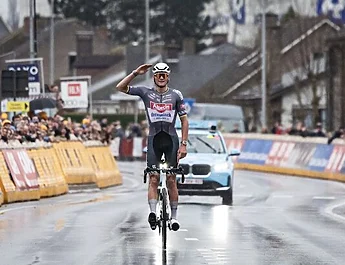
And then there is Mathieu van der Poel, a stable meteor, a living paradox – unpredictable by method. Stéphane tells the story of Roubaix the way you tell a legend in motion: “There are those days when the team sets everything in motion very early. You see it on TV, you know it’s going to explode. And in the finale, when everyone is ‘dead’, Mathieu also tells you he’s dead… but he still hands the pull to Pogacar. These champions, when they take turns as a pair, neither of them gets up. And as for victory: one day it’s you, one day it’s me.”
Stéphane slips us an anecdote you won’t read anywhere else but on 3bikes. At Paris-Roubaix 2025, when Tadej Pogačar crosses the line 1’18” behind Mathieu van der Poel, his jersey still streaked with dust, Van der Poel comes to see him and says: “But why did you arrive so fast in the corner where you crashed?” They had just been through hell at more than 50 km/h on cobbles that shake the soul. Pogačar then answers, mercilessly honest: “I was so dead… that I hadn’t even seen there was a corner.”
Contract life: lucidity as a lifeline
This is the part that is often avoided, and yet explains so much: the contract. The staff, like the riders, live with a horizon that is redrawn every summer.

“In France, people talk about the 35-hour week; in a WorldTour team, you are more on a day-package basis. They tell you 180 working days, blocks of races, camps, rest periods. There is no obligation of result of the type ‘so many bottles, so many grams’. They ask you to be professional, reliable, anticipat
The golden rule I made for myself: in July, I ask whether they are keeping me. If they say ‘we don’t know’, it means they’re not keeping me. So I anticipate, so as never to put my family in difficulty.”
In this navigation, he has had outstretched hands, loyalties, friendships that weigh: thanks to Cyril Saugrain – and above all thanks to Peg. Peg is his wife. He insists, weighing his words gravely. “My wife sacrificed herself for years. When a kid is sick and you’re abroad, she’s the one who calls her boss to say she isn’t coming in. Without her, no balance, no career. Today, she has taken flight, she is moving ahead, and I’m proud of her. But without her, I wouldn’t be here.”
The typical day, unvarnishedFor those who love the smell of logistics, here is the score, almost raw:
|

In between, a question we ask him: does he keep a personal airlock? A jog, a walk, an indoor trainer snatched from the truck… He smiles.
“When I need to, I find an hour. But the main thing is to arrive fresh at the next table. A tired hand is no longer the right hand.”
The unexpected (and how it no longer quite is)
He cites a handful, which say it all:
- Turning weather: plan for hot and cold, sweet and savoury.
- Capricious hotel: anticipate menus, hot water for the mechanics (hands sore from washing bikes? Plan solutions for them too).
- Changing tastes: a flavour they can no longer stand? Have the other one ready.
- Race that runs away: musettes already ready for several scenarios.
“With experience, you don’t eliminate the unexpected, but you reduce its impact. When things go off the rails, you have to stay calm. Everyone watches the soigneur without saying it.”

Champions are Dad’s colleagues
He tells us a scene we love. His son, when younger, often met riders at home or at the bus. For him, Fabian Cancellara was not “Spartacus”, but Fabian. Mathieu, not “Van der Poel”, just Mathieu. Jasper, Mads, Brad… “He knew the first names, not the surnames. For him, they were Dad’s colleagues. It puts everything back in its place.” This reversal of perspective, Stéphane keeps on the table: seeing the man before the palmarès. That is probably why people talk to him so easily.

What the job is becoming
We ask him how he sees the evolution of the staff’s role. His answer is clear. “It has become a real profession. We no longer call ‘a buddy to help out for three weeks at the Tour’. Teams have professionalised care, nutrition, logistics, data. We are moving towards one masseur per rider at the big events: sleep, recovery, mealtimes, everything is linked. The challenge now? Training. In France, there aren’t enough soigneurs. And aligning everyone: sports directors, mechanics, nutritionists, cooks, coaches… You don’t win ‘by department’, you win when everyone speaks the same language.” And reminding young people who dream of getting into cycling, not necessarily as riders: “Never stop school. Choose studies that keep you close to sport: press officer, cook, physio, prepa

A simple ethic, an upright gratitude
There is in Stéphane Gicquel a way of holding his line that commands respect. Being available without losing oneself, professional without drying up, lucid without bitterness. You feel it when he talks about those renewals that don’t come, those mergers that sweep teams away, those phone calls that save seasons. He has no bitterness, he has a method. “You don’t control everything. You control your way of being. Ask early, prepare a plan B, don’t put your family at risk. And work. Always.” He also doesn’t forget to say thank you: to Cyril Saugrain, who has marked the road since the early years, and to Peg, his wife, the invisible pillar of all his seasons. “Without her, I wouldn’t be here. It’s that simple.”

Epilogue (provisional)
As we close our 3bikes writer’s notebook, we think back to a sentence he lets slip with a smile: “Perfect professional happiness may be unattainable, but we can get close to it. Being good, loving what you do, helping others, and living from it. Me, on the table, I touch it with my fingertips.”

We often tend to sum up a team by its riders and its directors. We forget those who, in the shadows, carry the hours, the bags, the confidences and the nights that are too short. We forget the hand that relieves, the ear that listens, the eye that anticipates. We forget the soigneur.
This story is not a posthumous tribute, nor a romantic sentimental piece. It is an observation: in the great victories, there is always a little magnesium on the fingers, a marker on a cooler, a strawberry bar chosen at just the right moment, a podium bag ready “just in case”, an hour of confidences we will never hear, and Stéphane Gicquel who, without a sound, holds things together.
And that is just fine.
=> To learn more about the Alpecin‑Deceuninck team: ALPECIN DECEUNINCK CYCLING
=> And here, if you want to discover all our other portraits: All our Portrait articles
Share the post "On the table, they lay everything down: confidences of a soigneur"