Share the post "Nicolas Fritsch, or the art of reinvention"
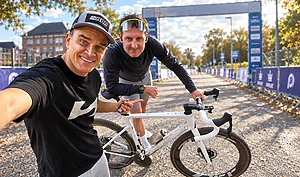
We had seen him a thousand times on screen in recent years, without ever truly meeting him in person. His voice, however, had never left us: calm, clear, almost clinical at times, capable of catching a race on the fly and dissecting the invisible. Fritsch. A name that rings out like a pendulum swing, almost mechanical. Yet, when we meet him face-to-face for 3bikes, there is nothing mechanical about him: only someone extremely present, humble in listening, demanding in thought, eager to pursue ideas to their conclusion without ever overstating them.
By Jeff Tatard – Photos: Nicolas Fritsch
The setting is simple: a table, two coffees.
The world could fade away around us; nothing would matter but the thread of conversation.
We’re here to paint a portrait. Not an inventory. A portrait: that of a man who has lived several lives in the same body, and who retains on his lips that gentle way of looking at effort as a language.
Before cycling, the strides
Before gears and pelotons, there were strides. Running…

He remembers very precisely the moment he realized he loved it. A cross-country race, won. Young. “It’s not the victory that matters; it’s what opens up behind it.” The sensation of a body surpassing itself. Of a breath that carries further. Of a moment when “you feel connected to something greater than yourself.”
The scene is not spectacular, but it is foundational. A silent cornerstone.
In fact, that’s where he starts when asked about his beginnings. He could immediately mention cycling, his cycling family. But no. He talks about running. As if everything else only came second, a logical ramification of a first love.
Why running, in a cycling family? Perhaps because his cyclist father wanted to prepare him without burning him out, we thought… Perhaps because he first needed to learn effort, commitment, and only then technique.
In his words, it appears as a correlation rather than a contradiction.
“You don’t become a cyclist by chance”; you become one because you’ve already learned to love effort.
And then, one day, cycling took over. A first race. Then a first victory, then US Créteil. The story accelerates…
The Call
For him, the spark didn’t come from an inaccessible idol, but from an image that remained etched in his mind.

Summer 1989. In his grandparents’ living room, somewhere in Italy, he watched on television the insane duel between Fignon and LeMond, that time trial that overturned the Tour by eight small seconds. The room was quiet, the screen crackled, and suddenly everything changed: that day, something took root. A vision. A dizzying moment. A click.
What he remembers is not so much the figure of the hero, but the possibility: “You can be there!”
Cycling became a must, from then on. Not as a revelation, but as a thickening certainty. And time accelerated.
Turning Pro, Seizing the Opportunity
“The day you become a trainee, you breathe different air. It’s no longer the same altitude at all.”
It was 1997. A foundational year for French cycling : the birth of Cofidis and FDJ. A new breath of life. A youth of projects and ambitions.

Nicolas was one of the two youngest trainees in the peloton, alongside Loïc Lamouller, who came through Aubervilliers. He joined Française des Jeux directly.
Our first memory of Fritsch among the professionals. A well-known and reputable race in Brittany, the mid-August Breton classic. He was on the start list, not much older than 18, and we struggled to grasp the scale of the leap he had just made. Ultimately, he didn’t finish the race. Emmanuel Magnien of the Festina team won that day.
It doesn’t matter. What matters is not the race; it’s the entry door.
| He discovers the professional environment… “No big explanations. No formalized pedagogy. Just an immersion”. |
He speaks of his FDJ years with lucidity. No bitterness, but an observation: “no one really explained the reality of cycling at the time.”
In an environment marked by doping scandals, where the peloton sometimes ran at two, or even three speeds, young riders like him, arriving without bearings, found themselves facing a world for which they weren’t given the keys. “They didn’t tell you clearly what you could hope for, nor why you wouldn’t win.”
This lack of communication, more than the harshness of the sport, is what he remembers: “novices were not prepared to understand the system they were entering.”
No pedagogy, no perspective, no explanation of the real limits of performance at the time. In other words: “there was a structure, but young people weren’t told what was really behind it.” You entered the high level without explanation, without context, without instructions.
Result: some quickly understood the unwritten rules of the environment… and others were left by the wayside.
He progressed quickly nonetheless, also because he was a true talent… Tour du Finistère. Tour de Suisse. He shone. Not through brute force: but through subtlety. Through intelligence. Through precision.
He is meticulous. He searches, measures, dissects. He conceptualizes before repeating. His strength is not only physical. It is cognitive. He observes, not only the world around him, but his own body. He asks himself: « What happens when I train? How can I improve it? What is the real effect of what I do? »
In his way of telling the story, we understand that performance was never an end in itself. It was a process. A dialogue with oneself.

A game of hypotheses and proofs.
From his FDJ years (la Française des Jeux, as it was called at the time) compared to his time in Spain with Saunier Duval, he also notes a clear cultural difference between the French organization and certain foreign structures.
“Among foreigners, there’s a stronger, more immediate sense of belonging,” he says. Not something theorized, but a felt certainty: a team where commitment goes beyond a simple paycheck.
He recounts, for example, that a mechanic would have been ready, an hour before the start, to dismantle and then reassemble his bike if necessary, without discussion. Not because it was his job; but because it was their common cause.
He doesn’t criticize France or French structures, but he acknowledges that abroad, particularly at Saunier Duval, there was an atmosphere that fostered greater engagement, almost organically.
He observes. He compares. He learns.
Even when the media cyclone of the Riccò affair, “the Cobra,” erupted, yet another demonstration of a fractured, multi-speed cycling world. He could have been lost in that turmoil. He endures.

If he had to relive a day as a racer, he wouldn’t necessarily choose a victory. He would choose a moment of grace. One of those rare instances where everything aligns: the legs, the mind, the context, where the body seems to detach from the world, as if the road opened up for you alone.
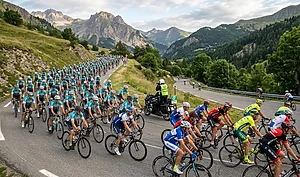
He recalls Paris–Corrèze. That day, he broke away. No one caught him. The gap grew, and grew again, up to eight minutes on a charging peloton, led by the greatest leaders of the era.
A smile appears as he recounts: “They were all at the front, taking turns to close the gap… but they couldn’t catch me.”
At the finish, some, incredulous, asked him: “Did the motorbikes help you?” He bursts out laughing as he tells it. No. Not at all. Just a day in a state of grace, where you touch the untouchable.
And then there’s another image, which he keeps like a jewel in a case.
Mont Ventoux. Alongside Armstrong. For many, an inaccessible fantasy; for him, a physical memory, to the point that he told himself that day: “Even if my career ended tomorrow, at least… I would have experienced that.”
He finished 9th in the stage. And yet, it’s not the ranking that matters. It’s the sensation, that of having fully occupied his place, if only for a time, on those lunar slopes where legend is measured by breath.
Two images, two flashes: Paris–Corrèze and the Ventoux. Two suspended moments, where a rider’s life boils down to the essential: being there, exactly there, on his own trajectory.
The end, or rather: the other beginning
His professional career ended in 2008. And very quickly, the question that no athlete escapes arose: “What now?”
Liberation, vertigo, rebirth? Probably a bit of all three at once.
He left the pro circuit, but not sport. For him, effort is not an interlude; it’s a way of inhabiting the world.
So he switched to triathlon. Why?
Because he needed somewhere else. A new language. A challenge without bearings, shrouded in fog, where no one expected him anymore.
He took the plunge. First Nice, for the first time, to learn, feel, understand. Then ten years later, he returned. And this time, everything came together: an incredible qualification for Hawaii.

In Nice, he won all categories combined, and above all, he placed just behind the fifteen professionals, as a discreet reminder that the former racer is still there, very much alive, transformed, but intact in his ability to push himself.
He recounts this day without emphasis. No grandiloquence, no mythology. Only facts, sensations: “the body charting its course, the breath saying yes, endurance expanding.”
A few months earlier, in April 2018, he had already set the tone. A training weekend, as insane as it was obvious for him:
- Saturday: 180 km of cycling,
on a Van Rysel that Decathlon had just given him the day before.
- Sunday morning: Paris marathon in 2 h 50, exactly the pace calibrated to win, two months later, his ticket for Hawaii.
We were there, 3bikes had already slipped into this piece of preparation, as if we sensed something was happening.
It wasn’t just training. It was a transition. A metamorphosis. The moment a man understands that the end of one story is merely a threshold to another.

One gets the impression of an illogical narrative. But it must be understood: for him, endurance is not an exercise; it is a breath.
In Hawaii, the heat isn’t what strikes him most. It’s the humidity. That climate that the body absorbs like an invisible, extra weight.
He goes into robot mode. He moves forward. Always.
With this solid constitution, this ability to heal, mentally and physically.
What does he find in triathlon? A form of totality. Three disciplines that break down effort into several variations. A way to prove to oneself that one can still learn.
And the fundamental simplicity of the man reappears. Speaking of great triathletes, he utters this sentence, almost as an observation: “In each of the three disciplines, they would have a largely international level.”
No false modesty, no exaggeration.
Just respect. “The greats are great.”
He thinks in particular of Kristian Blummenfelt, Olympic triathlon champion, capable of chaining 180km of cycling at an average of 45 km/h , then a marathon in 2 h 30, as if human limits had never existed.
At the mention of his name, Nicolas smiles, a smile mixed with admiration and disbelief: “I admire those guys. What they do… it’s unreal. You have to see it to believe it.”
For him, what is impressive is not just raw performance, but this mental consistency, this way of remaining present in the effort, minute after minute, where the body would want to collapse.
He doesn’t just see a stopwatch. He sees a narrative. An inner architecture. Total commitment.
For Nicolas, admiration is never naive : it is lucid, sensitive, inhabited. It says something deeper: “that sporting greatness is not only in victory, but in that quiet courage that consists of standing at the very edge of oneself.”
Fitnext, the other school
In his journey, he gets certified, graduates, passes his exams, learns coaching, transmission, but also physiology, biology, biochemistry, etc., all from experts, and then there’s Fitnext too… he joined Erwann Menthéour in 2016. Here again, he doesn’t seek to magnify. He says what needs to be said: “It wasn’t all good. But I learned. About the body. The mind. Nutrition. Relationships with others.”
He takes it in. He retains it. He absorbs it. Always learning. Still…
Becoming the voice, entering the media
Then came another transition: entering the media, the role of consultant. For most cycling enthusiasts, this is where he became familiar. His calm and precise voice on Eurosport is one of those instantly recognizable, like a road companion capable of illuminating a fragmented peloton or revealing what isn’t visible on screen.
This transition to the microphone happened without fuss, almost naturally. He settles into it as if it were an already familiar room. What he likes? Analysis, but not the cold analysis done after the race is over. What drives him is live, in-the-moment analysis, when the breath of the race is still present, when nothing is yet written.
“There, you can make mistakes. It’s not a big deal. What matters is being there. Being true in your intention.” He describes this work as a balancing act: too much emotion, you get lost; too much neutrality, you lose the life. You have to navigate between passion, precision, and pedagogy, being both in the race and just above it.
What makes him unique is that he allows himself not to know. “I don’t know.” Three rare, precious words that maintain a space for honesty. For him, a good analysis is not one that is right, but one that reveals: that uncovers the invisible, that opens the viewer’s horizon, that allows them to feel the race differently.

The podcaster: letting words breathe
Late Cycling. Then Bistrot Vélo.
In these formats, he explores another relationship with speech. Freer. More human. More sensitive.
He looks for what isn’t found on air. The “off-air.” The unspoken. The gray areas.
“There, we don’t comment: we listen. We let it live.”
What does he want to create? A place where something is deposited. Not just information, but a part of oneself.
“There’s a framework. Yes!” Because you need a compass. But “80% of the time, it’s the exchange that guides. 20%, it’s improvisation.”
He states it as an obvious truth: “You can’t summarize an hour of conversation in two minutes of commentary if you haven’t already done the work beforehand.” This work of condensation—sorting, filtering, prioritizing—is a skill acquired patiently.
For him, this process doesn’t happen sitting behind a desk. His true laboratory is when he runs. That’s where ideas emerge, assemble, rub against each other. The formatting comes later, often in the car that takes him to the Eurosport studios. The road then becomes the last airlock before going on air : a place where thoughts settle and gain coherence.
His guests always surprise him. But when he mentions the one who surprised him the most, he talks about Paul Seixas, “a brilliant rider,” he describes him thus: “He is not only strong, he is very intelligent. And power only makes sense if it is thought through.”
Modern cycling, between lucidity and tension
His vision of current cycling is not nostalgic. It is lucid. Nuanced.
More scientific? Yes. More unbridled? Perhaps. More short-term oriented? Certainly. He is surprised to have never loved cycling so much, despite everything. Perhaps because it has become ultra-televisual. What worries him, however, is: “the disappearance of certain amateur teams, these talent reservoirs, these essential nurseries.” A silent hemorrhage. The risk: “that future champions are scouted earlier, but more brutally.” “Cadets are asked to live like pros. Three training sessions a week are no longer enough to ‘be competitive’.”
Cycling changes. But what about humans? They remain the same. And that’s where the danger lies.
What sport taught him
Sport is a school of self. It places you before yourself. It forces you to answer questions you would never have asked.
When asked what he learned, he remains silent for a long moment.
Then… “Sport taught me to know myself. It’s not an answer. It’s an obvious truth.”

He speaks of balance. Of humility. Of adaptation.
His greatest pride is not a victory. Not a ranking. Not a trophy. No. It’s a transition. He remains modest at this moment, and we won’t share the intimacy he confided to us off the record, but he speaks of his children, his daughters, and the learning he tries to transmit to them through sport.
Having left pro cycling, having found another path, having built a new identity, all without bitterness, without resentment. With elegance.
So, cycling is not his life. It’s just one of his languages.
Life Philosophy
When asked to summarize his life philosophy in one sentence, he smiles. He searches, not for a formula, but for a truth. And what he proposes sounds like a silent promise: “Do your best, but always remain curious.”
Simple. Pure. True.
Let’s conclude with discreet grace and depth
Nicolas Fritsch is not a hero of legendary cycling. He did not build his life on a list of achievements. He did not seek to become a celebrated figure. And yet. He possesses that rare quality: the ability to reinvent himself, to move on, to continue learning, without losing his core.
Childhood running, pro cycling, triathlon, media, podcast… Each chapter doesn’t erase the previous one. They add up. They build. He never defined himself by what he did, but by how he lived it. Precise. Thoughtful. Curious. Human.
In his words, we find a simple truth: “sport is not just what you accomplish, but what you become thanks to it.” His journey is less a straight line than a series of adjustments. A dance with life.
What is striking is the silent coherence of it all. As if, despite the turns, he had always been exactly where he was meant to be. He shares his perspective without seeking to convince. He tells his story without seeking to impress. He analyzes to reveal, not to shine. And perhaps that is the most beautiful thing in this story: Intelligence is never a weapon for him, but a tool in service of understanding.
Strength is never domination, but exploration. Cycling, triathlon, speaking, listening: all these disciplines say the same thing. That life is a movement. That meaning is not given. That it is built.
And that, if one remains curious, if one stays alert, if one accepts to start over, then nothing is lost: everything transforms. Nicolas Fritsch is one of those who move forward quietly, with that calm class that doesn’t seek to show off, but to transmit.
His voice on Eurosport, his conversations at Bistrot Vélo, his view of the world, all contribute to drawing the same thread: To understand, and to make others understand. To see, and to make others see. To learn, and to transmit.
So, if one were to retain one thing from this portrait, it might be this: In a world that demands certainties, he prefers nuance. In an environment that celebrates summits, he honors transitions. In an era obsessed with the short term, he cultivates depth. Because sport is not just about watts, but about soul. Because an athlete is not just a body, but a being. And because the most beautiful victory, the one we often forget to celebrate, is perhaps simply to become oneself.
=> If you want to hear his voice, take a moment to discover this exchange in Bistrot Vélo with Paul Seixas: Bistrot Vélo avec Paul Seixas
=> And here, if you want to discover all our other portraits: All our Portrait articles
Share the post "Nicolas Fritsch, or the art of reinvention"