Share the post "Nicolas Roche, the man who never stopped moving forward"
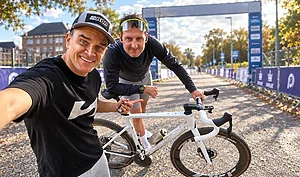
He arrives, slim silhouette, calm smile, helmet under his arm. The autumn wind kicks up a little dust on the path, one he now knows so well. Nicolas Roche has just donned his first rainbow jersey, that of Gravel, this free and wild discipline where you reinvent yourself with every new path. Thirty-six years after his father Stephen, another Roche thus wears the colors of the world. But this time, it’s a new story, a chapter of his own. Stephen’s son, the World Tour rider, the discreet captain, the man of duty… he closed this chapter quietly, without drama, with the same elegance he showed in getting back up after a fall. And today, he moves forward, still on two wheels, but on a different terrain. When the recent Gravel World Champion granted us this interview, it wasn’t just about talking about performance, watts, or achievements. It was about talking about life, about rebirth, about what remains when the bike computer’s timer stops. A sincere, human dialogue, sometimes modest, often luminous, reflecting this man who has made cycling much more than a profession: a mirror of his existence.
By Jeff Tatard – Photos: @roche_nicholas
The Beginnings: When a Name Becomes a Road
Conflans-Sainte-Honorine, early 80s… A little boy runs in the garden with an oversized jersey and an undersized bike.
On the frame, a sticker in the colors of Ireland, a souvenir of the father everyone admired. Stephen Roche. World Champion, winner of the Giro, the Tour, the Vuelta. A mythical treble etched in the history books. And, already, an immense shadow in which one had to learn to stand tall.

“Cycling has always been a part of my life,” Nicolas confides to us, in a calm, steady voice. “Since I was little, I played at being a cyclist.” It’s a simple sentence, but it says it all: cycling was never a discovery, much less a rebellion. It was an obvious fact. Not an obligation. A presence.
A bit like those landscapes you think you know by heart, until one day, you decide to carve your own path through them.
His truly began at 12 years old.
Ireland, the return, family, wind, rain.
He lined up for a local race, with no other ambition than that of a kid who wanted to have fun. He finished second. And that day, in the humid September air, a seed took root. “I had decided to do more the following year.”
Two years later, rugby, another Irish passion, tore his cruciate ligaments. An injury like a signal. His body told him to choose. Cycling became essential. Definitely.
Growing up with a name like Roche is both a driver and a burden. “It was a mix,” he admits. “Always pressure, because I was never good enough. People always said ‘he’ll never be like his father.'” But there was also pride. The pride of bearing a name written in school textbooks, of having a role model at home, not on a poster. “My father is in my contemporary history book, can you imagine?” he tells us with a smile. A legacy both inspiring and cumbersome. A compass and a weight.

Between France and Ireland, Nicolas built a plural identity. Two languages, two cultures, two sensibilities. “I see it as an opportunity. I love and am proud of my two roots. I’ve lived in the south for a long time, so maybe I have a French leaning,” he laughs.
But Ireland remains in his soul. It’s where he learned courage and simplicity. Two qualities that would accompany him throughout the peloton.
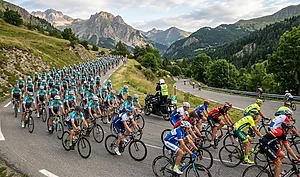
Seventeen Years in the Peloton: Craft Before Glory
Seventeen years in the World Tour. That’s all. A number that summarizes the longevity of a craftsman, more than a seeker of spectacular feats. “My consistency is what I’m most proud of.”
Roche embodies constancy, rigor, and effective discretion. In a peloton often dominated by the flamboyant, he chose to be reliable. Always ready, always fair, always professional.
Of course, there are regrets. “I would have liked to win more, especially a Tour stage.”
But cycling isn’t just about finish lines. There are those days of invisible work, those perfect relays, those victories that don’t appear next to his name but to which he contributed. “I helped and played an important role in my leaders’ victories in the world’s most beautiful races.” And it is there, undoubtedly, that the nobility of his career is measured.

Fall, Get Up, Start Over
A brutal turn. “That year, I almost lost everything.” Divorce, injuries, weariness. “I couldn’t train anymore.” But he didn’t give up. “Cycling allowed me to keep my head above water.” Because for Nicolas, cycling isn’t a profession: it’s a backbone.
He never thought of stopping everything. Never.“I always fought, in all circumstances.” This isn’t a superficial statement. It’s his DNA.
And in this world where the spotlight changes from one day to the next, he maintains a simple philosophy: “Being a pro is a way of life. Even on vacation, you can’t overindulge, because you pay for it afterwards.” He laughs, but you can feel the experience behind the words. “That’s the difference with other sports: there’s no real decompression phase. Even on rest days, you have to pay attention to everything.”

It’s a form of asceticism. But also a freedom: that of knowing yourself perfectly. Of being master of yourself in a world that imposes everything on you. And if he had to do things over? “Not much.” A disarmingly simple answer. “I don’t like to think about that. Because it won’t change the present.”
The Transition: Reinventing the Road
For many athletes, retirement is a black hole. A silence after the clamor.
Nicolas, for his part, pushed forward. “It’s not easy, but I preferred to move on.”
No break, no cocooning. He chains together projects, travels, collaborations. “I travel 300 days a year. I have 4 or 5 different activities. I don’t allow myself to rest. The time is now.”
The tone is energetic, determined. He doesn’t speak like a retiree, but like an entrepreneur. He knows that in sports, memory is short. “The mistake many make is to ease off and then say ‘I’ve been forgotten.'”
He admits, however, that some days are tough. “My mind is still coming to terms with it being over. Even though I chose to stop.”

So, he reinvented himself. Not in a void, but on the bike. Gravel came like a breath of fresh air. “It was the desire to stay fit, to travel, to see cycling from another angle.”
And this time, no radio, no earpieces, no meticulously planned strategies. Only dust, solitude, freedom. A freedom earned through calf strength and experience.
His title of Gravel World Champion, he doesn’t see it as revenge. Rather as a recognition. “I’ve been here since the beginning of European Gravel. I’ve worked with organizers, with the UCI, I’ve given advice, done promotion. This title is a thank you for the sacrifices I continue to make.”
And when asked what this title truly represents, he looks up, searching for words. “A lot. Especially after breaking my hip in February.” A short, modest sentence, but of immense density.
He no longer defines himself by rankings.
Today, he is an ambassador. Not just for a brand, but for a way of life. Free, curious, balanced.

=> To follow his news, Gravel adventures, and projects around the world, find Nicolas Roche on Instagram: @nicolasroche |
Discipline and Philosophy: More Than Motivation
For Nicolas, mental strength is not a posture. It’s a way of life. A way of being in the world.
He has weathered storms, absorbed doubts, faced routine. But he never confused motivation with discipline. “The mind is important, but it takes much more than that.”
“Motivation pushes you to start. Discipline prevents you from stopping.”
He believes that this discipline is both innate and cultivated. A seed watered every day, with the sweat of one’s brow. And when he doesn’t feel like it, because yes, it happens, he doesn’t force himself out of obligation. “I don’t like obligations. Today, my balance is there. I’m not a Gravel pro. I’m a brand ambassador, I do races, but I no longer have anything to prove or accounts to render.”
It’s a mature relationship with performance.
That of a man who has learned to detach without denying himself.
Success, for him, no longer has the same face. It’s not on a podium. It’s in balance. In the fact of loving what he does, of transmitting, of inspiring. “I’m not sure what success is. But this title means a lot, especially after what I’ve been through.”

Image, Sincerity, and Style
On social media, Nicolas Roche appears as he is: simple, smiling, stylish.
Not calculated, not staged.
“It’s me, it’s all me. For it to last 20 years, it has to be natural. You can’t play a role for that long.”
That’s probably why his community follows him, with respect and affection. Because he doesn’t preach, he shares. Because he doesn’t overact, he embodies.
Yes, he loves fashion. Beautiful things, beautiful objects. “It relaxes me,” he says.
And it shows: a sure taste, a sober style, a balance between athlete and aesthete.

When Bianchi contacted him, it was like an obvious choice. “They called me in 2022, saying: we think we can do projects together. I had never raced with them, but I knew our images were compatible.”
His collaborations are not image contracts, but stories of values.
Of authenticity. Of trust.
And it is this authenticity that today gives him a true place of inspiration.
“I think yes, I have a role. But I don’t advocate any extremes. My life is about showing that balance is enough.”
Balance. Always. “I like wine, but I’m careful. I train, even if I have other occupations. When I’m injured, I fight to come back. Because I want to show that it’s doable.” And he does it. Quietly. With consistency.
On social media, many thank him.
Often strangers. Enthusiasts, sometimes injured, often tired, who find in his journey proof that one can always get back up. “It’s a source of pride for me to know that, perhaps, one day, I helped someone not to abandon their project.”
Perhaps that is the finest achievement of his second life.

Vision, Future, Message
The world of cycling is changing, opening up, fragmenting. But Nicolas remains faithful to a clear line: sincerity and perseverance.
When asked what message he would like to convey, he looks down at his left leg. A tattoo. Three words. Never give up.
It’s not a marketing slogan.
It’s a scar transformed into a motto.
A way to remember that every fall, every injury, every doubt, can become a springboard.
Nicolas Roche never sought to be the strongest. He wanted to be the most authentic. The one who cheats neither others nor himself. And in a world saturated with images and posturing, that honesty has the quiet strength of greatness.

Epilogue – What Remains When the Road Ends
When he puts his foot down, Nicolas doesn’t look back. There’s no nostalgia, no “it was better before.” There’s a calm gratitude. That of having lived a full life.
He was the son of, then the rider, then the captain, then the free man. And at each stage, he knew how to redefine himself, without denying the previous one.
He didn’t just ride the roads of the world. He rode through doubts, expectations, borders, labels.
And he’s still there, on the bike, a wry smile, Gravel dust on his legs, the wind in his face.
Because ultimately, he never stopped being that kid from Conflans, the one who played at being a cyclist. Except today, he no longer needs to play.
“Never give up.” Three words, a thousand lives.
And, somewhere between France and Ireland, a man who continues to move forward, quietly but intensely, because the road, for him, never truly ends.
Share the post "Nicolas Roche, the man who never stopped moving forward"