Share the post "Why off-bike training is never useless"
There always comes a time in a cyclist’s life when the pedals move away. An injury, an operation, a business trip, or a simple family vacation in a place without a bike. Then, you watch your legs, once hard as fresh wood, lose a little definition, and your morale drops with the elevation. You tell yourself that everything is going to hell, that hours of training evaporate at the speed of a missed sprint. And then, in a burst of good will, you try a few push-ups, some awkward core exercises, two water bottles as dumbbells… before asking yourself: “does it really do any good?” The answer, surprisingly, is yes. And even more than you imagine… and we’ll explain why!
By Jeff Tatard – Photos: ©3bikes.fr
When the Top Talks to the Bottom: The Cross-Training Effect
The human body is not a stack of spare parts. It’s a symphony of interactions. When you work your upper body, even without any leg involvement, your entire organism reacts. Scientists call this the cross-education effect.
In short: if you strengthen your arms, your core, your shoulders, your brain and your hormonal system send signals to the entire body, including your resting legs. It’s as if your body refuses the idea of total idleness.
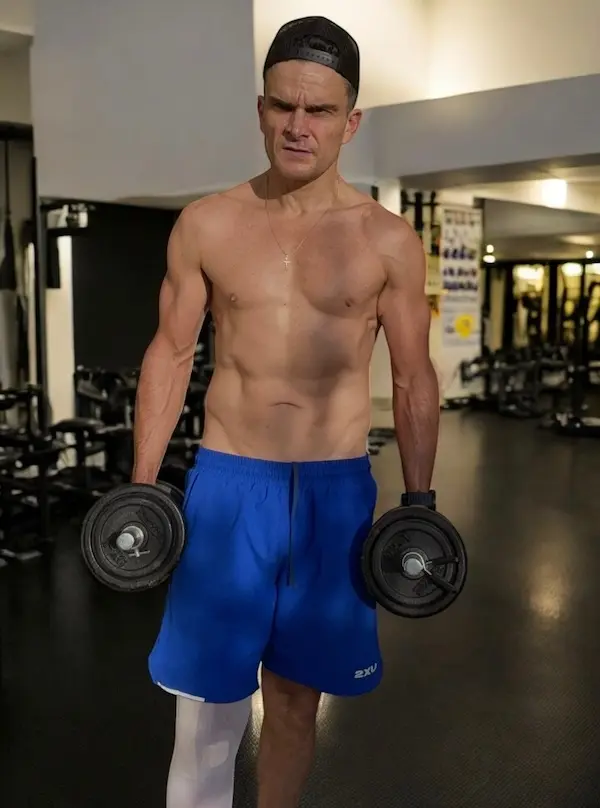
What Physiotherapists and Neurosciences Say
« The brain doesn’t compartmentalize movement, it directs it. When you stimulate one side or one area, the other learns too », explains Mathieu Moretti, physiotherapist and specialist in movement neurosciences. « That’s the magic of the nervous system: it generalizes effort. The upper body trains the lower body, even remotely, because everything goes through the same motor learning circuits. » And he’s right.
On a nervous level, each arm contraction awakens bilateral connections — both sides of the body receive the message. On a hormonal level, each effort releases testosterone, growth hormone, IGF-1, and myokines, those small molecules that stimulate muscle regeneration wherever they pass.
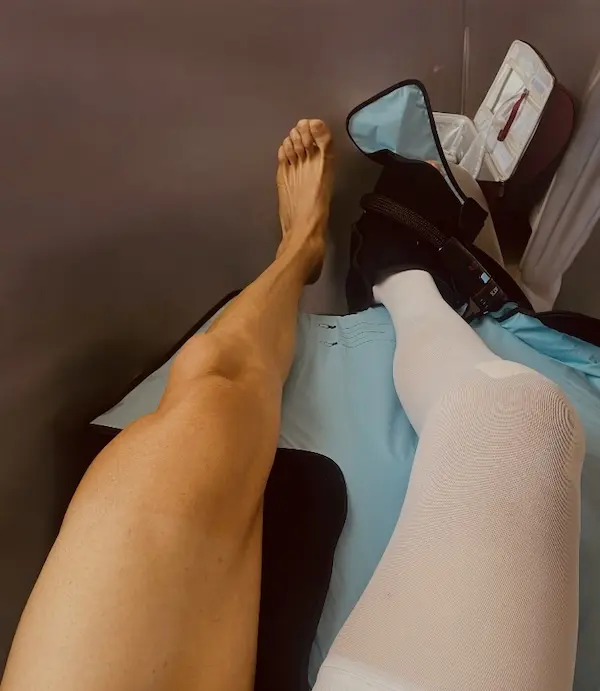
The result: even when immobile, the injured leg continues to learn, to resist, to prepare itself. The healthy muscle talks to the suffering muscle, and the body listens.
What Happens Inside
First, on a nervous level:
When you contract an arm muscle, your brain activates bilateral motor circuits; in other words, both sides of the body receive the message. Even the leg that isn’t moving keeps its connections active, ready to get back to work as soon as the light turns green again.
Then, on a hormonal level:
Each session, even a light one, stimulates the production of testosterone, growth hormone, IGF-1… and those famous myokines, small chemical messengers released by active muscles. These signals circulate in the blood and encourage protein synthesis in all muscle fibers, not just those being worked.
The result: you may not gain muscle, but you limit muscle loss. You keep the engine running, even at low revs.
The Hotel Room, an Improvised Gym
So yes, it lacks asphalt, warm air, and passing scenery. But a hotel room can become a small laboratory for cyclist maintenance.
A few push-ups to wake up the heart, some core work to remind the trunk of its purpose, chair dips, a side plank for the pelvis. No need to do a lot: 10 to 20 minutes are enough to keep the metabolic flame alive, restart hormones, and keep the mind connected to the effort.
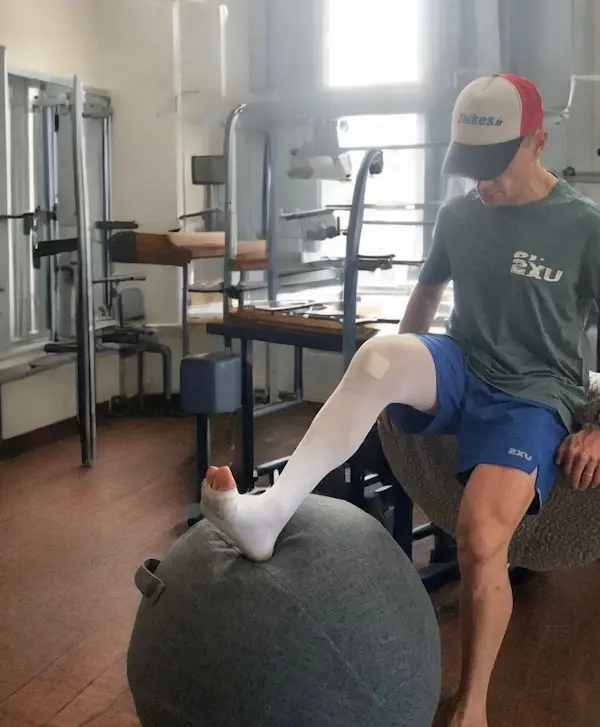
And if you are recovering, the principle remains the same: work what you can, to keep alive what you cannot yet. The healthy muscle talks to the injured muscle. It’s a silent but effective conversation.
The Body Has Memory, and It Will Repay You
The most beautiful thing about all this is that this internal solidarity translates into recovery. You rediscover cycling with legs that remember, a heart that hasn’t forgotten everything, a nervous system ready to find its rhythm again. Those who have gone through a long convalescence know it: you think you’re starting from scratch, but the body keeps the thread.
Better a Body in Motion Than a Body Making Excuses
So, the next time you find yourself away from your bike, stuck between two meetings, a suitcase, and a hotel room carpet, don’t sigh. Place your hands on the floor, straighten your back, breathe. Every drop of sweat is a message to your body: “I haven’t forgotten what we do together.”
And when you finally get back on your saddle, your legs responding again to the call of the asphalt, you’ll see: the engine will restart faster than expected. Because it never really stalled.
What We Suggest You Remember
Even when stopped, a cyclist who moves remains a cyclist. The human body doesn’t like boundaries: if one muscle works, all the others benefit a little. And sometimes, between two push-ups in a hotel room, it’s morale that you strengthen above all.
Share the post "Why off-bike training is never useless"