Share the post "Low-cost TPU inner tubes: a false economy"
When you’re a cyclist, whether you ride for pleasure or sport, you often look to optimize your budget. And in this quest for savings, platforms like AliExpress or Amazon are irresistible magnets. Take TPU inner tubes, the latest ultra-light trend that promises performance and weight savings for your bike. On AliExpress, you can find a TPU inner tube for between €5 and €10, sometimes even less. Compare that to the €25 or €30 for a Continental, Pirelli, or Schwalbe TPU tube, and the deal seems sealed. Why spend five times more for a piece of inflatable plastic? Well, let us explain why these bargains are often a trap, and why, as avid riders, we’re fed up with these low-cost products that make us lose time, money, and patience.
By Guillaume Judas – Photos: Vittoria, Aliexpress, DR
The Mirage of €5 TPU Inner Tubes
On paper, everything seems perfect. Descriptions on AliExpress or Amazon are full of superlatives: ultra-light, high resistance, perfect compatibility. You’re promised a TPU (thermoplastic polyurethane) inner tube that rivals major brands, for a fraction of the price. At €5 a piece, you tell yourself that even if it doesn’t last as long as a Continental, you get five for the price of one!
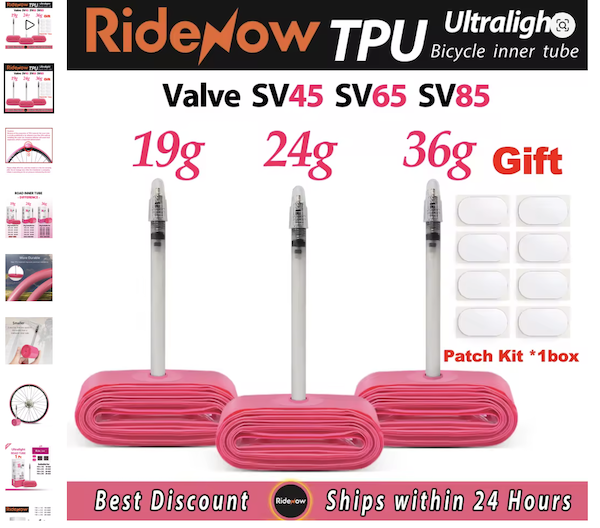
For example, take a look at this global search on AliExpress for low-cost TPU tubes, where models like the CYCLAMI for less than €6 are abundant. So, you order, all excited, and you wait (sometimes a month) for the package to arrive from the other side of the world.
But from the first pedal strokes, reality catches up with you. Several people in our circle have tested these cheap TPU inner tubes, and believe us, it’s an infuriating experience. First problem: porosity. Some of these tubes slowly lose air for no apparent reason. You inflate your tire to 6 bar in the evening, and the next morning, it’s at 3 bar. No visible puncture, no hole, just a tube that leaks like a sieve. The result? You spend your time reinflating, checking, and stressing before every ride. And that’s in the best-case scenario. We’ve just been told about a model of TPU tubes (bought on Amazon this time) that doesn’t hold pressure for more than two or three hours.
Then there are the valves. Oh, the valves! That simple, low-quality thing that breaks, deforms, unscrews poorly, or worse, lets air escape as soon as you try to inflate. We’ve seen low-cost TPU valves leak at the junction with the tubular part of the tube on the first manipulation, rendering the tube unusable. Compare that to a major brand valve, which withstands hundreds of inflations without flinching. It’s like night and day.
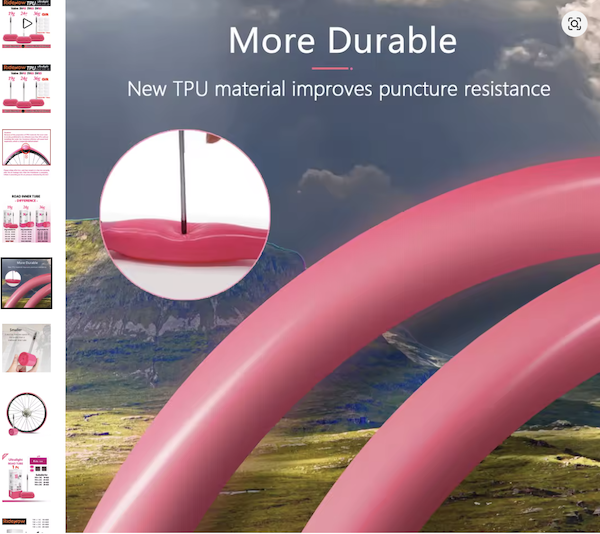
And then there are punctures. If you manage to ride more than 50 km without incident with a €5 TPU tube, buy a lottery ticket, because you’re lucky. These tubes are often so fragile that a slightly sharp piece of gravel or a clumsy manipulation during mounting is enough to puncture them. We’ve seen tubes tear like paper at the slightest contact with a tire lever, or puncture after a simple pothole. Meanwhile, the Continental tubes we’ve been using for 18 months withstand kilometers of bumpy roads without a hitch, provided a few mounting precautions are followed (no pinching, use of appropriate tools, etc.).
For a concrete example of quality, look at the Pirelli P Zero SmarTube in TPU for about €25 or the lightweight Continental ContiTPU for €23.
Why these low-cost products are a bad calculation
You might say: “OK, they’re less reliable, but at €5, I can afford to buy more.” Except that this reasoning is an illusion. Let’s take a concrete example. Let’s say you buy five TPU tubes for €5 each, totaling €25, the equivalent of one major brand tube like those mentioned above. In one month, three of your low-cost tubes puncture, one is porous, and the last has a defective valve. You’re back to buying a new batch, and the cycle repeats. Meanwhile, your €25 Continental tube lasts 6000 km, or even more if you’re careful when changing tires, without any problems. In the end, not only have you spent more money buying cheap tubes, but you’ve also wasted time repairing, reinflating, and stressing on the side of the road.
And let’s talk about time, specifically. A puncture in the middle of a ride means 10 minutes lost (if you’re fast), not to mention the frustration. If you’re in a race or a sportive, it’s a ruined outing. Add to that the environmental impact: these disposable tubes, often poorly packaged in single-use plastic, end up in the trash faster than you can say it. Meanwhile, a quality tube, well-maintained, lasts for months.
The underlying problem: quality sacrificed on the altar of price
Why are these low-cost TPU tubes so disappointing? Because the race for low prices imposes unacceptable compromises. Manufacturers (often anonymous) cut corners on material quality, quality control, and valve precision. The TPU used is sometimes so thin that it becomes fragile, or poorly chemically treated, which explains the porosity. The valves, meanwhile, are often assembled hastily, without the necessary finishes to guarantee perfect sealing. Conversely, major brands invest in premium materials, rigorous testing, and controlled manufacturing processes. Yes, it costs more, but that’s the price of reliability.
And don’t talk to us about exceptions. Yes, sometimes a €5 TPU tube does the job for a few weeks. But that’s luck, not a guarantee. With major brands, you pay for consistency: you know that 9 times out of 10, your tube will hold up.
A call to reason: invest in quality
Cyclists, stop falling for fake bargains! These €5 TPU inner tubes are not an investment; they are band-aids on a wooden leg. By trying to save a few euros, you end up paying more, in money, time, and frustration. A major brand inner tube is a purchase that pays for itself over time. Take care of your bike, mount your tires correctly, avoid pinching, and a good TPU or latex tube will accompany you for hundreds, even thousands of kilometers, while offering excellent performance.
You know that at 3bikes.fr, we love good gear. But we regularly encourage you to weigh the pros and cons of impulsive purchases or to choose equipment that suits your practice. It’s not about doing just anything and only buying what seems like a miraculous deal. Because as the saying goes: “We are not rich enough to buy cheap.”
So, the next time you’re tempted by an enticing offer on AliExpress or Amazon, ask yourself: do I really want to play the lottery with my bike? Or do I want to ride with peace of mind, with equipment that holds up? The answer is obvious. Stop being fooled by these disposable products and bet on quality. Your bike (and your nerves) will thank you.
Share the post "Low-cost TPU inner tubes: a false economy"