Share the post "In Samuel Plouhinec’s impossible draft"
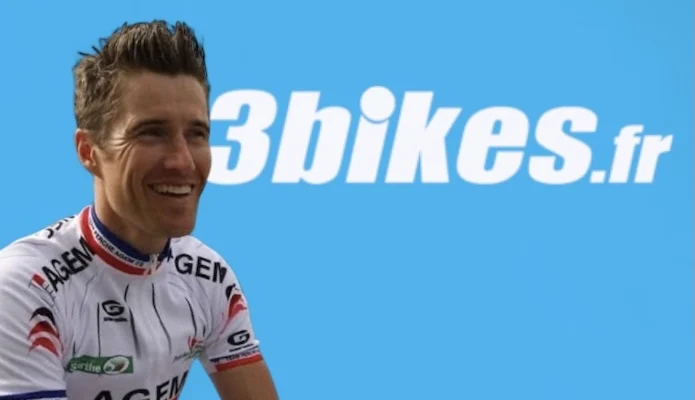
There are riders you can follow. Others you can hope to hang on to in the right breakaway. And then there are those, rarer still, who force you to reconsider the very notion of speed… Samuel Plouhinec belongs to this last category. For a moment, we tried to slip into his slipstream. But very quickly, the realization hit us: impossible. Instead, we preferred to stop, put a foot down, and listen to him. Because with him, the road is even more captivating when he tells its story than when it flies by at 50 km/h.
By Jeff Tatard – Photos: All Rights Reserved
When asked about his very first memory as a racer, Samuel doesn’t mention a major classic or a professional peloton, but a first victory in the minime category in Coudreucieux. That’s where it all began. A modest finish line, but already that unique feeling: raising his arms, crossing before the others, experiencing that simple exhilaration. “My first victory,” he says, “in the minime category. That’s when everything clicked.”

Cycling is sometimes summarized as a story of numbers — 409 victories in his case — but it is actually a succession of intimate markers, invisible milestones. For Samuel, this initial milestone remains foundational. In Coudreucieux, he found more than a victory: a certainty.
The Awakening of the Juniors
Two years were enough to transform this obvious talent into a life project. As a junior, Samuel discovered that he wasn’t just fast, he was truly gifted. “It was at that time that I realized I had abilities. I started to hope to make it my profession. Even though, since I was a kid, I was already saying I wanted to become a professional racer.”
This “I want to make it my profession” is not just a phrase. For a young man from Sarthe, it’s an immense horizon. Far from televised stars, he already imagined a life of sacrifices, travel, crashes, but also battles won with panache. The dreaming child became a young man on his way to a destiny.
The Wall of Professionalism
And yet, this dream came with a brutal price. In the professional world, the light is as blinding as it is cruel. Plouhinec discovered a cold reality there: “Among the pros, everything is meticulously planned, the pressure is constant, and there’s no room for error.”

His first two years at Cofidis were enough to summarize the harshness of this environment. Mononucleosis wiped out an entire season. Then, barely recovered, a dramatic accident: hit by a car just before the Tour de l’Ain. Fractures, cervical compression, endless rehabilitation. And, as if that weren’t enough, the chilling silence from the management. No more contract. No more news. Nothing.
“The only one to check in on me,” he recounts, “was Cyrille Guimard, the one who signed me.” In the solitude of an injured rider, this gesture meant more than any podium. Samuel knows it: in this environment, you are judged by the immediate result, never by the person.
The Amateur’s Revenge
So he returned to where he truly felt alive: the amateur world. “As an amateur,” he says, “there’s more freedom, raw passion, and above all, true camaraderie.” There, Plouhinec was no longer a number on a contract: he was a rider who won, who breathed, who embodied perseverance.
The numbers speak for themselves: 409 victories, including 29 in the 2011 season alone. The record of an insatiable rider. “I had no secret. I was a winner. I loved to race, everywhere, all the time.” French U23 Champion in Apremont in 1996. French Elite Champion in Saint-Brieuc in 2009 — his fondest memory. “It’s the race everyone dreams of winning. For me, it was the culmination.”
Every jersey, every bouquet, every departmental circuit race became a chapter in this extraordinary palmarès. But behind the numbers, there is above all a style: instinctive, offensive, generous. Plouhinec doesn’t calculate. He attacks, he sniffs out opportunities, he dares. His bike is an extension of his will.

The Mindset, the Other Engine
But his career is also marked by fractures. Literally and figuratively. By crashes and returns to the highest level. Samuel Plouhinec never languished at the back of the peloton.
How do you come back from so many injuries? How do you maintain that rage after fractures, battered knees, blank seasons? Samuel lowers his eyes, thinks, then simply says: “I don’t really know… I always managed to keep my spirits up. I never really doubted.”
It’s not a pose. It’s a raw truth. Where others sink, he persists. Because for him, riding is breathing. His strength is not only in his legs; it is in this absolute refusal to give in to fate. He is resilience personified.
Cycling Today
In 2017, Samuel closed the chapter on competition. Without a fuss. Without emptiness either. “I had prepared for it; I didn’t feel a void.” As soon as his career ended, he immersed himself in real estate, alongside his wife. A controlled transition, without hitches. But cycling remained. Not as a profession, but as a rediscovered joy. “Today, it’s about pleasure. I ride several times a week, with friends, with my son Evan. It’s a joy to share that with him.”
Evan, 14, is starting to show great promise. Small build, but already his father’s pedal stroke. So Samuel sometimes returns to Masters competitions, pushed by his son who wanted to see him race with his own eyes. The circle is complete: the child from Coudreucieux has become the family man who transmits the passion.

The Torchbearer
Because Samuel never cut ties. He coaches the young riders of Brette-les-Pins, advises, guides, transmits. In his discourse, one word often comes up: simplicity. “Today, young people no longer want to race in small local events. Yet, that’s where you learn. If we neglect them, organizers get discouraged, and an entire talent pool disappears.”
His words sound like a warning, but also a reminder: cycling is not just made up of big televised stages. It’s a sport that feeds on anonymous riders, village races, and passionate volunteers. Without this foundation, no champion can emerge.
A Look at Modern Cycling
He observes, clear-sighted, the evolution of the peloton. “The level is homogeneous; young riders arrive very early, with incredible maturity. But they pay an enormous mental price. Their careers will perhaps be shorter than ours.”
He formulates this observation without excessive nostalgia. Just with a clarity nourished by experience. He, the instinctive, the generous, knows that modern cycling, ultra-precise, leaves little room for raw pleasure. This is undoubtedly why he always preferred the amateur world.

Philosophy of a Winner
If Samuel had to write a message on a jersey for a young rider, it would be: “Be convinced of what you do, and do it fully.” His entire career is contained in this sentence. He never did things halfway. Neither training, nor returns from injury, nor full seasons. This thoroughness is not vain stubbornness, but a way of being in the world.
“My philosophy? To see through what I undertake, with passion and conviction.” This is the finish line of a life. Not a checkered flag, but an attitude, a fidelity to oneself.

Still in His Wheel
So, what did we find when trying to take his wheel? We didn’t find a rider we could follow. We found a man who always rides a little further than us. But above all, we found a story of rare intensity: that of a champion who managed to remain human, who won by hundreds without ever losing sight of the essential.

His mark is not only in the palmarès, but in the roads he continues to travel, in the young people he accompanies, in his son he guides. Samuel Plouhinec is not a former champion: he is still, today, a living lesson in perseverance. And if we cannot hold his wheel, we can at least remember his words, keep them as a guide: believe, persevere, attack, transmit. Because some men pedal too hard to be followed, but true enough to be listened to.
Share the post "In Samuel Plouhinec’s impossible draft"