Share the post "12- or 13-speed: which drivetrain for you?"
In the world of road and gravel cycling, where precision and efficiency are paramount, the transition from 11-speed to 12-speed, or even 13-speed, drivetrains still fuels technical debates. For an experienced cyclist, changing a drivetrain is not limited to an aesthetic upgrade: it requires a detailed analysis of the gear ratios offered, mechanical compatibility, and the impacts on the entire system.
By Guillaume Judas – Photos: depositphotos.com, ©SRAM, ©Campagnolo, ©Cervélo, ©Specialized, ©3bikes
For over 40 years, the evolution of the number of speeds, from 5-cog freehubs to modern cassettes, has transformed road cycling, mountain biking, cyclocross, and now gravel. While each new standard initially met with resistance due to mechanical constraints, riders generally end up appreciating the comfort offered by additional cogs. With the arrival of 12-speed drivetrains in the early 2020s, followed by 13-speed, it is even the concept of the double chainring that is being questioned, potentially marking a revolution.
The stakes of moving to 12 or 13 speeds
Moving from an 11-speed to a 12 or 13-speed drivetrain requires reflection on your needs in terms of gear range. Adding one or two cogs to the cassette allows manufacturers to broaden the range of ratios, offering more versatility. Whether you are a professional racer or a touring cyclist, a 12-speed cassette generally increases the gear range by 10 to 15% compared to an 11-speed, making a cassette change for varied routes superfluous, except in specific cases. With 13 speeds, this range extends further, but the gearing is not necessarily finer, contrary to what one might expect.
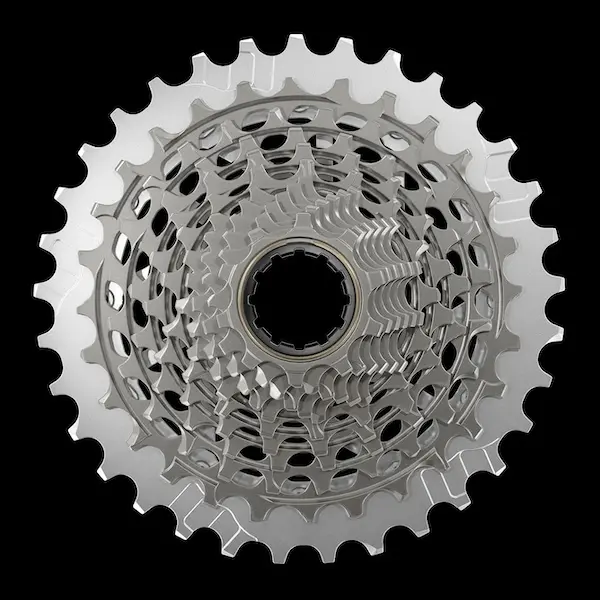
Specifically, new cassettes prioritize versatility: small cogs (10 or 11 teeth, with “tooth by tooth” spacing up to 13 or 15) for riding fast on the flats or descents, and large cogs for climbing steep inclines. However, to maintain a fluid pedaling cadence around 30 km/h, these highly versatile cassettes sometimes have marked gaps between cogs (for example, from 15 to 17, 16 to 18, or 17 to 19). This “jump” can bother some cyclists, who regret the absence of cassettes with a tighter range, better suited to specific routes.
This is why some hesitate to adopt these new drivetrains: what’s the point of more cogs if the tooth counts offered don’t always match their usual needs?
Ever more performing drivetrains
12 and 13-speed drivetrains, however, offer undeniable advantages, particularly in terms of speed, fluidity, and precision of gear changes, which improve with each generation, especially with the widespread adoption of electronic derailleurs. These systems, present on almost all 12 and 13-speed drivetrains (with a few exceptions, such as some entry-level mechanical options), allow for customization via dedicated applications. Thus, moving to a new generation is not just about gaining one or two cogs, but about benefiting from an overall more performing groupset.
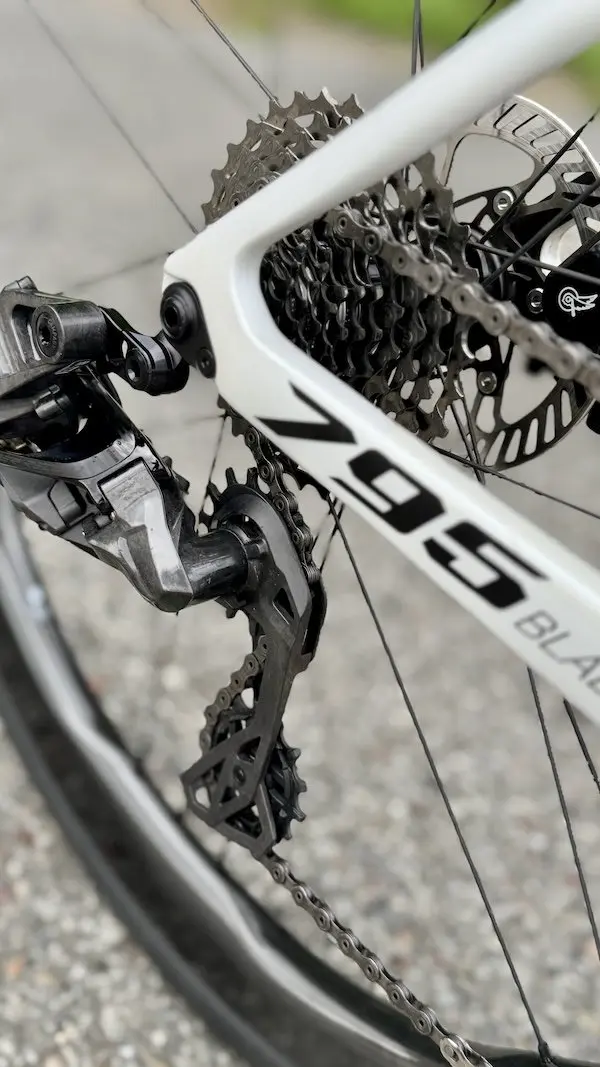
However, this gain comes at a cost. The transition to 12 or 13 speeds often requires replacing the entire groupset (levers, crankset, derailleurs, cassette, chain), for a budget of 1,500 to 4,000 € depending on the range. Some drawbacks also persist. In 12 speeds, wide-range cassettes require a longer derailleur cage, adding 20 to 30 g. The total weight of the groupset increases slightly (+50 g for a 12-speed cassette compared to 11). With 13 speeds, the narrowness of the cogs (reduced spacing) increases the tension of the derailleur springs, which can accelerate chain wear.
Furthermore, wheel compatibility remains limited, especially for proprietary standards like Campagnolo’s N3W. Finally, for users of mechanical 11-speed groupsets, moving to high-end 12-speed often requires an electronic derailleur, with the constraint of regular battery recharging.
13 speeds and the single chainring question
With a double chainring, some ratios overlap, so a 2×11 or 2×12 drivetrain actually offers only 14 to 15 distinct ratios. Faced with this observation, manufacturers are developing single chainring drivetrains with 12 or 13 cogs at the rear, offering almost as many available ratios as a double chainring, but with more simplicity, weight savings, and better aerodynamics. This choice is particularly popular in MTB and gravel, where the absence of a front derailleur reduces mud accumulation, but it is also gaining ground on the road.

However, a single chainring drivetrain implies more pronounced gaps between each cog, especially with wide-range cassettes (for example, 10-51 teeth in gravel). For use on hilly but not very steep routes (like in northern France), a single chainring can be ideal, provided the cassette can be adapted for more demanding terrains if necessary.
At SRAM, for example, 12-speed road single chainring drivetrains are compatible with cassettes from 10-28 to 10-36. With a 50-tooth chainring and a 10-28 cassette, the smallest gear ratio is equivalent to a 39/22, sufficient for 99% of our rides on flat terrain (Paris region, Picardy, Brittany). In the mountains, 10-30, 10-33, or 10-36 cassettes offer gear ratios equivalent to 39/24, 39/26, or 39/28. SRAM also offers smaller chainrings (48, 46, 44, 42, 40, 38 teeth) to adapt to the needs of those who find the 50 too “tough”.
With 13 speeds, the single chainring option becomes even more appealing. At SRAM, XPLR groupsets for gravel offer a wide range of gear ratios. Campagnolo, a pioneer of 2×13 on the road with the Super Record Wireless, offers an interesting single chainring alternative with 10-29 or 11-32 cassettes, providing balanced gearing. It remains to be seen whether Shimano, with the future Dura-Ace Di2 (the current one dating from 2021), will follow this trend or propose another approach.
Wheel compatibility: a key constraint
The transition to 12 or 13 speeds directly impacts wheel choice via freehub body compatibility. Cog spacing decreases (3.7 mm for 11 speeds, 3.3 mm for 12, even less for 13). Shimano and Campagnolo offer partial backward compatibility for 12 speeds: a Shimano 12-speed cassette can be installed on an 11-speed HG freehub body, thanks to similar spacing on the first cogs (although the derailleur must be compatible). This allows existing wheels to be kept.
In contrast, SRAM requires the XDR standard for its AXS 12-speed groupsets, which is incompatible with HG due to an additional height of 1.85 mm. For 13 speeds, as with the Campagnolo Super Record Wireless, the N3W freehub body (11/12/13-speed compatible) is required, limiting wheel options. In gravel, Shimano’s Micro Spline standard for 12 speeds (cassettes starting with 10 teeth) is also specific.
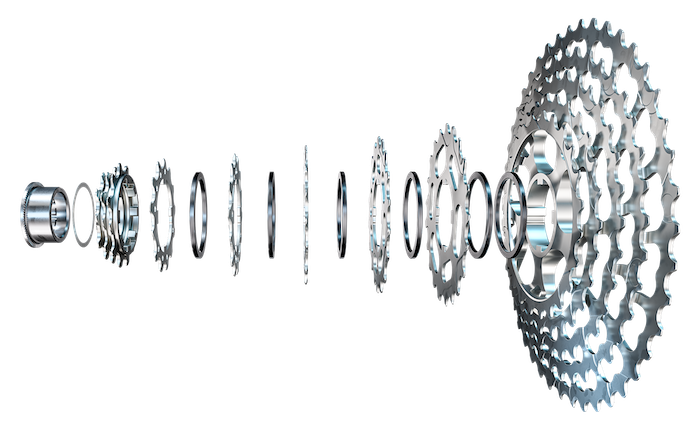
For an experienced cyclist, it is crucial to assess the compatibility of their wheels, especially if they are used on multiple bikes or an indoor trainer. Shimano remains the most flexible option for now to avoid hub changes.
A strategic choice for the experienced cyclist
The choice between 12 and 13 speeds depends on your riding style. 12-speed is now an established standard on the road for Shimano and SRAM, offering a good balance between versatility and precision. 13-speed is gaining ground in gravel with single chainrings (SRAM XPLR, Campagnolo) and is timidly breaking into road cycling with the Campagnolo Super Record Wireless 2×13, before a possible generalization in the coming years.
In both cases, and if you are still hesitating, the gains in gearing and precision outweigh the drawbacks if you invest in adapted wheels, but compatibility and cost constraints hinder impulsive upgrades. Consult a mechanic for a personalized setup – the ideal drivetrain is one that disappears, allowing your power to shine.
Share the post "12- or 13-speed: which drivetrain for you?"